Monday, September 17, 2012

Freedom of Expression, Sovereignty and Interdependence

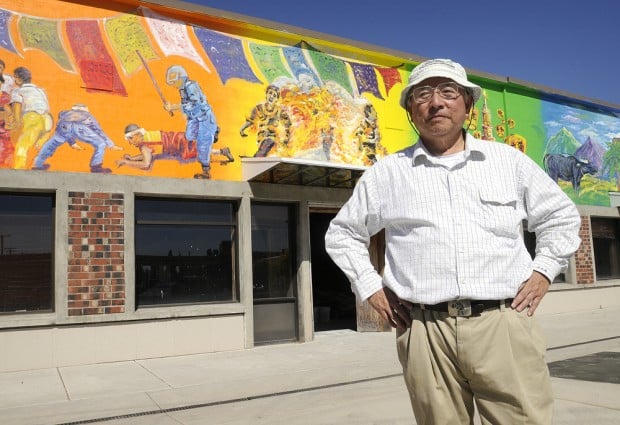
There is an interesting story (see here and  here and in Forbes here and  SCMP story here [requires subscription] ) about a Taiwanese-American who had a mural painted on his building in Corvallis, Oregon, promoting independence for Taiwan and for Tibet. According to news stories, the Chinese Consulate in San Francisco wrote a letter to the Mayor of Corvallis asking her get David Lin to take the painting down. She wrote saying she did not have the authority to do that, since it is protected free speech, so the consulate sent two officials to meet with the mayor (presumably to pressure her, though one news story mentioned that they did not actually ask her to have the painting taken down). This, somewhat predictably, has led Oregon's politicians to line up to blast China.

Perhaps most surprising in this story is the idea that China's diplomats, who are a pretty savvy bunch, nowadays, thought that the mayor could somehow have the painting removed. This shows a surprising lack of understanding of the American political system (not to mention the Constitution).

Furthermore, it seems to American eyes quite astonishing that China would think it had the right to request the removal of political art in the US. Since China is constantly complaining about outside interference in its domestic affairs, at first sight this seems, to American eyes, an example of Chinese interference in American affairs. 

But of course, that is not the way the Chinese government would see it at all.  It sees the picture as seditious. It is offended by the images, and feels compelled to register its protest. In this case, its protest has had the unintended consequence of publicizing the painting, and the issues it promotes. It has cost China PR points in the US, making China seem to be excessively assertive and to be attempting to undermine American values such as free speech.  Chinese nationalists and the government, however, see the sentiments in the painting as beyond the pale, beyond what can be protected as free speech. But by seeking to express that position in the US, it has undermined its interests. (While not as extreme, it does remind me of the Qing government's attempt to arrest Sun Yat-Sen in London with the claim that he was a criminal. There too, the Qing's bungled attempt led to Sun becoming world famous.)

Most interesting in this case, however, is how notions of national sovereignty can be seen to be weakening with globalization. China is concerned that its national sovereignty is weakened by a painting in the US. The US politicians feel that US sovereignty is weakened by Chinese diplomats seeking to have the painting taken down. In an increasingly interdependent world, both may be right, but the result is that the notion of sovereignty is weakened, because we cannot pretend that what we do in Corvallis does not have an effect in China. That is true whether we are American, or Chinese.

Wednesday, September 05, 2012

Neuroscience and Anthropology

I wish I had time to read David Eagleman's book Incognito:The Secret Lives of the Brain. I heard him speak on Fresh Air. He argues that our conscious mind only sees a small portion of what actually goes on in the brain. He notes that we can easily lift up a cup without thinking of the thousands of nerves and muscles that need to be controlled just to successfully pick up a cup. 

He also notes that our brain is made up of different parts, and that the different parts are often fighting with each other. This is true for the conscious and emotional sides, left vs. right, and more. He says we can see it in that sometimes we want to keep a secret for social reasons, but there is also a side of our brain that does not like to keep secrets, because secrets raise our level of stress.
"You have competing populations in the brain — one part that wants to tell something and one part that doesn't," he tells Fresh Air's Terry Gross. "And the issue is that we're always cussing at ourselves or getting angry at ourselves or cajoling ourselves. ... What we're seeing here is that there are different parts of the brain that are battling it out. And the way that that battle tips, determines your behavior."
This is interesting because Richard Wilk, in his book Economies and Cultures, has argued that “human nature” has different aspects. Contrary to the economic assumption that humans are individualistic rational maximizers, neuroscience is confirming the view that different parts of the brain operate on different principles. This is a good example of how biology and neuroscience can support long established anthropological insights. And it is an example of why anthropologists should not fear, and resist, biology.

Saturday, September 01, 2012

Journalism, Truth and Politics

I'm not sure what to make of Andrea Seabrook's decision to leave her job as NPR's Washington correspondent to set up a new website/blog called DecodeDC. She complains of being lied to by politicians, and of being forced to report on the daily posturings and the theatre of DC rather than what is really going on. I sympathize, but from a certain point of view, it seems naive to complain about this: all politicians spin and tell half-truths, and it is the job of journalists to see through this, or to report on this. Otherwise, we would all simply read the politicians' press releases.

By coincidence, I just listened some old podcasts these days that provide admirable reporting that sees through the spin and fog.  David Wessel writes for the Wall Street Journal, which can often be quite ideological, but in his interview on NPR's Fresh Air, he discusses his book Red Ink and the problems with the federal budget deficit in a clear and bipartisan manner. He is able to explain why each side is not telling the whole story, and how values and ideals about the future determine the different views of what should be done.

In another example, Ryan Lizza wrote a story for the New Yorker on Paul Ryan, before he was nominated as Romney's VP partner. The story is very balanced, as noted in a Washington Post article, though Paul Ryan feared it would be a hatchet piece. Lizza does note, however, that Ryan had not had much bad press. Ryan has been popular with the press; he is considered fairly open, frank, and accessible.  On the other hand, Lizza in a blog is extremely critical of Ryan's GOP convention speech. He lists five attacks against the President that he says "were breathtakingly hypocritical" and ends saying, "Ryan started this race with a reputation for honesty. He’s on his way to losing it."

The problem is that some journalists seem to believe that all problems have technical solutions (Adam Davidson of NPR's Planet Money is the the best example). But political problems are NOT technical problems. It is a dangerous conceit of extremist ideology of the right and left that there is one best "scientific" solution to most problems. Political problems are "political" because they deal with who gets what, and they depend on values, and one's ideal image of the future. Lizza, in an interview on Fresh Air, mentions that Paul Ryan is motivated by Ayn Rand's philosophy of objectivism (As an aside, I view her philosophy as puerile, a very unsophisticated view that does not understand social forces and culture, but that is a topic for another day). Lizza reports that Ryan believes a person can only be free when they take responsibility for themselves, and that too many people are dependent on government, making them less free. This is a legitimate view that most people can accept to some extent, but it has to be balanced with the opposing view that one cannot be free when worried about where their next meal is coming from, or whether they can pay for cancer treatment, or for their parents' healthcare. And who should pay for all this? How we balance these issues depends on our class, our vision of a good society, and our values. There is no technical or scientific answer (though not all answers are the same and there are some answers that do not add up!)

Already many comments on Andrea Seabrooks website are very critical of her posts for being naive or biased. That should not surprise us. Good journalism, like Wessel's and Lizza's, help us understand the issues better, but they have to balance the blue and red perspectives, and show how both are valid moral views, even when politicians are not being entirely honest in their statements. Even then, partisans will have their gripes. That's politics.

Monday, August 27, 2012

Death of Armstrong

One could say that two Armstrongs died this past weekend. One is the myth of Lance Armstrong. Since he declined to take the accusations against him to arbitration, he's agreeing that they are true. He's not even throwing the dice to see whether he can win in arbitration. Amazingly, many Americans still consider him a hero. The French cycling press, much reviled by Americans for accusing Armstrong of cheating all those years, deserves an appology.

The other Armstrong who died was Neil Armstrong (no relation). He was always a hero to me because he refused to take the limelight. He was only the astronaut who stepped off the landing module first. His trip was made possible by the work of thousands, and he always remembered that. His modesty and humility is from a different age, and I admire that. He never tried to cash in. He is a true hero, because real heroes are reluctant heroes.

I actually saw Neil Armstrong as an 11 year old or so, when the astronauts were in Paris. We were living in France at the time and happened to be in Paris and out walking when we came across the crowd waiting for the motorcade to pass by. Somewhere I have a picture I took of a hand waving out of an open window of a black limousine. I assume it was Neil Armstrong's hand, but have no idea. Maybe Collins and Aldrin made him sit in the middle for that ride.

I've often thought of that event. I realize now it was a PR event, probably designed as a Cold War show. It was exciting to see the astronauts. I'm not sure how it shaped my values and molded my mind, but I assume it had some effect since I remember it clearly today.

China has tried to do the same thing with its astronauts. They've been sent to Hong Kong to bolster the SAR's patriotism, as have China's Olympic athletes. The demonstrations by athletes is rather embarrassing, since Hong Kong has its own Olympic team, but whatever. There have been large crowds to see the athletes, apparently, and there is coverage in the media, but most students I know are not interested it such propaganda. There were even some CUHK students who protested the arrival of the astronauts, though our university president was on hand to be photographed with them and have their glory shine on him too.  The idea of space travel as glorious is a bit weird.  It is 40 years late, for one thing. And with robots, it would seem cheaper and safer not to send humans in space. And one would hope we are not going to start a race to colonize outer space (though the US started the race with the Columbus-style planting of the flag, it is good that no one followed up on that, at least so far).

There is widespread opposition in Hong Kong to the imposition of the "National Education" for primary schools. Many assume it is just a way to brainwash children into loving the CCP.  Propaganda tours like that of the astronauts and athletes make people worry. At the same time, some in Hong Kong, both in the pro-Beijing camp and in the pro-democracy camp, seek to demonstrate their patriotism and love of the motherland by rallying to the Diaoyutai issue. A China Daily commentary suggests the Diaoyutai issue would be ideal for teaching "National Education." Really? Are they really going to present the messy details, including the facts that make the Japanese think they are in the right? Robert Sutter has an interesting opinion piece that was republished in today's SCMP entitled "China's Self-absorbed Nationalism--It's Worse Than It Looks." He notes that China's sense of victimization and its sense of itself alone as moral in international relations (which is not accurate) frightens China's neighbors and prevents Chinese from understanding why the neighbors view China with distrust. Of course, not all Chinese hold these jingoistic nationalist sentiments, any more than most Americans hold the nationalistic and exceptionalist sentiments that we'll hear at the Republican convention. Nationalism and patriotism are a scourge everyone, and are getting worse with the worsening economy.

So, how do we teach about heroes? Which heroes will we pick for our youth? 

Choosing heroes is a bad business. Lance Armstrong is considered a hero, but we now know he cheated. He has to be taken off the pedestal. Neil Armstrong was hardly a hero, in many ways (though my kids' secondary school had a "house" called "Armstrong", recognizing him as an explorer in the company of Drake, Scott and Hillary). In some sense, he was just the bus driver for an elaborate long-distance bus. But he symbolized human curiosity, and embodied the achievement of landing on the moon. And by carrying that burden with grace, and not trying to cash in, he was a hero to more than just Americans. His death is sad, even though his achievement will be remembered for many decades (if humans survive that long).
Sunday, August 19, 2012

Research as just asking people

One of the strengths of ethnographic fieldwork is that anthropologists can observe what people really do, rather than what they say they do.  This is more difficult in urban environments, and takes longer, but it pays in data of greater reliability and value. Often, students think they can just go into a village or store and ask questions and get the answer.  I was reminded of this issue while listening to an NPR story about voter behavior research in the US.
All kinds of people have tried to divine the thoughts and feelings of the American voter. But until recently, the only way researchers and pols could figure to study a voter was to ask the voter questions. You either put them in a focus group or you polled them on the phone.

But according to Jennifer Green, another researcher who studies voters through experimentation, that's no way to study a voter. You have to use controlled experiments, she argues, because voters themselves often don't understand what moves them. Most of us, she says, don't.
"If I showed you a quacking duck and I said, 'Hey, do you think this would make you more likely to buy this insurance?' You would say, 'No!' You're going to say, 'I want to know how much it costs! What it will cover! All those details so I can make an informed decision.' We want to portray ourselves as people using information to make informed decisions."
But obviously, Green says, the things that move us often have nothing to do with what our conscious minds tell us is important. "The thing that makes an impression on us, changes our minds ... may be a quacking duck," she says. "And we only figure that out by testing. Asking people is not the same as testing."
This is a reference to the Aflac duck, which has been the mascot and main actor in many TV commercials selling insurance (here is one with the famous Yogi Bera, himself famous for witty sayings, though he also said "I really didn't  say everything I said."). This story points to how important it is to go beyond what people just say about their behavior. A questionnaire that asks "Will you vote?" does not test whether the respondent will vote, just whether they say they will vote. Too many students and researchers forget this. When I have pointed this out to academics (often in other disciplines), their only reply is, "Well, yes, but this is the best we can do."  No, that is not good enough. This story is an example of how much better the research is when we keep this distinction clear.


Sunday, July 15, 2012

God and Athletes

I've long found it surprising that athletes could credit God with their athletic success. I can understand saying that talent is God-given, but the idea that God could care who won a tennis match (Michael Chang) or a basketball game (Jeremy Lin) seems ludicrous, almost insulting. An interesting NY Times article on Ryan Hall, a marathoner who will represent the US in the London Olympics next month, notes the important psychological advantage that comes from believing God is on the athlete's side. It seems that even altitude training is not scientifically proven to benefit runners, but may be more placebo effect:
Scientists debate its effects. The variables that determine performance are complex, said Tim Noakes, an exercise physiologist at the University of Cape Town who served as an altitude expert for FIFA, soccer’s world governing body, at the 2010 World Cup in South Africa.
“If you look at the literature, some people benefit and some get worse, and the general result is no effect,” Noakes said of altitude training. The placebo effect, though, can be significant, Noakes said. He urges those who believe in altitude training to continue and those who are skeptical to skip it. At the elite level of marathon running, he said, psychology probably plays a more crucial role than physiology.
“The more stable you are as a human, the better you are as an athlete, and religion is a very stabilizing force,” Noakes said. “You don’t have doubts. God is looking after you. That’s incredibly powerful. If Ryan finds special strength in his religion, it’s much more important for him than training at altitude.”
...He does not view his reliance on God as an abdication of responsibility but as a means of empowerment.  ...
 The article notes how oddly some view his close conversation with God, and quotes Tanya Luhrmann (who coincidentally teaches at Stanford, which is where Hall got his degree in sociology.)
Some elite runners seem taken aback by Hall’s faith-based training.
“So he really thinks God is saying, ‘Run 10 times 1,200 meters today,’ or ‘Take tomorrow off’?’ ” said Dathan Ritzenhein, who finished ninth in the marathon at the 2008 Beijing Olympics, one spot ahead of his countryman Hall. “Wow.”
Hall’s belief in a direct conversation with God was not a fringe occurrence, said T. M. Luhrmann, a Stanford anthropologist who spent a decade researching charismatic evangelicals and wrote a recent, critically acclaimed book, “When God Talks Back.” Polls have shown that about a quarter of Americans have reported a direct revelation from God or have experienced a voice or a vision through prayer.
“Just the way a well-parented child will carry with them the soothing voice of their mother and father, these folks are really trying to build God as that kind of personal relationship,” Luhrmann said in an interview. “It really does give an emotional buffer to people. It seems people are able to carry with them a sense of comforting reassurance and a sense of inspiration. So it’s not so alien as it seems.”
Between Luhrmann's empathetic understanding of evangelicals, and the psychological advantage that certainty can provide, we can understand why we get the professions of faith from elite athletes. It is often said that the difference among elite athletes is not their physical abilities, but their mental toughness, and having God in their corner helps create that mental toughness.

Monday, July 09, 2012

On being "busy"

A commentary in the New York Times ("The 'Busy' Trap") notes that people in New York typically reply to "How are you?" by saying they are very busy, apparently complaining but really bragging, implying their work--and life--is important.  This is perhaps even more the case in Hong Kong, where people have taken the time saved by having domestic helpers and invested it in more work rather than leisure. Plus, since Hong Kong professionals often travel in the region for their work, appointments for professional and social purposes need to be scheduled weeks and even months in advance.  The writer of the NY Times piece--who is a professional writer--makes many important points, including that he needs to work less in order to be able to get more done.  His practice of writing for about five hours a day and taking the rest of the time to visit friends and do other things is good advice for students writing a thesis. I feel many students writing a thesis chain themselves to their desk, but then rather than write, they check (and post on) Facebook and read blogs.  They then feel guilty and spend more time in front of their computer, unproductively.  I highly recommend the article to all students, not just the loafers, but the most ambitious ones too.  I, of course, am too busy to follow his advice....