Monday, March 25, 2013

Rugby Commercial Analyzed


This year's Cathay Pacific ad video for the Hong Kong Sevens, Always Game, has several themes that I've noticed over the years. Obviously, the ad highlights the flight attendants' beauty. Their approach is not as crass as that of Nok Air, but they are still selling the women's looks (pretty face, shapely bodies, and friendly smile). This has been a long-standing theme for Cathay Pacific. It seems that 80% of their flight attendants are female, and they still are able to impose strict standards on the colors of the make-up, to hire based on good looks, and to force older attendants to retire.

The ad also is a "feel good" ad about Hong Kong. It has local allusions that many non-locals might not get. There is the double-decker bus, the Star Ferry, and of course the skyscrapers. The dim sum steamers also are a local touch, and the flying dumplings are like rugby balls being kicked, trying to link Hong Kong with rugby. The flight attendants' numbers on their backs, the lifting of a flight attendant like in a lineout, and the running with the bag (think ball) all refer to rugby.

Other parts of the commercial refer back to the popular 2011 Cathay ad (which was so popular it was recycled for 2012, which was a bit disappointing). The ad agency was McGann Worldgroup, and according to CulturePub, the title was "Mind vs Muscles" (but their video and caption seems to miss the point that the ad was for the Hong Kong Sevens, and the players in black are not the All Blacks, but anyway. It is not really clear why the players--several of whom are recognizable HK Sevens team players, are dressed in black.)  In case you were not sure about it, they show parts of the video on a screen in the background, as the flight attendants walk around. The girl brushes off the boy's chest, just like in the old commercial. And the high heeled cleats refer to the amusing ending of the 2011 commercial.

There is one comment by a fan on the Cathay website that sums up the many people's views of the ad:
I LOVE this commercial! I can't understand it but then its got everything. great music, hong kong elements, gorgeous girls, rugby
As an aside, when the flight attendants were threatenting to work to rule over the 2012 Christmas holidays if they did not get a better deal from Cathay management, a certain C. Anderson wrote to the SCMP saying:
Where is the 'care' Cathay crew pledged?
Do Cathay Pacific flight attendants have a death wish for their company?
I am no fan of incompetent management and have no idea if Cathay is run well or not, but I do take exception to a union whose members have claimed to care about their passengers, but who seemingly care more about what lines their pockets than their travelling customers or the Hong Kong institution that employs them.
See the rest of the letter here [subscription required]. This letter is hilarious in its ignorance. It seems to believe that the ads are put out by the flight attendants' union, rather than by management that is selling its flight attendants under the guise of "good service." While it is true that service on Cathay Pacific is far superior to that on United, for example, it is also true that Cathay is a allowed to set rules that would not be legal in the US.

Thursday, January 24, 2013

Pharma Spam as Informal Economy

I have long been interested in the informal economy (the businesses that avoid some taxes, but offer legitimate services), so I found a Planet Money story about the companies that sell drugs via SPAM to be fascinating. See story here. Two companies got into a dispute so released each other's records (I'm not sure what they were doing with the other company's records in the first place, but anyway) giving a trove of data for researchers. Brian Krebs is one of the researchers who used this data, and like a historian or anthropologist (because anthropologists also only see a small part of the story, even when they live it), he has reconstructed how these companies that sell Viagra and Accutane operate. Among the interesting tidbits: profit margins for drug sellers is about 20% (less than Apple), and most customers are actually satisfied (ie the companies mostly sell the real pharmaceuticals, not poisons or fakes). And the spammers are different companies, who work on a commission of about 30-40%.  Not mentioned in the story is that this informal economy exists because of irrationalities in our global patent system. This is the real globalization from below.

Friday, January 11, 2013

Cooking meat without heat

Our department had a "Turkish night" yesterday, with members of a Turkish cultural association called "Anatolia Cultural and Dialog Centre" (or ACDC), which is like a British Council office for Turkey (but with better food). They demonstrated a number of food specialties, and Turkish tea. We had exchange students from NYU in the US (themselves, of course, of various ethnic backgrounds), and our mix of students, plus volunteers from ACDC, hosted by the CUHK school of hotel management in their wonderful teaching kitchen--one of the few examples in CUHK of collaboration across different faculties. A fun night for all.

I had two anthropological observations. One was of how "Turkish cuisine" was being constructed by the ACDC speaker. He began by saying that Turkish cuisine is one of the great cuisines of the world. I'm not a foodie or a food expert, so am perhaps ignorant, but I found this surprising. It made me wonder how many "world cuisines" there are, and if soon every nation-state will have its "traditional cuisine." He mentioned that Turkish cuisine is based on Ottoman cuisine, and that it is "rich" because it is "not just one taste" but incorporated many dishes and specialties from different parts of the Ottoman empire: the Balkans, Mediterranean, and the Middle East. He then stumbled slightly, and it became clear that, well, these dishes were not originally from Turkey, and are still eaten in Armenia, Syria, etc., so he added that though they are originally from different places, "they are still Turkish cuisine." It is not that the Turks "invented them, but they became Turkish." Everything he said was unobjectionable, but it does show the constructed nature of "Turkish cuisine," especially as it later turned out that not only are many "Turkish" dishes originally from non-Turkish parts of the Ottoman empire, but even within modern Turkey, there is great variation in cuisine. Southeaster cuisine is much spicier, for example. So what, really, is "Turkish"? It is clearly pointless to deny there is something called "Turkish cuisine," and yet, the variation in origins and in current forms makes it difficult to pin down. This is so typical of culture generally, that it could be the topic for a treatise on the nature (and ambiguity) of culture.

The second observation came as I discussed one of the dishes we saw prepared. This was çiğ köfte, a dish made with raw beef or lamb and eaten wrapped in a salad leaf. We had a vegetarian version, made with potato instead of the usual beef. As part of the preparation, they had explained that it needs to be mixed, kneaded really, and we had a strong young man demonstrating the heavy work that is required. We were also told that this tends to be a "male" dish, something men make when they get together, as opposed to sarma, which is more commonly made by women. So far so good; we know about gendered foods (in fact, when I tell Chinese that I like "sesame oil chicken", they usually laugh, because that is a food prepared for women in the month after childbirth, so not something men usually eat, or like).

In talking to some Turkish friends afterwards, they mentioned that it is supposed to be much spicier than the version we got, and that one recipe even calls for a proportion of 2 kg of meat (and they said the meat had to be special, high quality and lean, with no fat or tendons), 1 kg of bulgur wheat, and 300 to 400 gr of peppers. Then they said you need to knead the meat to cook it.  I said, "Cook it? But there is no heat." "Yes." Start over. Why do you knead it? Another friend tries to help explain this, and he says you need to "kill the meat."  What? The meat may be fresh, but once it is ground up, it is surely quite dead! After some further exploration, they explained that in Turkish, the word is literally to "cook" the meat, even though it does not involve heat. What changes in the meat, however, is that it no longer tastes like meat. I wondered if Turks thought beef tastes bad, as some Italians do (which is why they prefer veal, and why they often fry it or put lemon on it, I suppose). But they confirmed that Turks like the taste of meat, and that it is not to mask an unpleasant taste. In this case, however, it is raw (though very fresh), and so perhaps there is something in the taste of raw beef that needs to be hidden. I'm not entirely sure why raw beef that has been mixed with bulgur wheat and peppers is considered "cooked." But I found it fascinating that, in speaking in English, they borrowed words like "kill" and "cook" which made no sense to me, but that capture the idea of making the beef edible. And that was exactly how they explained the term: they said they needed a term to describe making it edible, and so chose those terms. Levis-Strauss (author of The Raw and The Cooked) must be smiling. He long ago described how the term "cooked" was used to describe making something edible, and here we have another example.

Tuesday, December 04, 2012

Student interviews


A few days ago I participated in interviewing students who were applying to go on exchange programs overseas. I was afraid that interviewing 32 students for 5 minutes each would be horrible, but it was not as bad as I thought. I of course used it as an opportunity to learn more about the students and Hong Kong. I again was shocked to see some students with family incomes of HK$11,000, $13,000, and $14,000 per month. I don’t know how many people live in the family, but even if there are only 2-3 people, at these incomes, I’m amazed the students came to the interview well dressed and apparently well fed.

I found out from one student with very high secondary school grades, but a low grade in “Religious studies”, that some schools require all students to take Bible classes. This student, being nonreligious, found the class (and teacher) dreadful, so did not do well. That was a good excuse/explanation, which contradicts the “Do Your Best Anyway” rule I’ve always told my children, i.e. that you do not get the chance to add an asterisk to your transcript to explain “The teacher for this course was not good so I did not do well in this course.” He was able to add the asterisk in our interview, because I asked about the course.

I was amused at how the business school students were almost all extremely instrumental in their reasons for going abroad and for choosing various schools. They have apparently been given training in their school for how to do interviews. They are all smooth, but I would not exactly say polished, because it comes across as something prepared and not very genuine. (Maybe they should take an acting class. Oh, but that is in the arts, and not “practical.”) It was jarring to hear 18-19 year olds talking about wanting to go to a certain university in the UK or Sweden because it would look good on their CV, or would make it easier for them to get a good job in an international company when they got back. It was a relief when a social science student said she wanted to go to Sweden to learn about their egalitarian gender roles, or when another said that after learning so much about Britain, they wanted to go and experience it herself.

This difference also extended to dress. The business students came in their black suits. Two males had either outgrown theirs (as happens quickly with 18 year olds) or had borrowed it from a smaller friend; they were bursting out of the jacket (one had to unbutton it to sit down). Two students who had seen some of the other students in the waiting room were dressed apologized to us for not dressing properly, even though they were fine. After all, they are students, attending an interview to go study abroad—why would they wear a suit to that? You wear suits to job interviews because that is what you will wear at work; you want to look the part. But no one in the US, Europe, Taiwan, Japan or China wears a suit to class. In any case, it was chilly (by Hong Kong standards; it was about 16 C or 61 F) so many students were bundled up in coats and we could not really see what they were wearing.

In the interviews. when asked to introduce themselves, many students recited a brief memorized spiel about their personality. That, to me, is a waste of time. It is awkward to describe ones own personality. No words a student can say (or write) will convince me she/he is “outgoing and friendly” unless I can already see that they are so from the way they talk and use their eyes. But all students had some personality trait to label themselves with: outgoing, adventurous, risk-takers, curious, hard working. None of it was convincing, so I just discounted the words. I was paying attention to the tone and style of the speech, thinking, “Is this the type of student who will be able to make friends in a foreign country.” I’m neither a psychologist nor a diviner or cold reader, but I did my best to guess.

I was also surprised to note that at least in these admittedly very short interviews, it was not a good idea, when asked at the end of the interview if the student had any questions, to actually ask questions. Several students revealed deep worries that made me wonder whether they were suitable for an exchange (e.g. asking about what students get from exchanges, or how to handle racial discrimination). Others asked questions that are impossible to answer (e.g. what characteristics we were looking for, or how they could improve their performance). Worst of all were several who needed a long time to think about what questions they had. The couple of questions that I thought were good were very specific questions about their case, but I felt they could have gotten the information in other ways, not at the interview. Obviously, some students have heard, or been told, that they should have a question, but that is not always the case.

I was also surprised to see that some students had prepared, and in answer to questions about their intended host country, could rattle off figures on population, GNP per capita, etc. Most students were well prepared. Ninety percent of the students would do fine, and in fact, many of the shy ones would benefit the most. But there are few slots available. Potential donors out there: scholarships for exchange programs can make a huge difference in a student’s life. Consider endowing an exchange program!

Tuesday, November 27, 2012

Tea and milk

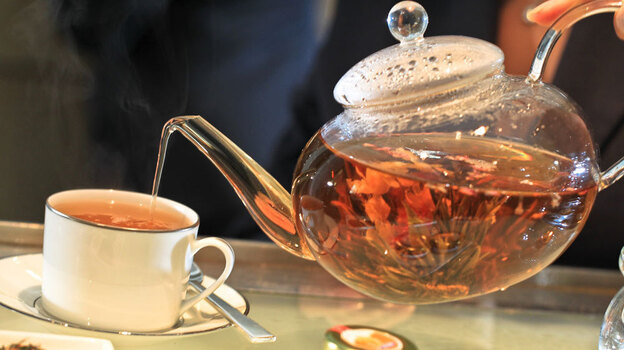
I heard an NPR story about the health benefits of tea that commented on the American habit of adding milk to tea (see NPR link here). Apparently, in the US Starbucks even has a green tea latte. The audio version of the story treats the Chinese view that one should not add milk to green tea as exotic and snobbish, the view of a purist. I've obviously been in Asia too long, because the idea of milk with green tea is an abomination to me. Yuck. But the tone of the reporter, treating this view as amusing, surprised and annoyed me. His idea that you could add milk to high quality "dragon well tea" (I kid you not--he actually said that!) made me think of the Chinese practice of adding Sprite soda to French red wines (not all Chinese; just some nouveaux riches). That practice is mocked by Americans, and yet he was not in the least self-conscious about his practice of adulterating high quality tea. I suppose a true relativist would say, "to each his own."

But don't add milk to green tea when I'm around.

Saturday, November 03, 2012

Winners and Losers

It is days before the US presidential election, and most news media are claiming the election is too close to call, or a tossup. This may or may not be true; the NY Times blog Fivethirtyeight by Nate Silver does the neat trick of aggregating surveys and it predicts Obama will win, but even he recognizes in his Nov. 2nd post that bias in the polls could mean Romney could still win. He says this is unlikely, however, because the polls have been fairly consistent and accurate over the recent elections. Silver is also more accurate because he focuses on the Electoral College, and not on the popular vote. It seems that the Obama camp advertized heavily in the summer in the swing states and so is running more strongly there than expected when compared to the rest of the nation, making it much more difficult for Romney to win those states and thus the election.

Still, there is uncertainty in the election's outcome. I find it fascinating that at the moment, both Obama and Romney are even. But whoever fails to get 270 seats in the Electoral College will be a "loser." We will "know" that he waffled too much on too many positions, or he was too weak as a leader. The arguments explaining the failure are all there, but held back by the uncertainty of the outcome. Once we know the outcome, we'll know who the "loser" is. It amazing, given that close to half the country is going to vote for the "loser." But the same thing happens in sports. Two weeks ago, Stanford failed to score a touchdown against Notre Dame from first and goal at the 4. The last attempt was a run up the middle, and Stanford supporters felt the back got in on his second effort, but the play was ruled dead. Stanford lost the game, and Notre Dame, though barely surviving, has gone on to beat Oklahoma and is now ranked #3 in the country. But even if you lose by inches, you still lost. And winning the popular vote does not make up for losing in the Electoral College; just as Al Gore.

We also don't know who will win the Indiana senate race. There, Congressman Joe Donnelly decided to run for Senate because he was quite sure to lose his seat, which happens to be my family's home town of South Bend. He had barely held on in 2010, and saw the writing on the wall. He was not expected to win the Senate race against Richard Lugar, the long serving Republican senator. But the Lugar lost the primary to Richard Mourdock, a Tea Party Republican. Mourdock then said in a televised debate that pregnancies from rape are "something God intended to happen." His support is now plummeting. Donnelly, who looked like a loser just a week ago, is now, it seems, going to be a winner. In politics, and sports, it is winner take all.

Monday, September 17, 2012

Freedom of Expression, Sovereignty and Interdependence

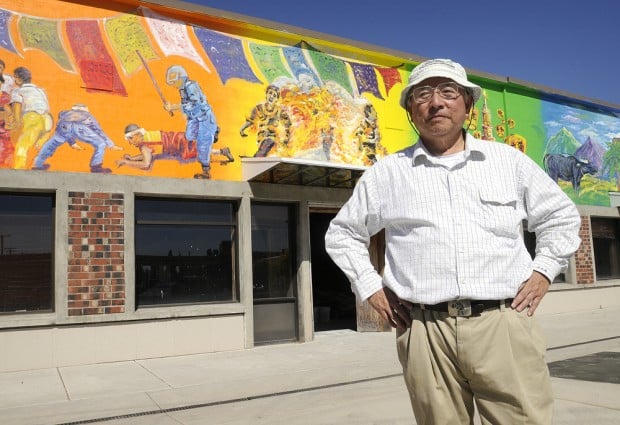
There is an interesting story (see here and  here and in Forbes here and  SCMP story here [requires subscription] ) about a Taiwanese-American who had a mural painted on his building in Corvallis, Oregon, promoting independence for Taiwan and for Tibet. According to news stories, the Chinese Consulate in San Francisco wrote a letter to the Mayor of Corvallis asking her get David Lin to take the painting down. She wrote saying she did not have the authority to do that, since it is protected free speech, so the consulate sent two officials to meet with the mayor (presumably to pressure her, though one news story mentioned that they did not actually ask her to have the painting taken down). This, somewhat predictably, has led Oregon's politicians to line up to blast China.

Perhaps most surprising in this story is the idea that China's diplomats, who are a pretty savvy bunch, nowadays, thought that the mayor could somehow have the painting removed. This shows a surprising lack of understanding of the American political system (not to mention the Constitution).

Furthermore, it seems to American eyes quite astonishing that China would think it had the right to request the removal of political art in the US. Since China is constantly complaining about outside interference in its domestic affairs, at first sight this seems, to American eyes, an example of Chinese interference in American affairs. 

But of course, that is not the way the Chinese government would see it at all.  It sees the picture as seditious. It is offended by the images, and feels compelled to register its protest. In this case, its protest has had the unintended consequence of publicizing the painting, and the issues it promotes. It has cost China PR points in the US, making China seem to be excessively assertive and to be attempting to undermine American values such as free speech.  Chinese nationalists and the government, however, see the sentiments in the painting as beyond the pale, beyond what can be protected as free speech. But by seeking to express that position in the US, it has undermined its interests. (While not as extreme, it does remind me of the Qing government's attempt to arrest Sun Yat-Sen in London with the claim that he was a criminal. There too, the Qing's bungled attempt led to Sun becoming world famous.)

Most interesting in this case, however, is how notions of national sovereignty can be seen to be weakening with globalization. China is concerned that its national sovereignty is weakened by a painting in the US. The US politicians feel that US sovereignty is weakened by Chinese diplomats seeking to have the painting taken down. In an increasingly interdependent world, both may be right, but the result is that the notion of sovereignty is weakened, because we cannot pretend that what we do in Corvallis does not have an effect in China. That is true whether we are American, or Chinese.