A friend of mine who is a doctor lamented the fact that the
Covid vaccine, which was developed in under one year and that works with astonishing
95% efficacy and thus should be viewed as one of the crowning achievements of
scientific medicine, has become mired in political controversy. He wondered if
it had to be this way. Could different leadership have led more people to
accept the vaccine?
Ezra Klein, in one of his recent podcasts, also asks what
would have happened in the counterfactual world where Mitt Romney was approaching
the end of his second term as president (having defeated Obama in 2012) when
Covid-19 broke out: if he had promoted masks and vaccines, would opposition to the
vaccine and to masks have still appeared?
Tara Haelle, a science journalist who covers the anti-vaccine
movement, has an opinion piece in the NY Times that I think clearly shows that
Romney would not have been able to prevent the anti-vaxxers.
She shows that anti-vaxxers have been organizing since the
early 2010s, and that they had adopted the strategy of arguing for their
misinformed opinion with the argument of “freedom” since at least 2015. In that
year, California pass a bill to eliminate nonmedical exemptions to school
vaccine requirements, in response to the growing number of children not
vaccinated and the resulting outbreaks of measles. Republican Texas state representative Jason
Villalba proposed a similar bill, but his proposal led to an uproar and the bill was
never taken up for a vote. Just for proposing such a bill, Villalba was primaried from the right
and lost the primary. Even though his primary challenger went on to lose the
general election, it became clear to Republicans that supporting vaccines was politically dangerous. After reading Haelle’s article, I suspect that Romney lost in
part because he was not able to motivate the anti-science anti-vaxxers. (As an
aside, people seem to forget that the election was actually fairly close; Romney
is now widely viewed as a “loser” and people have all sorts of reasons for why
he lost. Someone just told me yesterday that he lost because he did not
campaign hard enough. Oof!)
Still, looking at other countries’ reactions to Covid, one
can’t help but feel that with different leadership, the current disaster in the
US did not have to be like this. Further evidence that leadership is important
comes from how Republicans have flipped on vaccine mandates in Missouri in just
a few years. In mid-August, our local newspaper reported that Missouri’s
legislature in 2014 unanimously passed a bill requiring all college students
who live on campus to be vaccinated for meningitis. Meningitis is not that
common; its incidence peaked at 1.5 per 100,000 in 1981, and in part thanks to
vaccines, has declined to 0.11 per 100,000 in 2017. But it is a serious illness; the CDC says “About
10 to 15 in 100 people infected with meningococcal disease will die. Up to 1 in
5 survivors will have long-term disabilities,” including brain damage.
It's astonishing that in just 6 or 7 years, Republicans in Missouri have gone from pro-vaccine to anti-vaccine, from agreeing to a vaccine requirement to arguing that vaccines mandates are an attack on civil liberties.
Missouri’s current Republican governor, Mike Parson, in 2014 was a state
senator, and he voted for the meningitis vaccine requirement. Now is against requiring a Covid vaccine, saying “The Government doesn't have a place to play in mandates of the
vaccine.” (The ACLU has argued, correctly in my opinion, that vaccine mandates or requirements are not a violation of civil rights but actually protect everyone's civil rights. You can see a clear Opinion piece on this here.)
Eric Schmitt, Missouri’s current Republican Attorney General, was then
a state senator and voted for the vaccine mandate. Now he’s against masks and
vaccine mandates, calling them part of the “dystopian biomedical securitystate.” (See video here.) It is not irrelevant that Schmitt is campaigning for the Republican nomination to run for the open senate seat next year.
Most surprising, some Missouri Republicans even want to passa law making it illegal for businesses to require their employees to getvaccinated for Covid-19. Usually Republicans are against
regulating businesses; now, over the issue of Covid, they are reversing their
usual stance. This is especially surprising in Missouri, which is an “at will” employee state, meaning that unless an employee has a contract, they can be fired for
any reason (the only exceptions are termination based on “race, religion,
national origin, sex, ancestry, age, or disability.”)
It is astonishing that we are in such a polarized country that
even viral infections and deaths do not change the minds of people who insist
on individual “freedom.” Alabama and Mississippi have run out of ICU beds, repeating
the tragedy we saw early in the pandemic in Italy and New York City. But this
time it was entirely preventable. Yet people persist in their arguments that vaccine mandates are oppression.
As one doctor on the radio commented, the truly sad aspect
of this current phase of the pandemic is not only how unnecessary all this suffering is, but also how we in the general public have
become used to these high numbers of deaths.
AHARON SARELI: ... one of the challenges of this last delta
wave compared to the last summer, when we were hit by a massive surge as well,
is that last summer everyone seemed to be in the battle against COVID together.
It's almost like the world was holding its breath.
And I think one of the challenges with this surge is that if
you're in the hospital, if you're a physician, if you're a health care giver or
if you're a patient that is seriously ill or dying from COVID, you're in it and
you're faced by what we've been talking about. But for the rest of the
community, if you step outside of even Florida hospitals, life goes on. People
are driving around. People are in the streets. People are going on about their
lives. And I think that we've almost become numb as a community to what COVID
is doing to those patients that chose not to become vaccinated and are now
paying the price.
Like many people, I find myself distracted by the virus, as
if infected by a different virus that makes me into a zombie that has to read
the news. I find myself unable to stop reading about models and what the exit
strategy will be for the “stay at home” orders in the US and elsewhere.
Policies in Sweden, Taiwan, Korea, and elsewhere are all fascinating. I know
many others are infected, too; friends tell me, and journalists write about it.
At the root of the problem is uncertainty, which is
something I’m thinking a lot about in my research on pesticides, too. Though we
now know a lot more about the Covid-19 virus (and doctors are better able to
treat patients), there are many things we still don’t know. Most importantly,
we don’t know what the world will look like after the pandemic passes, and when
that will be.
Some people are able to just live with the knowledge that we
don’t know. A friend wrote to a small group of us proposing a trip sometime
next fall, and when I wrote back “I think it is going to be more than a year
before we can travel freely, don't you?,” another friend wrote curtly,
“Guessing game at this point.” Since he is a surgeon, I was about to write
back, “Well, you must have some model in mind.” But then I realized he was
right; it is pointless to speculate, and I just have to accept the uncertainty.
And there is a lot of uncertainty. While China, Taiwan and
Korea have done a great job containing the virus, how long can they maintain
their containment policies, including closed borders? Paradoxically, the chaos
in the US and much of Europe, including the lack of preparation, slow reaction
and lack of testing, may lead the US to develop a herd immunity that allows the
US to come out of the epidemic earlier than areas that contained it better.
We don’t know whether a vaccine is possible; after all, we
don’t have a vaccine for other coronaviruses. So it is possible that the only
exit strategy for the virus is to keep the epidemic at a low level, so that it
does not overwhelm the hospitals, until the population develops enough immunity
that the virus does not spread very easily. This, essentially, is the Swedish
path, where people are encouraged to keep social distance but there has been no
stay at home order.
As doctors learn how to treat patients better, the death
rate is declining, and may soon be lower than the death rate for the annual
flu. But at this point, we don’t know, because we don’t really know how many
asymptomatic cases there are, so we do not know the total number of cases,
which is the denominator for the death rate (death rate = # dead/# infected).
So while we currently think the US is a mess, and that Southern governors opening up their economy now seem irresponsible, the US and Sweden may turn out to
be the better way to get out of this pandemic. We don't really know.
Some people are obsessed with knowing whether they have had
the virus. A friend of mine told me of a group of co-workers who decided to get
antibody tests (which are starting to be available here for $200-$260 (see one example here). The test checks your blood for antibodies to tell you whether you have had a
Covid-19 infection and developed the antibodies. I asked why they wanted this
test; they said they “just want to know.”
This is very odd, because though they think they will be
liberated after a positive test (meaning they have antibodies for Covid-19),
actually, their behavior should not change whether it is positive or negative. If
they are negative, they still have to wear a mask and stay home. If they are
positive, they assume that if they have Covid-19 antibodies, that they cannot
be re-infected. They are probably right, but we don’t know this for sure. One study found low levels of antibodies in recovered patients, suggesting they may have only weak or no immunity. There have been a few
anecdotal cases of apparent “re-infection,” and while it is more likely that
their original infection just lingered (i.e. that when they were supposedly
recovered and virus free, that they still had the infection), we can’t be sure.
So to be cautious, they should still practice social distancing. Furthermore,
it is not like they can suddenly go to the movies or to restaurants: they are
all still closed, and few of their friends can go anyway.
In addition, there are serious doubts about the reliability of
these serological tests. There are now only four tests approved by the US Food
and Drug Administration (FDA), but 107 that are merely self-validated andpossibly fraudulent or unreliable. Those are the tests that are easily
available, of course.
Even with a “reliable” test there is a problem, because most
tests are only 95% reliable, meaning that they make a mistake 5% of the time.
If I test positive, it is more likely that it is a false positive. In Missouri,
it is very unlikely that any one person has had a case of Covid-19. When rates
of infection for California came back at between 1.5 and 2.4 percent, experts
thought these figures were much too high. Though a recent study suggests NewYork City may already have a 14 percent infection rate, experts are skeptical. Certainly, in the
St Louis metropolitan area, where we have 2,720 cases as of yesterday, (0.1% of
our area population, and 127 deaths), the chances of anyone being infected is
very small.
The main problem with testing, however, is that it is
interesting and important for epidemiological understanding of the epidemic,
but is not very useful for the individual. Specifically, if a population’s
infection rate is low, say 2%, then a test that is 95% accurate is not very
helpful. If I test positive, I have roughly the same chance of being truly
positive and of being a false-positive. Ninety-five percent accurate sounds
good, but it is not if you are testing for something that is very rare. (To
think with another example, since Yellow Fever is extremely rare in the US and
few have antibodies for it, if I take a test that turns out positive for Yellow
Fever antibodies, it is a lot more likely that the test is wrong than that I
had or was exposed to Yellow Fever.)
Testing is key for public health purposes. We need tests to
see who has the Covid-19 disease so we can be sure to isolate them and then
contact all who have been in contact with them, so they can self-isolate. And
for public health purposes, everyone should wear a mask to avoid infecting
others in case they have the virus, and they have to wash their hands regularly
and avoid crowds.
But if you are sick, it does not matter whether what you
have is the flu or Covid-19; the treatment is the same. You are going to have
to let your body’s immune system fight the infection, just like you do for any
cold or flu. You need to protect others as though you are infected with
Covid-19 (or any communicable disease): isolate yourself, avoid contact with
others, wash your hands and keep your dishes and cups separate, etc. From my
individual point of view, if I have a fever and shortness of breath, I have to
just assume that I have the coronavirus. But people want to know, so they want
to take the test.
Models are the most sophisticated ways we try to predict how
the pandemic will unfold, and they help us think clearly. There are even peoplewho take a “wisdom of crowds” approach and use multiple models to estimate more
accurately (sort of what 538.com does for political polls). One expert claims that as the
pandemic has progressed, predictions have become more accurate, but that is a
bit like saying that as you drive closer to your destination, your prediction
of your arrival time is more accurate. By the time the pandemic is ending, we
will not have much uncertainty. In the meantime, I'm willing to say, "I don't know."
There have been reports the CDC is
reconsidering its recommendation that people not wear a surgical mask when they
go out (see WaPo story here and NY Times story here, for example). As it has become clear that asymptomatic people can transmit
the coronavirus, more and more Americans have been
wondering whether it would not be a good idea for ordinary people to wear
masks all the time.
Scientists have long said that wearing surgical masks to
protect against SARS and Covid-19 is not effective. The scientific
view is that surgical masks help prevent someone who is infected from spreading
the virus, but wearing a mask does not protect against becoming infected. (Here is an adamant position against non-sick people wearing masks, from 29 Feb.) As this NPR story from 2015 notes,
masks are good if you are sick so you don’t spread germs to others, but it is
better to just stay home. The CDC, as of today, only recommends wearing a facemask around
other people if you are sick, or if you are in the same room as someone with
coronavirus who cannot wear the mask (e.g. because of difficulty breathing).
The Hong Kong health authorities during SARS essentially
agreed with this viewpoint, and said that people should wear masks to avoid stigmatizing
anyone who had to wear a mask. The thinking was that if only sick people wear masks, then they would be discriminated against; people who should wear one would not do so to avoid being shunned.
Actually, most Hong Kong residents felt that wearing a mask would help at
least a little, and even if they had doubts, “it’s better to be on the safe side” and “it can’t hurt.” It has gradually become common sense that wearing a mask protects the wearer. And
this approach predominates with the coronavirus; the Hong Kong government
encourages people to wear a mask when they go out. This is contrary to the WHO, which only recommends
wearing a mask if caring for an infected person.
An opinion piece in the NY Times by the medical anthropologist Christos Lynteris argues that though there is little evidence
that wearing a surgical mask is a good prophylactic against the coronavirus, in Asia wearing
a mask is a sign of being modern, of taking hygiene seriously, and of concern
for others because wearing it prevents the spread of the virus if the wearer is
asymptomatic. Chinese first wore masks in 1910, when the Cambridge-educated
doctor Wu Liande recommended the use of gauze masks to fight the pneumonic
plague. He was right, and his success, in contrast to European doctors at the time who disagreed
with him, was a source of pride for Chinese and began the custom of wearing
masks against contagion, Lynteris argues.
But it was SARS in 2003 that made mask-wearing ubiquitous in
recent times. I was in Hong Kong at the time, and no one went out without a
mask. However, it has never been shown that the wearing of masks was significant in
winning the battle against SARS.
The PRC government position is that before hospital personnel realized
there was a coronavirus outbreak, many hospital workers contracted the disease
and dozens died. The government then mobilized 20,000 doctors and nurses from
the rest of the country to go to Wuhan to deal with the epidemic, and all used
masks, eye shields and gowns, and none of them were infected. George Gao, a leading Chinese researcher, says it is a mistake that people in the West are not wearing masks,
because asymptomatic and pre-symptomatic cases can spread the virus.
There are three issues with having everyone wear masks.
First, the medical effectiveness of ordinary people using masks and N-95 respirators is not clear. This MedpageToday article from 2009 shows how
contradictory the evidence has been, with many tests showing no benefit to wearing
a surgical mask to avoid contagion. A recent Lancet article includes a box that shows most countries agree there is no benefit to the public
from wearing masks.
But then you have non-medical commentators, like this AI entrepreneur, who think the argument for wearing masks is clear, and who calls
for everyone to wear masks. (It's funny how people successful in one field, especially rich people, show no hesitation about propounding on other areas outside their area of expertise.) The problem with masks is that if they are not worn, removed and disposed of
correctly, they are of little use. The “best” masks, the N-95 respirator, makes
it very difficult to breath if it is worn properly, with edges sealed. (And one
cannot have facial hair and seal the edges.) Some have said (and I know from experience) that even walking
is difficult when wearing the N-95, if it is worn properly.
The second issue is the shortage of masks in the US. When
Covid-19 struck, the government stockpile of N-95 and surgical masks was way
down because of a failure to restock after the 2009 Avian Flu epidemic (blame for this can be spread widely). The CDC and other authorities’ recommendation was that the general public
NOT wear masks, and that they leave them for the health professionals who really
needed them. There are horrifying reports of many hospitals and nursing homes
where staff have to reuse masks. By comparison, during SARS, we were told in
Hong Kong that we should replace the mask once it became wet from our breath,
roughly every two hours. So one can’t help wonder whether the calls for the
public not to wear masks are because of a kind of rationing, giving priority to
those who benefit the most, rather than that the masks do not help at all. But
of course the argument that they do not help long precedes the coronavirus
crisis.
Third, there is the issue of the image of masks. Americans
have been giggling about Asians wearing masks for years, and I’ve noticed that
in a number of cases of reported anti-Asian incidents, the victim was wearing a
mask (on 'maskphobia' see here). A number of Chinese friends have been shocked at Americans’ reluctance to
wear masks. This humorous video sums up American’s views on the wearing of masks.
The lyrics say:
Don’t wear masks They don’t work (and plus you look like a jerk) You might think you’ll help a billion but you scare the little children!
While in Asia, wearing a mask is seen as pro-social,
protecting others from one’s own possible infection, in the US it is a sign of
being sick. Americans have a strong antipathy towards medical masks, which is
surprising because everyone wore a mask during the 1918 pandemic (see here and here). This crisis may well change American attitudes.
People’s motivation for wearing
these masks goes far beyond simple considerations of medical efficacy. Cultural
values, perceptions of control, social pressure, civic duty, family concerns, self-expression,
beliefs about public institutions, and even politics are all wrapped up in the
“symbolic efficacy” of face masks.
Which leads me to wonder if libertarian and other Americans
skeptical of the government will not resist and even refuse to wear a mask. The same people who think Covid-19 is "political" will see wearing a mask as some sort of government plot. Already skeptical of science, they will wonder why the establishment has changed its mind on masks.
Interestingly, US hospitals have rules against medical
personnel wearing masks that seem to focus primarily on not scaring other
patients and avoiding the impression the hospital is germ-filled. Several
doctors who insisted on wearing a mask in hospital hallways have been disciplined
and fired, though it seems some hospitals have reversed themselves. As this NYTimes article today puts it:
Amid the confusion, furious and
terrified, doctors and nurses say they must trust their own judgment.
Administrators counter that doctors and nurses, motivated by fear, are writing
their own rules.
As the article notes, some hospitals are insisting that
masks are not necessary, and are insisting on all staff sticking to the rules.
Other hospitals are allowing, or even recommending, that caregivers wear surgical
masks at all times at work.
This article from WebMD yesterday (30 March) says that wearing
even a homemade mask might help, but hand washing and keeping distance
from others are more important. Many reading that article will think, “Better
safe than sorry,” and decide to wear a mask.
Since we will not eliminate the virus but can only try to control
it, i.e. prevent its rapid spread, I can’t help but wonder, after the “stay
at home” rules end on April 30, will the mask will become required when in public? We
face many months of continuing, albeit hopefully low level infection, until a vaccine
is developed or sufficient immunity in the population allows the epidemic to
burn out. Already an article from 20 March in The Lancet argues for
widespread use of masks, calling it a “rational recommendation”:
“As evidence suggests COVID-19
could be transmitted before symptom onset, community transmission might be
reduced if everyone, including people who have been infected but are
asymptomatic and contagious, wear face masks.”
Interestingly, of the six co-authors, two are based in Hong
Kong (the rest in the UK) and five have Chinese names (the one Anglo name is
based in Hong Kong). One wonders how much Asian attitudes towards masks
influenced their recommendation. Conversely, one wonders what cultural
attitudes make Western medical researchers resistant to the generalized wearing
of masks. This really shows how cultural attitudes can influence scientists' judgement.
It seems we are close to a tipping point where everyone in
the US will be allowed, or even encouraged, to wear a mask. But it will be hard
to know if it is medically advantageous and appropriate, or is being done
primarily to make people feel protected and more in control. But first the
country needs a supply of masks.
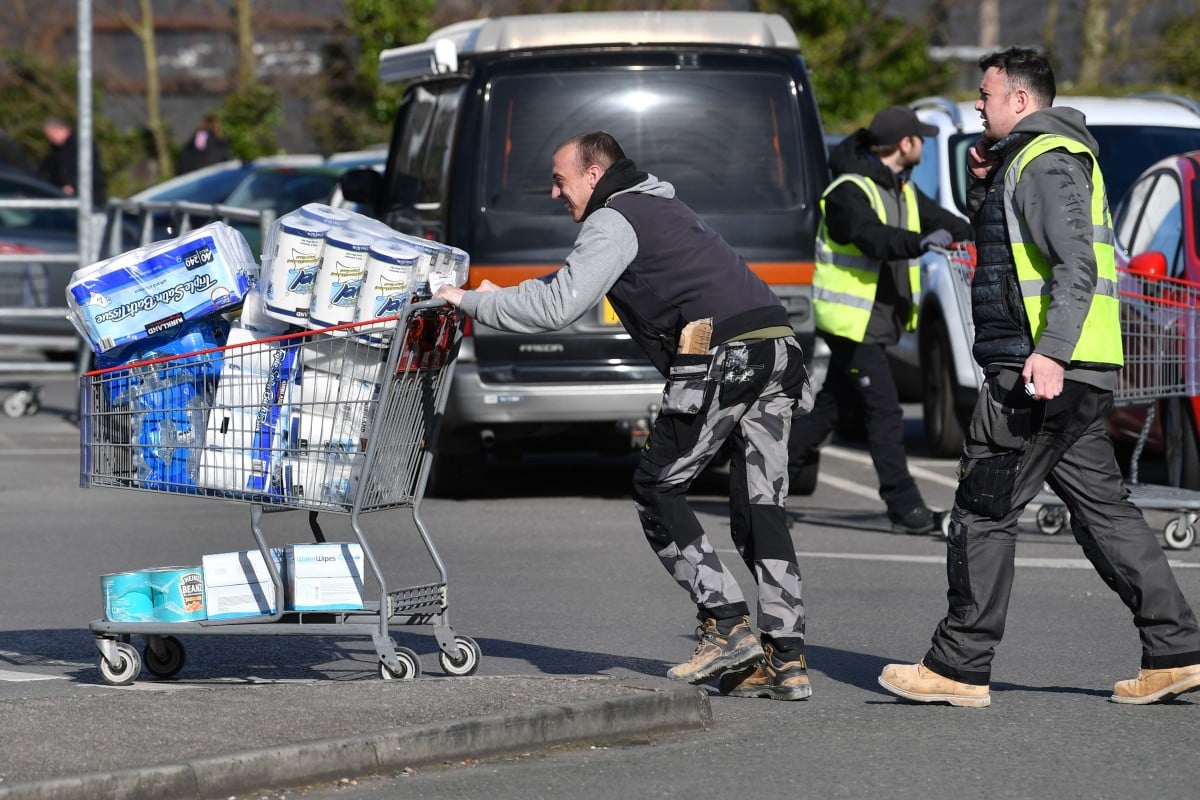
Two Covid-19 issues have been weighing on my mind: toilet
paper hoarding, and virus containment.
Many have been asking why people around the world have been
hoarding toilet paper. A friend of mine captured the irrationality of people
hoarding toilet paper by saying “It’s because they’re scared shitless!”
There is a long history of toilet paper shortages during
crises; the US had a run on toilet paper in 1973, in part created by a joke
told by late night TV host Johnny Carson, but coinciding with shortages of many
other consumer items, including gasoline (petrol).
I’m especially intrigued by this run on toilet paper because
it seems to have started in Hong Kong, and spread to much of the rest of the world.
Hong Kong even had a widely reported case of a toilet paper robbery. There
seems to be something cross-cultural about the phenomenon.
Reason 1: People resort to extremes when they hear
conflicting messages
Reason 2: Some are reacting to the lack of a clear
direction from officials [Hmm, this sounds like Reason 1]
Reason 3: Panic buying begets panic buying [This is true;
now that there is a shortage, I have no choice but to try to buy toilet
paper. This is the “game theory” explanation. But it does not explain why the
panic buying started in the first place.]
Reason 4: It's natural to want to overprepare. [Really?
Why focus on toilet paper and not tuna or beans?]
Reason 5: It allows some to feel a sense of control [Control
what?!An uncontrolled bowel?!]
So the psychologists say that by preparing when they feel
helpless, even just by purchasing toilet paper, people get a sense of control.
But none of these reasons explain why “toilet paper” and not, say breakfast
cereal. After all, diarrhea is not one of the symptoms of the coronavirus.
This is actually a classic cultural, and thus anthropological,
question: why do people value one thing over another. Economists can tell you
where supply meets demand, but they assume demand exists. Anthropologists want
to know what creates demand for a particular thing, i.e. why it has value.
Toilet paper symbolises control. We
use it to “tidy up” and “clean up”. It deals with a bodily function that is
somewhat taboo.
When people hear about the
coronavirus, they are afraid of losing control. And toilet paper feels like a
way to maintain control over hygiene and cleanliness.
So, to really get at the root of the phenomenon, we need to look
at the symbolism of toilet paper. The “control” some people talk about is not
controlling the disease, but the control of bodily functions that we usually
rather not think about. People think of toilet paper as essential for “hygiene.”
People are also told to wash their hands after they go to the bathroom. Thus,
toilet paper is associated with hygiene and hand washing.
Indeed, a lot of the “hygiene” people follow to protect themselves
against infection is not really effective. During SARS, there were many
reports of people cleaning all the door knobs inside the house, even though
they were in isolation at home. With no outsiders coming in, it is hardly
necessary to wipe door knobs. The same is happening now in the US. I've heard of people washing their hands compulsively even though they are in isolation. And in one
business I know of, though there are less than 10 managers left working in a large office, they have cleaning staff come through the
office numerous times a day to wipe down and disinfect surfaces. I think the managers
would be safer if the cleaning staff did not come, but the idea that surfaces should be “disinfected” and “cleaned” is very powerful.
Containment vs Mitigation
When Americans look at what China did to control the
Covid-19 virus, they tend to attribute it to China’s authoritarianism. It is
true that there are aspects of China’s response which were possible only
because of the authoritarian state—including the denial of the problem for 3
weeks, when doctors knew the virus was serious and spreading (though we still, even today, March 28, have officials in the US downplaying the seriousness of the epidemic). But most of China’s
response is not due to the authoritarian nature of the state, but to state
capacity. China was able to trace contacts and impose quarantines because it
had the health care personnel to do it. Proof that it is not due to
authoritarianism is the fact that Korea and Taiwan were also able to react as
quickly, but are very robust democracies. In Korea and Taiwan, people who came
down with Covid-19 had their contacts traced and notified, and some were put in isolation to prevent them from further spreading
the virus. This has helped contain the virus in China, Korea and Taiwan. (For
an article on Korea, see here; on Taiwan, see here.)
In one case, in Westport, CT, on March 5, 50 people at a
party were exposed to the virus and dozens subsequently came down sick. “Even in a well-connected, affluent town
like Westport, contact tracing quickly overwhelmed health officials. ... One of
the party guests later acknowledged attending an event with 420 other people,
he said. The officials gave up.” This is because they lack the capacity, and perhaps
the will. The parts of Asia that went through SARS were more aware that contact
tracing was important.
Contrast this with what was done in China. First, everyone
who traveled to other parts of China from Wuhan was forced by local
authorities to quarantine. Note that this sounds oppressive and authoritarian,
but they were able to do something similar in Taiwan and Korea. Then, they
closed off neighborhoods with infections, forced visitors to go through 14 days
of quarantine before going to work, and placed restrictions on restaurants (but
they did stay open, in contrast to ours which are all closed). I highly
recommend this 12 minute video (in window below) by a Japanese businessman based in Nanjing,
which was not heavily affected by Covid-19, but you can see the efforts the
city went through to contain the epidemic.
Containment may also be difficult because Americans are more
mobile (though I don't know if this is true); this video by Tectonix GEO shows how the cell phones of spring break partiers (known as Covidiots) on a beach in Fort Lauderdale spread to the rest of the country in the following weeks. This video shows how people from the New York metropolitan area spread over the entire US in the two days after Gov. Cuomo announced #stayhome rules. But millions of people left Wuhan for the Chinese New Year before January 25th,
and yet China’s local authorities were able to prevent them from transmitting the
virus locally by requiring visitors to isolate at home. Taiwan was also able to contact tens of thousands of residents who arrived from China to contain the spread of the epidemic. But the US does not have neighborhood
associations and health authorities like Asian countries have.
It is not because China is authoritarian that containment
was possible; it was because they had state capacity. The same is true for Taiwan and
Korea. In part, the experience of SARS in Asia meant that states there prepared
better. But the US is also underprepared because Americans, and especially
libertarians and Republicans, distrust state power. Trump dismantled the pandemic response team in 2018 that had been created by the Obama
administration.
A weak state is not a bug; it is a feature of America. The Trump
administration has been cutting budgets of all government departments,
including the CDC. The “small government” ethos is strong in America. It is
linked to ideas of freedom and liberty. You can see this skepticism of the
government and of public health officials, that grows from a fear of state
power, in websites like this of the libertarian magazine Reason.
No one knows what will happen with this pandemic; as thisblog post says, every model and prediction we read “is just a guess but with
statistics.” (But he’s not simply dismissive; he adds, “All models are wrong.
Some models are useful.”). And it is useful to go back to the Feb. 13 NY Times article interviewing Donald G. McNeil Jr., their health and science
reporter who has covered epidemics since 2002, to realize how little was known
as late as mid February. There are still important questions about the mortality
rate, like why the rate is so much lower in Germany than Italy.
But the chance for the US to contain the virus has passed.
China, Korea, Taiwan, Hong Kong and Singapore have largely succeeded but are
still fighting to contain the epidemic. In the US, because of a lack of testing and the debacle over tests, and
because we don’t know how reliable the tests are anyway, we have no idea what
percentage of the population has been infected. But now the US has passed China
and has the most confirmed cases in the world. Rah rah patriots can cheer, “We’re
number one!”
As long as people worry that going out will expose them to coronavirus infection, the economy will not rebound, even if authorities do relax restrictions.
President Trump and a number of business leaders want people to get back to
work, but the epidemic has to recede before people will go to the theatre, to
the mall, and to restaurants, not to mention travel internationally and take a cruise.
The chance to contain the epidemic has passed. Mitigation will be long and
messy, and it is hard to know how and when it will end.