Showing posts with label Hong Kong. Show all posts

Thursday, June 29, 2023

Three Observations on My Trip to Asia

I have a few observations on a very pleasant and productive trip to Hong Kong, with a brief visit to friends in Tokyo (that's in Japan, BTW; Hong Kong is not in Japan, for the Americans reading this who may not know 😉). 

First, the level of English in the Mainland Chinese students I taught at a workshop was surprisingly high, noticeably higher than four years ago when I last taught this workshop. I asked several of them how they learned their English, and some have spent time in the US or UK, but not all. One said she has been attending English tutorial classes since she was in nursery school. The look on her face suggested she did not enjoy these classes, much like American-born Chinese hate going to Chinese school. But her English was very good, whereas most ABCs don't learn much Chinese. One young lady sticks out in my mind; she said her mother regretted that her own English was not good, and so sent her to a boarding school in New Jersey for a year when she was 14. The daughter then came back to China for high school and university, and now, 10 years later at 24 years of age, she is bilingual and will be a top candidate at any graduate program she applies to. Sadly, her mother passed away, so cannot see how successful her strategy has been. This young lady represents, for me, a new generation of cosmopolitan Chinese who were exposed to English in the early 2010s and now, a decade later, are comfortable in both English and Chinese.

Secondly, I attended a small conference where young mainland and Hong Kong Chinese students presented their research to each other. I was struck by how the students spoke openly about the limits of what can be said. No one made doctrinaire statements or argued politics, but I was struck by how, in an intellectual context, everyone could assume that everyone knew we were subject to authoritarian rulers. People were not being cautious; they were matter-of-fact. It reminded me of how in the US, in university settings I have been in, there is an open contempt for Trump and matter-of-fact criticism of his boorish ways, in a way that is different from pre-Trump days. On the one hand, the heavy hand of the state and CCP is obvious (Chinese University still requires a University ID to enter the campus, though no ID is required at HKU). On the other hand, I'm told that it is now harder to get into Chinese University because high school graduates are choosing Chinese University over HKU because it is viewed as more politically liberal. I was told that many people are leaving, but that while in the 1990s, before the 1997 Handover, people held "going away parties" before they left, now people are leaving quietly. Often, I'm told, people find out someone has emigrated only once they see their friends' pictures set in the UK. I met one student who is accommodating to the new pro-Beijing rule, but it seems most people who are staying are waiting for the winds to change. As one friend put it, even Xi Jinping will not live forever, and his successors will have to respond to the problems and frustrations his policies are causing. From the US, it is easy to think of "the Chinese" and focus mainly on the nationalistic extremists and authoritarian ruling class, but the reality is much more diverse. And the problems of extreme nationalism and authoritarian thinking are unfortunately plaguing the US too. 

Pedal-assist bike with children aboard
My third observation is about how Hong Kong and Japan "work." Americans (at least some of them) spend much time criticizing the government, so it surprising that anyone is actually willing to work for the common good. Michael Lewis' The Fifth Risk is a paean to the dedicated civil servant, because it is surprising anyone accepts the call of public service given current criticism of government. One cannot spend time in Hong Kong or Japan without being impressed by how their infrastructure works. Hong Kong has built an impressive and efficient subway system over the past 40 years. The new subway line connecting Shatin to Admiralty makes the trip to Central, which my wife took daily, spending 45 minutes with two transfers, now takes only 31 minutes with one transfer. 

Vulgar Texas traveler
And Japan is so orderly and civil, in so many ways. Service workers are very polite (using a series of stock phrases that probably carry little literal meaning because they are used so much, but do have the effect of making interactions smooth and polite.) Customers in restaurants and cafes speak in hushed tones; the noise level is noticeably lower than in Chinese or American restaurants. (Contrast that civility with the "gentleman" in the photo to the right, at the STL airport, waiting for his latte, wearing sloppy clothes with a vulgar statement on the back). Sidewalks and roads are well maintained and clean. The birth rate may be low in Japan, but we saw many parents taking their kids out on pedal-assist bikes, on bike lanes that are narrow, but everywhere. And in contrast to much of the world, where people can park cars on public space for free (see Henry Grabar, Paved Paradise: How Parking Explains the World [Fresh Air interview here]), in Tokyo one can only buy a car with proof of a parking space. This makes neighborhoods more tidy and easy to maneuver in (not to mention that people don't drive around in circles looking for a free space.) 

The flight attendants on my JAL flight bowed to the passengers in the waiting area before they boarded the plane (many passengers would not have noticed it, because it was not announced, but I saw it). It reminded me of how Thai rugby players bow to the audience before a Sevens match. My flight on JAL (which I choose because it was the cheapest ticket) included two meals and a snack. The meals were good, and I was charmed by the miso soup they served in paper cups, as an additional drink. The plane was an American-made Boeing 787, but it was the first time I have seen windows that do not have shades that you pull down, but have a button that you push that makes the window go dark, like the sunglasses that go dark in bright light. Very cool. 

When I got to Chicago, I had to transfer to an American Airlines flight for my last leg home. Once in the airplane, the flight attendant announced that the toilet in the front of the plane was broken, so everyone would have to use the toilet at the back of the plane. Oh, and there is no WiFi, because the system is broken. To make matters worse, the flight attendants spent much of our 46 minute flight haranguing us with a sales pitch about the "great deal" we could get on an American Airlines credit card, for which they would give us 50,000 miles, which she said enough for a one-way ticket to Asia. The male flight attendant then had to go down the aisle holding brochures for the credit card to hand one out to anyone who wanted one (I did not see anyone take one), and the female flight attendant stood at the front of the plane as we deplaned, holding brochures fanned out in her hands. How humiliating. It's bad enough that flight attendants who are there primarily for safety in an emergency have to also serve food and drinks, but now they have to hawk credit cards. At the same time, their planes don't work properly.

Finally, people in Missouri complain about the humidity here. But they don't know humidity. Here are my glasses after I exited a subway station in Hong Kong, where we have real humidity.

Real humidity


Monday, October 24, 2022

Observations on my trip to Hong Kong

When I lived in Hong Kong, I found it amusing that visitors would often and repeatedly comment on how striking they found the clusters of skyscrapers of housing estates. So I find it amusing, now, that on the ride in from the airport, I, too, found the clusters of 30-plus story skyscrapers notable. The fact that I notice these buildings which I once took for granted shows that I no longer belong in Hong Kong. And yet, everything seems so familiar, like I never left.

The Covid protocols are a mixture of the efficient and nonsensical. I was tested by PCR test 4 times: on arrival, and 2, 4 and 6 days later. Each time, I received the results at around 8:30 pm, which is the time they notify people who have been tested before noon. I don’t know why the notifications are sent out as a batch and are not sent out as they are received. In addition, I had to take a Rapid Test every day and post the results (honor system). Half of these tests, then, were duplicating the PCR test. I tried to make it more useful by doing the Rapid Test in the evening, since I took the PCR test in the morning, but that meant I got the results of both tests at about the same time.

The PCR testing process itself was amazingly fast. I simply walked in, showed the staff member my Hong Kong ID and the appointment confirmation SMS text message on my phone. The staff person, who was behind a plastic barrier, entered my ID number and a code number from the SMS text on their keyboard, and my personal particulars (including my phone number) then appeared on a screen that was set facing me (none of the silly swiveling of the screen as in doctors’ offices in St Louis). She gave me a vial, which I then took down a line about 20 meters, and a “dispatcher” told me which of about 20 cubicles (temporary cloth medical stations) to go to for my test. Each time I arrived, the tester was still finishing up from the previous test and putting on new gloves. They took a swab of both sides of my nose, and with a second swab took a sample from my throat (“Say ‘Ah’”), and then, “You’re done, thank you” and I could leave. I don’t think it even took 3 minutes.

In theory, everyone entering a store or building has to scan a QR code on their “LeaveHomeSafe” app, which brings up the visitor’s health status in a QR code. Until a person’s QR code is blue, one cannot eat in a restaurant. (A friend who has resisted getting a cell phone for years was finally forced to get a smart phone!) I found that while restaurants followed this faithfully, most stores and buildings ignored it. I entered a Watson’s pharmacy and saw the QR code and scanner at the door but noticed that no one was using it. On the other hand, when I entered the Chinese University Library, a staff member was at the barrier where you scan your university ID to enter, and she gently called me back to have me sanitize my hands. (In my defense, I did not recognize the new, alcohol-spraying hand sanitizer as a sanitizer, and plus, didn’t we discover that Covid spreads not from contact by in the air?).

Surgical mask holder
Everyone, and I mean everyone, wears a mask. The only exception is when exercising, and on the beach. People walking on a promenade along the water, which could technically be considered exercising, were wearing masks.

Hong Kong residents also have a handy plastic mask holder, which allows you to fold a surgical mask and put it in your purse or pocket while you eat in a restaurant. I also discovered a "touchless elevator pad" 

Days before leaving for HK, I received the Congressional-ExecutiveCommission on China  report on human rights in Hong Kong titled Hong Kong’s Civil Society: From an Open City to a City of Fear. As a cover letter put it:

The report, entitled Hong Kong’s Civil Society: From an Open City to a City of Fear, draws on interviews with 42 current and former members of Hong Kong’s civil society and details how the draconian enforcement of the National Security Law crushed democratic institutions and a once vibrant civil society in Hong Kong.

The report is depressing reading, describing the jailing of politicians and activists for organizing a primary (which the government claims is “subversion”), the disbanding of many NGOs, children coming home saying their teachers told them to report if parents criticized China’s flag, and journalists forced to leave because of police harassment.

Touchless elevator pad
In contrast to the report, which focuses on the worst cases, I found people trying to live a normal life. Some professors have left Hong Kong because of the political situation and the National Security Law, but it has not been a mass exodus. Recent statistics show 1.6% of HK’s population (116,000people) left HK in the past 12 months (see here for more analysis on emigration and Covid departures). Professors that remain try to continue teaching as before; since they taught critical thinking and presented different sides of issues, and not one side, they see no need to change their approach. Especially because many courses still have to be offered on Zoom, and so are recorded, teachers also warn students to be cautious, but one colleague noted that some students do not hesitate to talk about what they did in the protests, despite teachers' warnings.

One friend, who had been quite supportive of the protests when I saw him three years ago (and probably would still be considered “yellow”), has traveled to the UK for work and commented that the Hong Kong friends who have emigrated are, in his view, overly negative on Hong Kong. It seems everyone needs to justify their choice: those who stay say it is not so bad, those who left emphasize how much it’s changed and how bad it’s become.

Now that the protests have been suppressed, perhaps it is easier to add some nuance, and not see them in simple bipolar terms of good versus evil, or democracy versus autocracy. Already in 2020, a special section in the anthropology journal HAU (issue 10[2]) offered some nuance on the protests. Many of the protesters were xenophobic and anti-Mainland Chinese, and a large number loved Trump (because of his anti-China stance). And though authorities will not admit it (because they “won”), much of the violence was caused by the government’s intransigence and by the police. The violence from a minority of the protesters probably doomed the protest movement.

I can see that people who, for family or work or other reasons cannot or do not want to emigrate, are coming to terms with the new reality. One Chinese friend (who is my age and who had emigrated to Australia in the 1990s to get his citizenship and then returned to Hong Kong) was surprised that his sons’ friends all supported the protests. He is relatively moderate and sympathized with aspects of the protests, but the protest movement appealed especially to youths. Yet, neither he, nor his sons (who graduated from university in Australia) are considering moving to Australia. My friend said he is disgusted with the “Mainlandization” of the government, with officials now speaking like CCP officials. He commented that because they did not do so right after 1997, when perhaps it could have been logical to make such a change, the patriotic language and public service announcements on TV in 2022 are quite jarring. But he’s not leaving.

Another young friend, educated in the US, complained bitterly of the government bureaucracy and rigidity with Covid regulations, but he admitted he would not leave Hong Kong, because his skills and bilingualism are only an advantage in Hong Kong.

The fact is, we all live in flawed societies. I live in a city that still has a gaping racial divide, where White kids in the suburbs go to excellent public and private schools while Black kids in north St Louis go to schools that in the recent past were so bad that the state had to take themover. Guns are so common that I sometimes hear shots fired at night. On the social network NextDoor, I read last week that two teenagers drove up to a gas station near my neighborhood, and one of them jumped into a car and stole it (here is a video of a similar incident at the same station). One of the first replies on NextDoor was that the owner should have had a gun! (Right, so she could shoot her own car and perhaps kill the teenager and maybe some innocent person walking by.) Today there was a mass shooting in a St Louis high school: three dead, six injured. I live in a country that is also entering a deeply xenophobic phase, where minorities are attacked and immigrants who have worked here (usually also paid income taxes) for decades have no path to citizenship. I live in a country where supposedly intelligent people continue to assert, without any evidence, that the 2020 election was stolen from Trump (despite the fact that Republicans did well in all the other races). I live in a country that claims to be a democracy and yet corporations and the wealthy can spend unlimited amounts in political ads and lobbying (see e.g. Leonard Leo’s $1.6 billion fund). And I live in a country where most people are going to vote for their tribe (red or blue) rather than based on the qualifications and policy proposals of candidates.

Americans like to think that the US is such a great country that everyone wants to come here, but according to a report titled Caught in the Crossfire: Fears of Chinese-American Scientists, government harassment of scholars of Chinese descent has led to an exodus: 

“The China Initiative caused panic and an exodus of senior academic researchers of Chinese descent in the US.” The number who dropped their American academic or corporate affiliation in 2021 in favor of a move back to a Chinese institution jumped by 23 percent over 2020. In 2021, 1,500 Chinese scholars who were educated in the United States left to go back to China."

Many Americans seem to believe the political rhetoric that the US is the greatest country in the world, and believe everyone wants to come to America. In fact, the vast majority of people want to stay home close to family and friends, and most refugees who come to America are driven out by violence and other problems at home.

It is easy, from the US, to imagine it is hard to live in an authoritarian place like Hong Kong. Yet many Americans are perfectly willing to retire to an autocracy like Dubai:

A sunshine-filled city, Dubai offers an outstanding quality of life for retirees. The city is famed for its friendly, multicultural population and array of lifestyle experiences that put convenience at the forefront – think on-demand home services and food delivery at the touch of a button. (From Retire in Dubai website)

Retire amid sunshine and cheap labor; all you need is US$500,000 in the bank, and an income of at least US$60,000 per year. Why worry about freedom?

The CECC report quotes an anonymous professor as saying “Hong Kong has changed from an open society to one in which people are gripped by fear. And the fear is encompassing.” This is certainly true for some. But most people are not activists or directly involved in politics. It is startling to realize that for many people, life seems to go on as before. Even if they are not happy about the National Security Law, what can they do?

Science Park: new buildings
Because many people are carrying on as before, the changes to Hong Kong will be gradual. Several people mentioned the way pro-Beijing papers identify an issue or a person and then attack them in concert. That riles up pro-Beijing supporters who add to the attacks online. That is how Beijing tries to bring about change. It is a bit reminiscent of the Cultural Revolution, though less intense (although it is plenty intense if you are the target). But most Hong Kong residents are not involved in politics and do not fear being attacked. The authorities have created a flag raising ceremony at schools, and added required patriotic education, but I heard ways that people get around them (e.g. by assigning a few Mainland students to attend on behalf of a department). Over time, these ritual may have an effect, or they may become empty rituals. Beijing is making Hong Kong students sing the national anthem; Americans sing the national anthem before all sports events. Does it have an effect?

People get used to almost anything. My sense is that people in Hong Kong will adapt. Like many in China, they will continue to hope that the government will reform, will open up. They will push at the margins; no street protests, but passive resistance, like the non-compliance with scanning the QR code in entering buildings. Hong Kong survived fairly draconian crackdowns under the British. Many hope it will survive this round of crackdowns, too.

Thursday, October 06, 2022

Back in Hong Kong

This entry is about details of travel to Hong Kong, and about airport/airline efficiency, and may be of limited interest to readers, since it is written mostly to record my experiences and to help me get over jet-lag. Mostly “1st World Problems.” Feel free to skip it, unless you want the details.

I came back to Hong Kong for a brief visit; I need to set foot in the SAR at least once every three years to maintain my “permanent” resident rights (this requirement only applies to “non-Chinese,” a concept that one could write an article about—American-born Chinese technically are “non-Chinese” because they are “born American” but in fact many manage to get the real permanent ID). I was already looking into how to fly back to HK when the government reduced the quarantine from three days in a hotel and four at home to just three at home, so I quickly bought my ticket. The website was so busy that I was not able get into the Cathay Pacific website to select my seats until the following day.
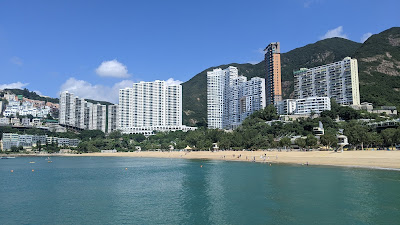
Repulse Bay
I flew on Cathay Pacific because 1) my accumulated miles would have expired on Dec. 31 if I did not fly a leg on the airline, 2) it was the only direct flight from the US to HKG, 3) I like Cathay’s service (politeness and efficiency—you’ll see below). But of course, Cathay does not fly to St Louis, so I had to fly STL to LAX on a code-shared flight operated by American Airlines (AA).

 My flight was supposed to leave STL at 19:45, and at 15:45 I got an email telling me my flight was on time. To make sure there were no problems (and because CX was not able to assign me a seat on the first leg, which was run by AA), I arrived at the airport more than 2 hours early. I tried to check in at the kiosk, but it did not work. The attendant came over, also tried, and then sent me to the service desk. No problem: I got two boarding passes, one STL-LAX, and the other LAX-HKG. So far, pretty smooth (except that CX does not participate in TSA PreCheck, so I had to do the shoes-off computer-out routine).
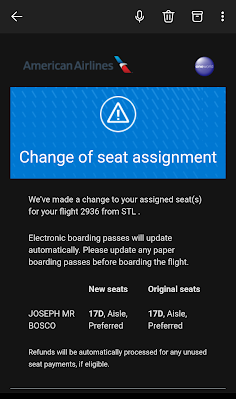
Change or no change?
Shortly after I got to my gate, C6, I thought to check where my plane was. My Flight Aware app then told me that my flight was going to be two hours late, but there was no indication on the monitor. Finally, about a half hour later, the monitor indicated the late departure, but it said we would only be 1:15 hr late, leaving at 21:00. But an email they sent at 18:02 said that we would depart at 20:29. (Before that email arrived, they sent me at 17:34 an email that my seat had changed from 17D to 17D—yes, that is not a typo! See screenshot.) Since I had a three hour layover, I was not too worried. 

At 20:26, they said they would start boarding in four minutes, so I got up and went to the restroom, about 30 yards up the hallway. When I came back a few minutes later, I was stunned to see that gate C6 was completely empty! Everyone had left, and the monitors at gate C6 still had my flight to LAX displayed.

I knew there was no way everyone boarded the plane that quickly, so I looked around, and I could see a family that had sat next to me was walking down the corridor. It turned out AA had changed our gate to C10. I got there after everyone had found places to sit, and so decided to stand, thinking we were about to board, but it took another 30 minutes, because people had to get off the airplane first, and then they had to clean it. All this time, there was not a single announcement about what was going on. The only announcements were that there was only space for 45 roller bags, and so everyone in groups 7-9 had better check them in now, to avoid further delaying our flight.

Finally, at about 21:00, they asked us to board. I got in my group (#4 of 9!) and once we were in the jetway, we just stopped. We waited in line in the jetway for 10-15 minutes. I heard staff in the front talking, asking passengers if the jetway was full, if people were still coming. One passenger went up and asked the staff woman at the head of the jetway and I heard them saying something about the pilot not having enough hours left to complete the flight. She sent an assistant to get a wheelchair (oh no, are we now disembarking the wheel-chair assisted passengers who are already on the plane?!) but just as the assistant was returning with the wheelchair, the staff woman said we could board, and told her assistant she did not need the wheelchair. Whew!

 Again, at no point did they announce what was going on. By now it was getting to 21:40, and I was worried about making my connection. The flight was scheduled to be 3:50 hrs, so would land around 23:30 LA time, and my CX flight was supposed to board at 23:50.

The flight itself was fine. I did, however, ask a flight attendant if they would make an announcement to ask passengers to let travelers with tight connections get off first, and she replied that they can do it, but that it depends on whether other passengers will cooperate. In my mind, I was thinking that passenger cooperation depends a lot on how the announcement is phrased, but, whatever. In fact, however, they did not make any announcement. I timed the disembarkation: the plane doors opened at 23:13, and I got off at 23:18 (since I was in row 17). Not bad. But again, pretty poor service. I’ve noticed AA does this; they seem to agree to do things to get a customer off their back, but then don’t follow through.

I was worried I would have to go through security again to get to the international terminal (like at Chicago’s ORD), which could take time since I did not have TSA PreCheck, but I did not, so I arrived to my CX flight gate with plenty of time. I was astonished to see that Cathay did not use the boarding passes for boarding the airplane: they used face recognition. You can see in the video below. Passengers are told to step on two green footprints on the ground and look at the monitor. The program identifies the face and then turns green and opens the gate. I was shocked that they used it, and that it seemed to work. In my case, the screen did not recognize me; it said to take off my mask (it was already off! Did they want me to take off my beard?) or see an attendant. The attendant was very patient as she dealt with me, and with a French passenger who had done something wrong with his quarantine statement and might not be allowed to board. She multitasked, and calmed him down, and took care of my my problem. I think the issue was that I had bought the ticket using my passport, but had submitted the quarantine information using my HK ID. After showing the ground staff my passport, ID and green quarantine QR code, she told me I was being upgraded to business class and gave me a new boarding pass, which I did not need to use, because now the computer recognized my face. I do wonder what picture(s) they have of me. And why are they doing this? Are people sneaking into Hong Kong with fake documents? One thing is for sure: this does remind every traveler to Hong Kong that Big Brother knows what you are doing. On the other hand, it is not just Hong Kong; today's NY Times has an article that says of the US, "Around 85 percent of the 221,000 daily visitors arriving from abroad are now verified by face, according to C.B.P. [Customs and Border Patrol] officials." In fact, it may be the US that wants Cathay Pacific to use facial recognition, not Hong Kong!


It is not fair to compare economy class on AA to business class on CX, but I do want to point out that my reading light on the AA flight did not work (it was not that they were all off; the reading light over the boy at the window seat did work). Not everything on my CX flight was perfect; if I plugged in my phone charger, the headphones had a loud buzz. But I have to say that the Airbus 350-1000 was so quiet that I could hear people near me crinkling a bag of potato chips or the flimsy water bottles; the crinkling made an annoyingly loud noise. (OK, now we are really descending in 1st World Problems.) In a moment of boredom, I decided to measure the background sound of the airplane, and it was only 70-71 db, which the app says is the sound of traffic. (For comparison, “Conversation in restaurant, office, background music” are 60 db, which is half as loud as 70 db, and a garbage disposal is 80 db [twice as loud, though that would depend on the model; see quiet Insinkerators here]).  

Hong Kong still tests everyone arriving in the SAR. There are temporary stations set up in the airport arrival hallway, with plenty of people directing passengers. At the first station, I was given a green lanyard with a green card with a bar code on it (there were twelve desks for this, and the entire procedure of submitting travel document and receiving the lanyard took half a minute. Then I went to the next station, where there are over 30 cubicle’s separated by temporary sheets, like in a hospital. I sat down, pulled my mask down, and they took a sample from both nostrils with one medical swab and a sample from the throat with a second swab (the first one did not go that deep, but the second one nearly made me gag). Then I was given the samples in a bag (I don’t remember whether there were two vials or only one) and I went further down the hall and handed them to another team that took them, and scanned the bar code. And I was done! Granted, I was among the first off the plane, but there were so many stations and so many helpers, I’m sure everyone got through very quickly.

Efficiency in moving people is one thing that Hong Kong excels in. The plane touched down at 5:55 am, and I got off the plane at about 6:05. I was at the luggage claim area by 6:19, and that includes taking a train from the far end of the terminal to the arrivals area (and a 5 minute wait for the train). The luggage came out right away (I’ve never understood why it is so fast in this enormous airport, and so slow in STL, which is very small). I was in a taxi on my way to my friend’s apartment at 6:40. Amazing: 45 minutes from wheels on the ground to in taxi, even with all the quarantine protocols.

And I received a text that my covid test was negative at 10:10. I now have to do a rapid test daily, for seven days, and go to a health center for a PCR test in two, four, and six days. It seems a bit extreme (especially doing a rapid and PCR test on the same day) but Hong Kong authorities can be a bit enthusiastic about safety. I've always wondered how many people actually get injured on escalators, because in Hong Kong (including today in the airport), there are announcements that say "Please hold the handrail and don't walk." Not "Stand on the right and walk on the left" as in the Taipei subway system.

One thing that Hong Kong does is load 8 taxis at once. The taxis pull up in 8 spots, and staff guide passengers from the single queue to load at the 8 spots, so people don’t have to wait as long. After experiencing the HK system, I get impatient when I go to other airports and I have to watch one or at most 3 people get into their taxi, while we just wait. When you are as crowded as Hong Kong is, you develop tools to move crowds more quickly and efficiently. The assistants even ask you where you are going, and give you a “Taxi information card” with an estimate of what it should cost, to help avoid cheating. (I noticed that I paid a $3 “Airport fee” on my Uber ride to the STL airport, but I don’t see that I got anything from that; it looks more like a troll fee).

I don’t mean to complain. It is a thrill to be able to travel again. And when you are in a place, you read and learn about things you would never hear about while outside HK, because there, you are paying attention to a different place's local news. The SCMP (which I don’t usually trust, but often does have interesting information) has an article about Beijing’s Ministry of Foreign Affairs asking all HK consulates to provide a list of their properties in Hong Kong, and when and how they bought it. Apparently, many consulates have ignored the missive, which had a Sept. 22 deadline. Most consulates declined to comment, so this part of the article caught my attention:

A former Asian diplomat said the request was ‘clumsy’ and could be ‘counterproductive’.

‘I think it is probably to intimidate and unsettle the diplomatic community and as a not-so-gentle reminder that Hong Kong’s boundaries of acceptable conduct by diplomats have changed.’ The envoy said. ‘I doubt it will work—those very few, mainly Western consulates, inclined to behave in the way the Chinese fear are not going to stop supporting ‘democracy’ or calling out Chinese violations of human rights in Hong Kong, while the majority of consulates who never had any intention of doing so will just get irritated.’ (Ng Kang-chung and Jeffie Lam, “Beijing seeks details on HK assets owned by consulates.” Oct. 6, 2022, p. A3)
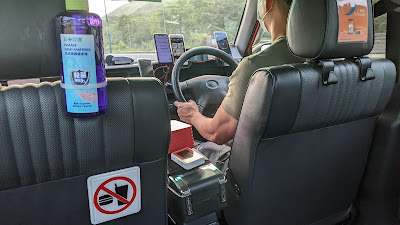
HK taxi, with multiple phones, and sanitizer. Orange box is air purifier. 
The article right next to it (“Slight increase in arrivals since easing of restrictions” by Rachel Yeo) notes that on Oct. 3, 768 tourists arrived in Hong Kong, and 471 left (this would not include me, since I enter with a HK ID). On January 24, 2020, before the coronavirus crisis, 22,872 visitors arrived. The article concludes with an economist saying that

It is possible to see air passenger capacity rebounding around 10 per cent at the moment to 30 percent of the pre-pandemic level by year-end. Still, there is a long way to go for Hong Kong to catch up as Singapore will reach 80 per cent soon.

Hong Kong is always competing with Singapore. And now, the terms of the competition are much less in its favor.

Wednesday, February 09, 2022

Connection & Separation

People like to believe the idea that we are all connected by “six degrees of separation.” This is the idea that between me and any other person in the world, there are only five persons, each of whom know each other and have a personal connection, i.e. six links. The research to support that notion is pretty weak; Stanley Milgram’s famous research that popularized the notion actually had at most 30 percent of seeds actually reach the target person; some psychologists even consider “six degrees of separation” an academic urban myth (see Psychology Today article here). 

What strikes me about this concept, however, is the separation, not the links. Some people enjoy “connecting,” meeting new people. To me, however, meeting people I will never see again is sad, almost depressing. Maybe I’m an introvert, or maybe it is because my family moved every two or three years until I went to high school, so I lost friends and contacts after every move. I value permanent connections and friendships, not brief encounters. Of course, this is a stupid approach, because you can’t have long friendships if you do not start with the encounters. Plus, nothing in life is permanent; we just have to go with the flow.

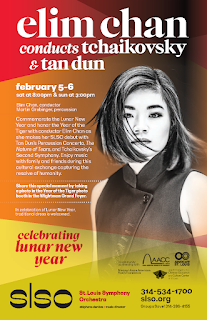
This was brought home to me this weekend when we went to a St Louis Symphony concert celebrating the Lunar New Year. Though we are being very cautious about going out and even about meeting people because my 91-year old mother-in-law is staying with us, we decided that since everyone in the symphony hall would be vaccinated (and mostly older), and everyone would have masks on the entire time, it was relatively safe. We were especially eager to go because the guest conductor was going to be Elim Chan (陳以琳), who in December of 2014, at age 28 and while still a doctoral student at the University of Michigan, won the Donatella Flick LSO Conducting Competition, the first female conductor to win the competition in its history (and one of only 5 females among 225 entrants in this overwhelmingly male occupation) (see NYTimes article here). We had read about her while living in Hong Kong, because she was Hong Kong born and raised, (see SCMP article here [paywall, after intro], for example). So we thought it would be fun to go see her conduct in St. Louis.

Elim Chan’s visit was held in partnership with the St Louis Asian American Chamber of Commerce, and through friends we were invited to meet Elim Chan backstage after the concert. Due to a bit of miscommunication, the person who was to take us backstage did not meet us at our seats after the show, as we expected, and we ended up waiting in the hall while the ushers cleaned up, searching for lost glasses and gloves. All this time we could actually see Elim on stage, deep in discussion with a musician. 

I was ready to abandon the whole thing. To me, what was the point of meeting her briefly, since we will never see her again (or if we do at a concert in, say New York, we certainly will not be able to meet her backstage). My mother-in-law, on the other hand, suggested we just call out to her to get her attention; I’m not sure whether my wife or I were the more mortified.

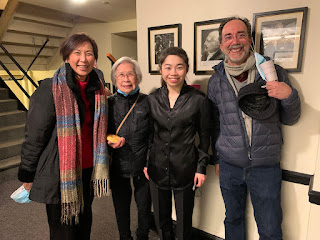
Finally a kind usher went and found our contact person, who very apologetically came and took us backstage, where we met and chatted with the conductor for five or ten minutes. She was charming and gracious, and said she was happy to be able to speak Cantonese with my mother-in-law.

And it turns out we have some connections. Elim Chan did her final two years of high school at Li Po Chun, which is a branch of the famous United World College located in Ma On Shan, very near the Chinese University of Hong Kong. Our daughter has a good friend, Bettina, who was one year behind Elim at Li Po Chun, and Elim knew Bettina. Bettina’s father was a colleague of mine at CUHK, and we knew him and his wife socially as well.

My mother-in-law asked Elim Chan if she knew Tsung Yeh, currently the director of the Singapore Chinese Orchestra. She said she of course knew about him, and that he was up there, indicating with her hands that she considered him to be in an exalted position. My mother-in-law noted that she was good friends with Tsung and his wife, because he had been conductor of the South Bend Symphony for 28 years before his retirement in 2016. South Bend is her home town. In fact, I also met the conductor many times, and enjoyed a long conversation with him in the O’Hare United Airlines lounge in the early 2000s, where he taught me many interesting things about conducting and we speculated on why his baton, which could really be a lethal weapon, was never confiscated or examined by TSA. He also had consulted with my parents, who were teachers of Italian, on the finer points of Italian pronunciation, so he knew my parents well.

We took pictures before we left; only then did we lower our masks briefly for the photo. And I was glad we had stayed and was really charmed by Elim’s graciousness. She may have had more interesting people to talk to than us, but she did not express that. A few of the departing musicians stopped by and complemented her on how efficient she had been, because it turns out that due to the heavy snowfall on Wednesday and Thursday, they were not able to hold rehearsals on those days as planned.

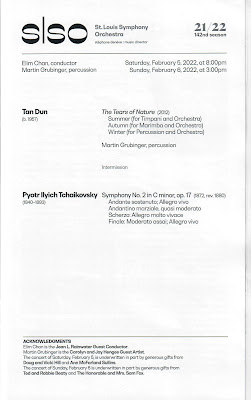
As we left and walked to our car, I reflected on this brief encounter. Though I very much enjoyed meeting her, I’m sad we’ll probably never meet again. And I thought about Tan Dun. The first piece performed by the symphony was composed by Tan Dun. I actually met him shortly after he arrived in New York. I remember that he was very friendly, and that he was surprised and amused that I spoke Chinese. He lived in an apartment across the street from me, on 113th street, in an apartment that was an “anthropology apartment.” I don’t know how or why, but that apartment had had a series of anthropology grad students living in the apartment over the years; the apartment even had a bow and arrow hanging on the wall, and as I remember it, no one seemed to know who they had belonged to. Ashraf Ghani, later the president of Afghanistan, had lived in that apartment four years earlier, I believe—at least, I met him there, when Ghani was finishing his notoriously lengthy dissertation.

So as pleasant as meeting Elim Chan was, there is also a sadness in it for me. It highlights the impermanence of relationships in the everyday flow of life. Not only is the notion of “six degrees of separation” a myth, but most of the “connections” we make are fleeting and fade away. Such is life.

Sunday, December 13, 2020

Holiday Cards and Gender

When my wife applied for her first job, shortly after moving to New York City in the mid-1980s, she addressed her cover letters to “Dear Sir or Madam.” At the time, I thought that sounded awkward, and had suggested that “Dear Sir” was generic enough to include women. She disagreed, and it is a good thing she did. The job she got was with a small law firm that had a male and a female partner, and they tossed out all the applications that said “Dear Sir,” which as I remember it now, was about half the applications. In my defense, female university students were still referred to as “girls” in the Midwest back then, and I had just learned to say “women,” which was standard on the East Coast. The culture was changing.

Words change meaning, and have different meaning in different places. In Hong Kong, female university students rejected being called “women” because that implied they were married. I remember one student saying “woman” had a sexual connotation, implying the person was not a virgin. Female students preferred the term “girl.”

When we were in Hong Kong, we often did not find time to write Christmas or New Year cards. With the end of semester rush (including grading papers, final exams, and preparing for trips over the holiday), it was often impossible to get the cards out. One year we sent them out after Christmas from my parents’ home in Indiana. Twice, I think we sent out Chinese New Year cards since we were so late. Gradually—and perhaps because we did not always send cards—we also received fewer cards. I thought email and social media would perhaps kill holiday cards. But in fact, now that we’re back in the US, we’ve started getting a lot more cards. I’m also making more of a point to send cards (though it does not look good for this year; I’m procrastinating by writing a blog post).

Card from MO Attorney General, using holiday to build name recognition 

One thing that surprises me is how many cards we get that are addressed to “Mr. and Mrs. Joe Bosco.” There are a number of problems with this way of addressing the card. First of all, “Joe” is informal, what people call me in everyday life, but if one adds the title “Mr. and Mrs.” then it seems the intent is to be formal, so it should be “Joseph.” Is there anyone whose birth certificate says just “Joe”? (Actually, I just looked this up, and the answer is, unfortunately, yes; “Joe” is the 705th most common name of 2019 [just below Lochlan and ahead of Carmelo, and poor “Joey” is 776th, right after Clyde], while “Joseph” is 24th). 

But more surprising is how my wife is eliminated from the address. The female half of the couple becomes just the appendage of the male, since only the male is named. This reminds me of a famous article in anthropology, “The named and the nameless: Gender and person in Chinese society” by Rubie Watson, which talks about how in the past, married women in south China were virtually nameless and how their names did not appear on their tombstones.

This way of addressing cards is especially surprising because most of the cards we get are from people we know through my wife’s professional contacts. In fact, most cards are from people I barely even know, but that she knows through work or boards on which she serves. They may know of me, but in many cases we’ve not even met.

I suppose that people write their cards like this because they are being traditional. The sending of holiday cards itself is traditional (not to say anachronistic). And the holidays are a time of traditional foods and rituals. But really, people should at least address the card to “Mr. Joseph and Mrs. Sara Bosco,” (or, if they want to be very hierarchical and proper, “Dr. Joseph and Mrs. Sara Bosco”--even though I'm not a “real” doctor). Or better, Mr. and Mrs. Joseph and Sara Bosco. Maybe “Joseph and Sara Bosco” (removing the titles) is better still, so it doesn’t look like my surname is “Joseph.” And, if we remove the title, then they can justifiably shorten my name and write “Joe and Sara Bosco.”

 And come to think of it, since they are really writing for my wife, they should put her name first: “Sara and Joe Bosco.” We never get cards like that; the “tradition” (aka patriarchy) of putting the male first is strong. It is hard to actually get angry at people who follow tradition; they probably worry that if they change the order they might offend me. (As a result, they offend my wife!)

 It is time to update these traditions, and to address cards with a bit more thought.

Tuesday, March 31, 2020

The Science and Culture of (Medical) Masks


There have been reports the CDC is reconsidering its recommendation that people not wear a surgical mask when they go out (see WaPo story here and NY Times story here, for example). As it has become clear that asymptomatic people can transmit the coronavirus, more and more Americans have been wondering whether it would not be a good idea for ordinary people to wear masks all the time.

Scientists have long said that wearing surgical masks to protect against SARS and Covid-19 is not effective. The scientific view is that surgical masks help prevent someone who is infected from spreading the virus, but wearing a mask does not protect against becoming infected. (Here is an adamant position against non-sick people wearing masks, from 29 Feb.)  As this NPR story from 2015 notes, masks are good if you are sick so you don’t spread germs to others, but it is better to just stay home. The CDC, as of today, only recommends wearing a facemask around other people if you are sick, or if you are in the same room as someone with coronavirus who cannot wear the mask (e.g. because of difficulty breathing). 

The Hong Kong health authorities during SARS essentially agreed with this viewpoint, and said that people should wear masks to avoid stigmatizing anyone who had to wear a mask. The thinking was that if only sick people wear masks, then they would be discriminated against; people who should wear one would not do so to avoid being shunned.

Actually, most Hong Kong residents felt that wearing a mask would help at least a little, and even if they had doubts, “it’s better to be on the safe side” and “it can’t hurt.” It has gradually become common sense that wearing a mask protects the wearer. And this approach predominates with the coronavirus; the Hong Kong government encourages people to wear a mask when they go out. This is contrary to the WHO, which only recommends wearing a mask if caring for an infected person.

An opinion piece in the NY Times by the medical anthropologist Christos Lynteris argues that though there is little evidence that wearing a surgical mask is a good prophylactic against the coronavirus, in Asia wearing a mask is a sign of being modern, of taking hygiene seriously, and of concern for others because wearing it prevents the spread of the virus if the wearer is asymptomatic. Chinese first wore masks in 1910, when the Cambridge-educated doctor Wu Liande recommended the use of gauze masks to fight the pneumonic plague. He was right, and his success, in contrast to European doctors at the time who disagreed with him, was a source of pride for Chinese and began the custom of wearing masks against contagion, Lynteris argues.

But it was SARS in 2003 that made mask-wearing ubiquitous in recent times. I was in Hong Kong at the time, and no one went out without a mask. However, it has never been shown that the wearing of masks was significant in winning the battle against SARS.

The PRC government position is that before hospital personnel realized there was a coronavirus outbreak, many hospital workers contracted the disease and dozens died. The government then mobilized 20,000 doctors and nurses from the rest of the country to go to Wuhan to deal with the epidemic, and all used masks, eye shields and gowns, and none of them were infected. George Gao, a leading Chinese researcher, says it is a mistake that people in the West are not wearing masks, because asymptomatic and pre-symptomatic cases can spread the virus.

There are three issues with having everyone wear masks. First, the medical effectiveness of ordinary people using masks and N-95 respirators is not clear. This MedpageToday article from 2009 shows how contradictory the evidence has been, with many tests showing no benefit to wearing a surgical mask to avoid contagion.  A recent Lancet article includes a box that shows most countries agree there is no benefit to the public from wearing masks.

But then you have non-medical commentators, like this AI entrepreneur, who think the argument for wearing masks is clear, and who calls for everyone to wear masks. (It's funny how people successful in one field, especially rich people, show no hesitation about propounding on other areas outside their area of expertise.) The problem with masks is that if they are not worn, removed and disposed of correctly, they are of little use. The “best” masks, the N-95 respirator, makes it very difficult to breath if it is worn properly, with edges sealed. (And one cannot have facial hair and seal the edges.) Some have said (and I know from experience) that even walking is difficult when wearing the N-95, if it is worn properly.

The second issue is the shortage of masks in the US. When Covid-19 struck, the government stockpile of N-95 and surgical masks was way down because of a failure to restock after the 2009 Avian Flu epidemic (blame for this can be spread widely). The CDC and other authorities’ recommendation was that the general public NOT wear masks, and that they leave them for the health professionals who really needed them. There are horrifying reports of many hospitals and nursing homes where staff have to reuse masks. By comparison, during SARS, we were told in Hong Kong that we should replace the mask once it became wet from our breath, roughly every two hours. So one can’t help wonder whether the calls for the public not to wear masks are because of a kind of rationing, giving priority to those who benefit the most, rather than that the masks do not help at all. But of course the argument that they do not help long precedes the coronavirus crisis.

Third, there is the issue of the image of masks. Americans have been giggling about Asians wearing masks for years, and I’ve noticed that in a number of cases of reported anti-Asian incidents, the victim was wearing a mask (on 'maskphobia' see here). A number of Chinese friends have been shocked at Americans’ reluctance to wear masks. This humorous video sums up American’s views on the wearing of masks. 
The lyrics say:
Don’t wear masks
They don’t work
(and plus you look like a jerk)
You might think you’ll help a billion
but you scare the little children!
While in Asia, wearing a mask is seen as pro-social, protecting others from one’s own possible infection, in the US it is a sign of being sick. Americans have a strong antipathy towards medical masks, which is surprising because everyone wore a mask during the 1918 pandemic (see here and here). This crisis may well change American attitudes.

The anthropologist Gideon Lasco has noted
People’s motivation for wearing these masks goes far beyond simple considerations of medical efficacy. Cultural values, perceptions of control, social pressure, civic duty, family concerns, self-expression, beliefs about public institutions, and even politics are all wrapped up in the “symbolic efficacy” of face masks.
Which leads me to wonder if libertarian and other Americans skeptical of the government will not resist and even refuse to wear a mask. The same people who think Covid-19 is "political" will see wearing a mask as some sort of government plot. Already skeptical of science, they will wonder why the establishment has changed its mind on masks.

Interestingly, US hospitals have rules against medical personnel wearing masks that seem to focus primarily on not scaring other patients and avoiding the impression the hospital is germ-filled. Several doctors who insisted on wearing a mask in hospital hallways have been disciplined and fired, though it seems some hospitals have reversed themselves. As this NYTimes article today puts it: 
Amid the confusion, furious and terrified, doctors and nurses say they must trust their own judgment. Administrators counter that doctors and nurses, motivated by fear, are writing their own rules.
As the article notes, some hospitals are insisting that masks are not necessary, and are insisting on all staff sticking to the rules. Other hospitals are allowing, or even recommending, that caregivers wear surgical masks at all times at work.

This article from WebMD yesterday (30 March) says that wearing even a homemade mask might help, but hand washing and keeping distance from others are more important. Many reading that article will think, “Better safe than sorry,” and decide to wear a mask.

Since we will not eliminate the virus but can only try to control it, i.e. prevent its rapid spread, I can’t help but wonder, after the “stay at home” rules end on April 30, will the mask will become required when in public? We face many months of continuing, albeit hopefully low level infection, until a vaccine is developed or sufficient immunity in the population allows the epidemic to burn out. Already an article from 20 March in The Lancet argues for widespread use of masks, calling it a “rational recommendation”:
“As evidence suggests COVID-19 could be transmitted before symptom onset, community transmission might be reduced if everyone, including people who have been infected but are asymptomatic and contagious, wear face masks.”
Interestingly, of the six co-authors, two are based in Hong Kong (the rest in the UK) and five have Chinese names (the one Anglo name is based in Hong Kong). One wonders how much Asian attitudes towards masks influenced their recommendation. Conversely, one wonders what cultural attitudes make Western medical researchers resistant to the generalized wearing of masks. This really shows how cultural attitudes can influence scientists' judgement.

It seems we are close to a tipping point where everyone in the US will be allowed, or even encouraged, to wear a mask. But it will be hard to know if it is medically advantageous and appropriate, or is being done primarily to make people feel protected and more in control. But first the country needs a supply of masks.

Monday, March 16, 2020

Still no need to panic, but need to be cautious


Re-reading my previous blog post, I feel that my emphasis was wrong. While there are no incorrect facts, the takeaway message now seems wrong. I did not sufficiently emphasize that the peak of infections can easily overwhelm hospitals. Currently, a doctor friend told me St Louis University hospital has only 10 vacant beds out of 65 ICU beds. There are only1888 ICU beds in the entire state of Missouri (population about 6.1 million). The number is low because of cost-cutting, especially since 2008, because having empty beds is “wasteful.” But reducing the number of beds so they are mostly being used reduces our capacity to deal with crises. As a doctor friend put it, “Hospitals in the US are already always running at 110 percent.” The additional serious cases of COVID-19, even if they are only 1 of 100 who get sick, can still easily be too many for the hospital to cope, and doctors will have to decide who gets the ventilator and who dies.

Three articles this past week, a piece in Medium by TomasPueyo, an article on Vox, and an article in the NY Times byNicholas Kristof and Stuart Thompson, make the point that the problem is not treating the disease itself, but is going to be treating the sick at the peak of the epidemic when hospitals are overwhelmed. I highly recommend these articles. The Times article also has a table that shows that the peak of the epidemic is likely to be in July, which means Americans' current “social distancing” is going to have massive economic effects.

It seems everyone I speak to has seen the Tomas Pueyo article, and I see now that it has been viewed 35 million times in 6 days. It gives me hope that ideas can, in fact, sometimes change people's ideas and behavior!

In the US, everything changed this week. Universities started closing on Tuesday, March 10, and the NBA suspended the season the next day. That was when everyone knew it was really serious. I don’t know all the factors that have gone into closing universities, but I’m told a major issue is uncertainty over a university's liability if they stayed open and someone got sick and died. It is easier to close. This is disturbing, because it is not clear what foreign students are supposed to do, and the extra travel this causes is precisely what we don’t want if we’re trying to prevent the spread of disease. I would have thought isolating the campus from outside visitors would have been more effective, in public health terms. But, I’m not aware of all the considerations. And I’m grateful I did not have to make these difficult decisions.

One thing I did not anticipate in my earlier blog was that Americans would take no precautions at all. I did not realize how unscathed the US was from SARS. Many friends who lived through SARS in Asia have commented on how blithely Americans have been taking the epidemic. I have not been panicking, but I have certainly been washing my hands a lot and avoiding crowds. I open doors with my back (to avoid touching the door with my hands), and push elevator buttons with my knuckle--all skills learned during SARS in Hong Kong. But a combination of lack of focus, and the fiasco with the US insisting on developing its own test for the COVID-19 virus and flubbing it, has led to serious problems. As late as yesterday, March 15, we’ve been reading reports in our local paper and on social media (see for example here) of people displaying coronavirus symptoms but not being tested because they do not meet some criterion. They perhaps came from Toronto, but not Italy, so are not eligible for the test. The problem is that from a public health point of view, we need to test everyone with symptoms so we can contact others who might have been infected. And there does not seem to be much contact tracing here in the US.

Taiwan is getting some attention for its success in limiting the epidemic, though it would be getting a lot more attention if it were part of the WHO. An article in the Journal of the American Medical Associationonline notes first, how early authorities moved to test visitors and suspected cases. 

On December 31, 2019, when the World Health Organization was notified of pneumonia of unknown cause in Wuhan, China, Taiwanese officials began to board planes and assess passengers on direct flights from Wuhan for fever and pneumonia symptoms before passengers could deplane. As early as January 5, 2020, notification was expanded to include any individual who had traveled to Wuhan in the past 14 days and had a fever or symptoms of upper respiratory tract infection at the point of entry; suspected cases were screened for 26 viruses including SARS and Middle East respiratory syndrome (MERS). Passengers displaying symptoms of fever and coughing were quarantined at home and assessed whether medical attention at a hospital was necessary.

China only began to take action by classing COVID-19 as a notifiable disease on Jan. 20, and shutting down Wuhan on Jan. 23.

Taiwan’s quick and effective reaction was possible because they have highly centralized immigration records and a National Health Insurance Administration (AKA "universal healthcare"), and were able to link the two databases. Though 850,000 Taiwanese live and work in China, and many came back to Taiwan for the Lunar New Year on Jan. 25, the health authorities could identify who had traveled from China within the previous 14 days and could contact them for testing. Taiwan’s household registration system also allows authorities to locate residents; the US has no such system. In Taiwan, and Hong Kong, they have the data and the will to trace contacts; this does not seem to be the case in the US. In Hong Kong and Taiwan, they also monitor people by tracking their cell phone, something that will probably not be politically possible in the US. But I had assumed tracking contacts of people who come down with COVID-19 would be standard procedure in the US, as it was in Asia for SARS in 2003, and is currently the case in Asia. But as I mentioned, they are not even testing many of the people who show coronavirus-like symptoms, let alone tracing contacts. The first case in Missouri was a student who took the train from Chicago on March 4, and came down with symptoms on March 6th. They did disinfect the entire train.

Many people are expecting the epidemic to end with warmer weather, as happens with the flu season. Unfortunately, the fact that there are coronavirus cases in Singapore, which is on the equator, and that the Spanish Flu actually first emerged in June-July of 1918, make this unlikely. (The seasonality of the flu is actually an interesting scientific puzzle.)

Frozen food section at Trader Joe's 
 The panic in the US really hit on Thursday March 12, when there were runs on supermarkets. The panic buying of toilet paper has been widely reported, and my local supermarket had empty shelves; even paper dinner napkins were all gone. Especially surprising was the fact that all the white vinegar was gone! Back in January 2003, Hong Kong newspapers carried stories that mocked Guangzhou people for clearing stores of vinegar, because “superstitious” people were boiling vinegar to prevent what later was known as SARS. Just two months later, there was also a run on vinegar in Hong Kong, as the illness spread to the region. So it is a bit surprising that I see vinegar also gone from my local supermarket.

Paper products at local supermarket
But there are notable differences in cultural ideas of how to quarantine. In Hong Kong, people were encouraged to keep windows open at home, and go out in country parks to get fresh air. (Many people do not realize that Hong Kong is actually 70% country parks and nature reserves.) In California, starting tomorrow, people are required to stay in their homes. It seems to me that it is very safe to go outside as long as there are no crowds, but that is not the advice we are being given in St Louis. We are expected to stay indoors; in Hong Kong, fresh air was believed to be healthy.

The most notable difference in how COVID10 is dealt with is with masks. In Hong Kong, everyone is expected to wear a mask when outside. In the US and Singapore, one is only to wear a mask if ill. The argument is that a surgical mask does not help much in preventing catching the virus. (Here is a brief and insightful anthropological analysis of the different beliefs surrounding masks.) Of course, most people operate on the “better safe than sorry” principle, so would wear masks if they could. But they have been unavailable in St Louis since late January. And now we learn from the NY Times and Wired that there are people who have been buying up masks and hand sanitizers since January, to sell them on eBay and Amazon at a steep markup. This should be the topic of a future (economic anthropology) blog posting, but for now, I'll just say that it adds to the chaos and distrust.


My 90-year mother-in-law lives near Seattle in a retirement home. When asked how she was doing, with all this worry about coronavirus, she said that she has seen so many things in her life, this does not scare her that much. After all, she lived through the Japanese occupation of Hong Kong during WWII, the Cold War and "Red Scare." Yes, this is serious. But with organization and care, societies can get through this.

Sunday, February 02, 2020

The Coronavirus Panic


I have been interested in “risk” for my research on pesticides, and as part of my work on magic and the supernatural. I therefore look at the world response to the new coronavirus that emerged in Wuhan with a slightly different perspective. While I understand the fear of a novel illness (having lived through SARS in Hong Kong), I also see that a lot of the fear is unnecessary and irrational, if understandable.

Every year, influenza kills thousands of people in the US and around the world, and people accept that as somehow normal. Pneumonia is the 2nd leading cause of death in HK (8032 people in 2017, causing 17.5% of deaths). And the death-rate from pneumonia shoots up for people over 74. In the US, 55,672 people died of influenza and pneumonia in 2017. The press regularly mentions large numbers of infected and dead (14,300 and 305 as I write) which seem like large numbers, but in comparison to the overall population of China is small. For the US, the NY Times reports
For perspective: The flu kills roughly 35,000 Americans every year. This season, it has already sickened an estimated 15 million Americans and killed 8,200, according to C.D.C. estimates.
  • Influenza kills more Americans every year than any other virus, Dr. Peter Hotez, a professor at Baylor College of Medicine, told Liz Sabo at Kaiser Health News. But the flu is rarely paid such attention, and fewer than half of adults get a vaccine.
  • “When we think about the relative danger of this new coronavirus and influenza, there’s just no comparison,” Dr. William Schaffner, a professor at Vanderbilt University Medical Center, told Ms. Sabo. “Coronavirus will be a blip on the horizon in comparison.”
As Elizabeth Rosenthal (a physician and NY Times journalistwho lived in Beijing through SARS) says, “Remember, by all indications SARS, which killed about 10 percent of those infected, was a deadlier virus than the new coronavirus circulating now. So keep things in perspective.” As you can see from the table below, influenza regularly kills between 0.2 and 0.4% of patients who see a doctor for the flu, and 7-13% of those who are hospitalized for the flu. It is estimated that 10% of those affected by the Spanish flu of 1918 died. The main reason for the fear today is that the coronavirus is new, so we don’t know everything about it. But much about it is already quite clear: the mortality rate appears to be at most 2-4%, and it spreads through heavy water droplets (i.e. sneezing and direct contact). This is not Ebola.


The media tend to emphasize the risk because fear attracts viewers. Readers are much more likely to forward and make viral an article that warns about the virus and emphasizes the danger. The NY Times had a photo essayentitled “China’s Battle with a Deadly Corona Virus” and “The Test a Deadly Coronavirus Outbreak Poses to China’s Leadership” but it was already clear on Jan. 21 that this virus is not as deadly as SARS or Ebola. And though we don’t know some things about the new coronavirus, we do know a lot, and it is misleading to call it “mysterious” (as Fox News did here)

Lest I be considered distant and unaffected by the virus, let me add that my wife has a colleague in China whose father-in-law is among the dead, so I fully understand how serious and tragic influenza can be. But we need to take reasonable precautions and not panic. Often, panic causes more problems than the problem that sparked the fear. The point is, as Ian Johnsonputs it, “This outbreak is serious but not catastrophic.” (His essay on the government's Aksionismus or "actionism" is excellent, like most of his writing.)

There has been a run on masks, but as Rosenthal notes, masks are not that effective. They help in crowded places, but they have to be replaced frequently, because if they work and get viruses on them, they are contaminated. It is basic hygiene, like washing your hands frequently, and staying home if sick, that helps prevent the spread of viruses. There are many draconian measures undertaken in China that are pointless (like shutting gates to apartment complexes at night). Lest Americans think they are more “rational,” I hasten to point out that our local drug stores have sold out of masks. We tried to buy some for a friend who wanted to send them to Hong Kong, but even in St Louis, there has already been a run on masks!

Many of the bans being put in place are informed as much by xenophobia as by public health concerns. Particularly worrying are bans on all Chinese (like in Singapore), as if being Chinese was a marker of likely being ill. Stories that focus on Chinese eating wild animals have gone viral (pun unintended) but have nothing to do with the cause or spread of the disease (see the weird case of “bat soup”here). Jason Oliver Chang, Associate Professor of History and Asian American Studies at the University of Connecticut, has created a Googledoc with resources to teach about “Yellow Peril” to try to counteract these racist and xenophobic narratives that unfortunately fit into Trumpian anti-foreign sentiments.

It is natural to be cautious and afraid. I remember from the SARS outbreak in Hong Kong, and Emily Feng of NPR in Beijing said the same thing last week, you can know the chance of getting sick is small and not worry about yourself, but you worry more about transmitting it to others. You think, “What if I’m the person that spreads the disease to my workplace?”

Those of us who lived through SARS in Asia changed our habits, as Rosenthal notes. In addition to washing our hands more often, we push elevator buttons with our knuckles and not our fingertip, and we stay home if we are sick. I’m struck that many people with a cold or flu symptoms in the US do not quarantine themselves, but continue going to work and social events. And how many people who are worried about the coronavirus did not get their flu vaccine this year?

It is not that we don’t have to be vigilant. In fact, Laurie Garrett (Pulitzer-prize winning author of books on epidemics and public health) notes that the US is totally unprepared for an epidemic because: “In 2018, the Trump administration fired the government’s entire pandemic response chain of command, including the White House management infrastructure. In numerous phone calls and emails with key agencies across the U.S. government, the only consistent response I encountered was distressed confusion.” Not that is alarming.

Another thing is also clear: governments are under tremendous pressure to "do something" even if it is not necessary; no one wants to be blamed for not doing enough. And the weird thing is, if public health efforts succeed and there is no pandemic, or the virus burns out naturally before becoming a pandemic, both health and political officials will be accused of overreacting! It is not easy to make the calls right now. But we individually can at least avoid panicking.

PS: Here is a good NPR Morning Edition story from Monday Feb. 3rd that argues there is no need to panic.