College football has gone crazy. My friends in Asia and Europe will be confused, so let me try to explain what has happened, and why it is so crazy. (This is a long post, so I've listed the main points at the end, if you want to jump to bullet points).
First, the facts. On Sunday, Nov. 28, 2021, the University of Southern California (USC) announced that Lincoln Riley had been named head football coach, with an annual salary of over $10 million. The 38 year old had been head coach at the University of Oklahoma, with a salary of $7.672 million. This news stunned the sports world; there had been rumors for days that Riley would leave to coach at Louisiana State University (LSU), but he had strongly denied them. So the fact that he left, albeit for a different school, was surprising. Oklahoma and USC are both schools with a tradition of great football; it was unprecedented for a coach to leave a school like Oklahoma for another great school, and the salary levels seemed very high, keeping in mind that the average coach in the professional NFL earns $6.7 million.
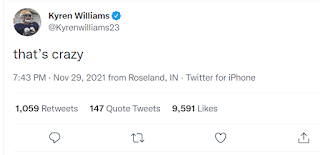 |
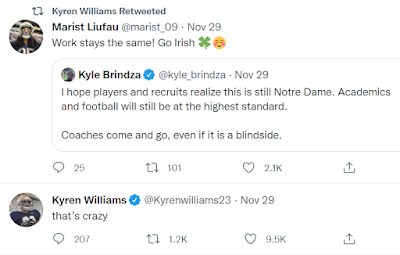
| Reaction by a star player |
Then, a day later, another bombshell: Brian Kelly, the coach at my alma mater, the University of Notre Dame, announced he was leaving to become the head coach at LSU. Again, a stratospheric salary: $9.5 million per year for 10 years guaranteed, with incentives that make it worth over 100 million in all. And apparently these deals come with additional perks, like cars, insurance, and travel allowances. Notre Dame is a private university, so we do not know his salary, but it was probably around $5-7 million. Kelly himself had once said that the Notre Dame head coach job was not a stepping stone; it is the pinnacle of coaching, a “destination job.” He had also
said just a week earlier that he was not leaving,
"… unless the fairy godmother comes by with that $250 million check, my wife would want to take a look at that first. I'd have to run it by her," Kelly said. But he had also indicated that he understood that to cement his legacy at Notre Dame, he had to win a national championship. This is something he was not able to do in the 12 years he coached there, from 2009 to 2021. Notre Dame has won a national championship 11 times, but not since 1988. In the 2021 season, he surpassed the fabled Knute Rockne in number of games won (105), and he is also the first ND coach to win 10 or more games in four consecutive seasons (though, to be honest, it is easier to do that now that teams play 12 or 13 games per season than it was when I was young, when there were only 10 games plus one bowl game each year. And until 1970, Notre Dame refused to play in bowl games, saying it interfered with student-athlete’s final exams. How quaint.)
Brian Kelly did take the team to the championship game in 2012 and to the playoffs in 2018 and 2020, and lost badly each time (14-42 Alabama, 3-30 Georgia, and 31-14 Alabama, though actually, in 2020 Alabama beat Ohio State 52-24 in the championship by an even greater margin, but everyone focuses on Notre Dame being “blown out” because Notre Dame has not won a New Year Six bowl game [Rose, Cotton, Orange, Sugar, Fiesta or Peach] since the 1993 season.)
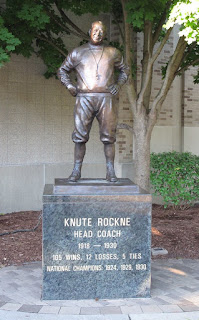
Brian Kelly knew that unless he won a national championship, no bronze statue of him would be erected outside the stadium along with the statues of Rockne, Leahy, Parseghian and Holtz. Early in the 2021 season, when he was about to win his 106th game, he said:
"I can tell you exactly where I sit in Notre Dame history," Kelly said during a conversation with CBS Sports this week. "The coach that won more games that hasn't won a national championship. That's where I'll sit."
So the fact that Kelly is leaving Notre Dame suggests he essentially decided he was not going to be able to win a national championship at Notre Dame (see pundits saying this here).
One can only wonder whether Kelly viewed Notre Dame’s academic standards as an obstacle to winning a championship. It is rumored that Lou Holtz left Notre Dame in part because the administration would not bend academic requirements enough. Many commentators note that recruiting should be easier for Kelly at LSU. Notre Dame recruits nationally, but athletes also need to be good students and there has to be a good match with the Notre Dame culture (which can be very conservative). Notre Dame’s graduation rate of 97% is also much higher than LSU’s 66% (which is in fact the second worst in the country).
Of course, the money is significant, but really, once you are earning even $5 million a year (and he’s been head coach at Notre Dame for 12 years, so has been earning big money for a long time), is the additional money really the main attraction? Athletic director Jack Swarbrick and assistant coach Tommy Rees each said that they think after 12 years, Kelly was ready for new challenges. While Kelly is considered a good coach, there will always be doubts about his talent until he wins a championship.
But I want to emphasize that I think a good coach does not just win games, but has to mold teenagers into men. He is a teacher. He has to help players develop to their ability, whether it is to contribute to the team or to go on to play in the NFL, and for life after football. Overall, Kelly was a good coach.
My friends in Asia are justifiably stunned at the prominence that sport plays in American universities. College sports, especially football and men's basketball, are major social activities and money-makers for many campuses. In fact, I once heard that then CUHK vice-chancellor (equivalent to university president) Lawrence Lau, an economist who came to The Chinese University of Hong Kong from Stanford University, tried to make sports more prominent and a focus for university community solidarity, but it failed miserably. CUHK students don’t wear CUHK t-shirts, either; there is no rah-rah "student spirit" and "school pride" of that sort in Hong Kong.
There are other aspects of the Brian Kelly story that are significant. First, one needs to understand that Notre Dame considers itself, and is widely viewed, as a special place. This is what makes Kelly’s departure so surprising. Skip Bayless is a TV pundit who said he was shocked by Kelly’s departure. He covered ND closely while a journalist for the Chicago Tribune, attending many games in South Bend and knows Notre Dame well. He said:
“It [Notre Dame] is a great place, I can’t tell you. We will talk about what Lincoln Riley said at his opening press conference about he’s going to make USC the Mecca of college football. To me, Notre Dame is still the Mecca, to me. It represents everything that’s great about college football, all rolled into one. It’s the movie Rudy, it’s “Play Like a Champion Today,” it’s those golden dome helmets that they wear, it’s the coolest gold that I’ve ever seen, it just comes off the TV screen and gets in your eyes, it’s so gold. The legacy, of obviously Rockne, of “play one for the Gipper,” all of it. There is no greater tradition than this one. I love my Oklahoma tradition, but woof, it’s not this. ... “He [Kelly] was made for Notre Dame, because he is Irish Catholic, he grew up in the Boston area, ...he was made for that throne there that is Notre Dame football.”
One thing that was shocking is that when Kelly announced he was leaving Notre Dame, his team still had a good chance to make the playoffs this year. As it turned out, Notre Dame ended ranked #5 on the following Sunday, and everyone knew this year’s team was young, so unlikely to be able to win the championship. But it was shocking that he would abandon his team just one week before they knew whether they would make the playoffs (only the top 4 teams make the championship playoff). He had to take the job right away because LSU needed him to make sure the players they had recruited stayed committed to LSU. Signing day when high school players commit to colleges is Dec. 15th. But Kelly knew he was abandoning his team when he left for LSU.
The rapid increase in college coaches’ salaries is crazy. “Craziness. In a period of seven days, we now have four coaches – Tucker, Riley, Kelly and Penn State's James Franklin -- making significantly more than the average NFL coach (average salary: $6.7 million).” College football has become extremely commercialized, with magazines focusing on high school prospects, coaches flying on private planes to visit potential recruits, the evolution of what is called “the transfer portal” that allows more and more so-called scholar-athletes to switch schools (like free agency in professional sports), and these astronomical salaries. In 40 states in the US, athletic coaches are the highest paid public employee in the state!
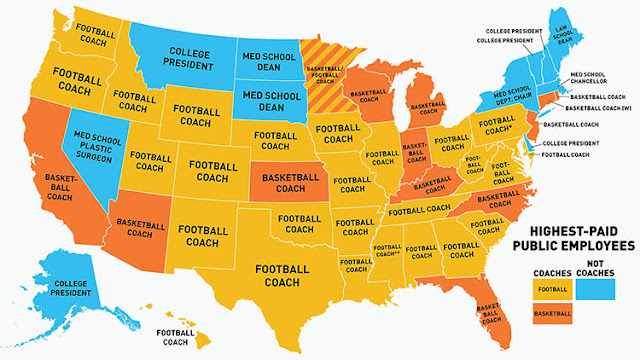 |
| Highest-Paid Public Employees according to Fast Company magazine. |
Some aspects of this commercialism may actually be for the better; the transfer portal prevents players from being “owned” like slaves by the team they happened to choose when they were 17 years old. (And the fact that over half the football players are Black makes this comparison very uncomfortably relevant.) Notre Dame tries in some ways to fight this tide and insist that athletes are students first, by, for example, not having athletic dorms. But in many ways, it is a losing battle; Notre Dame held out against a separate dining hall, but now has one. They used to prohibit freshmen from playing varsity, but that changed decades ago. At the same time, Notre Dame added to this commercialization when in 1990 they signed a television deal with NBC to broadcast all home football games, from which the university earns $15 million per year.
Increasingly, people realize the system is crazy. Pundits on Yahoo said Kelly’s move was “shocking” and the “latest example of sport gone mad.” The article in the NY Times said:
“If you equate it to college education, it’s insane,” Jackie Sherrill, the retired Texas A&M University football coach and athletic director, said of the industry and its soaring coaching deals. “If you equate it to business, it makes sense.”
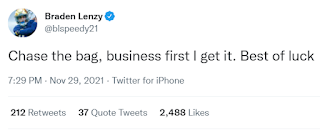 |
| A player's tweet accepting the business logic of the move |
In my conversations with some friends, I’m shocked that they simply accept Brian Kelly's move as normal, because he followed the money. I have a lot of problems with that, and it is not just because I’m nostalgic for a simpler time when salaries were lower. The idea that the value of a coach is whatever the market is willing to pay is wrong, because “the market” is not a pure market. This belief in “the market” as an impartial arbiter of value is an example of “
market fundamentalism,” a belief that fails to recognize how the market is shaped by laws, policies and ideologies. Coaches would not be paid so much if the universities had to pay the players, for example. And rules prohibiting players from switching teams also prevent a real market from emerging. Universities could also make a lot of money offering sexual services on campus (at least in states where sex work has been decriminalized). There are some things that are just morally repugnant and that we do not tolerate. Ten million dollar salaries for an athletic coach should be one of them. Just as CEO salaries in the US have gone through the roof since the 1980s (in a way that has not happened in Europe and Japan), so too have coaching salaries exploded (
see list here). There are many factors causing this explosion; one of them is the
Great Man Theory, which assumes one leader can make all the difference. Leadership is important, but even coaching takes teamwork, and the leader's role is often exaggerated.
I also object to these huge salaries for college football coaches because they do not fit with the mission of a university. Knute Rockne was a chemistry professor at Notre Dame. Coaching football was an extension of his teaching. He was paid like a teacher. Ara Parseghian retired in 1974 at a salary of $36,000, equivalent to $203,000 in 2021 dollars, also like a star teacher. Nowadays, football is a side hustle for university, one that brings in millions of dollars. And winning championships bring in alumni donations. Little by little, universities are turning into sports clubs that have universities on the side. I even know of young people (some are relatives) who choose to go to large state schools because they have big sports programs. (An aside: A Washington University in St Louis student compared the atmosphere surrounding the 2016 Presidential Debate between Clinton and Trump, which was held on campus, to a Division I athletic event, which the school does not have!) Forbes even ranks football programs like they rank companies and billionaires; Notre Dame’s football program is rated 8th in revenues and 5th in profits. What does “profits” even mean here, in the case of "non-profit" universities?!
“This “amateur” model of college sports yields $18.9 billion in annual revenue to universities and the NCAA, millions to coaches and athletic department officials, and essentially nothing to the athletes upon which the industry depends.” (LA Times opinion)
Notre Dame has benefitted tremendously from this commercialization, going from a small Midwest Catholic college to the #19 National University according to US News & World Distort Report. The football victories under Rockne and Leahy put Notre Dame on the map and made it the favorite of most Catholics and many others. Money from the NBC TV deal has allowed Notre Dame to give over 6,000 undergrads a total of $80 million in financial aid, plus scholarships for grad students. Because Notre Dame is a valuable brand, income from t-shirts and other gear has also been extremely valuable.
But the whole system rests on the free labor of players, who are only given scholarships. Some players are from families so poor that their parents cannot afford to travel to see their son play. Yet these young men generate over $1 million each for their universities. As a NY Times article notes (see original press release here):
“Professional-level payouts for college coaches are only possible because colleges and the N.C.A.A. illegally collude to directly restrict compensation for the mostly Black athletes so that the mostly white coaches and industry executives get to keep all the profits for themselves,” said Senator Chris Murphy, Democrat of Connecticut. “That’s shameful.”
The players are non-union, and at many schools (though not at Notre Dame), the school can cancel the scholarship if the players are injured or turn out not to be very good.
Many pundits heaped contempt on Kelly for abandoning his players before they even knew whether they would be playing for the national championship.(See one example here.) Dan Wolken of USA Today wrote:
For those who say you can’t blame Kelly for accepting a contract from LSU that is expected to be well north of $10 million per year, that’s bollocks. There is nobody to blame but Kelly for a classless, gutless exit before the kids he recruited to Notre Dame even know whether they’ll have the privilege of playing for a national championship.
Some of this is nostalgic idealism, like children finding out their teachers are paid a salary and don’t teach only out of love. But there is no doubt Brian Kelly’s reputation has suffered, perhaps unfairly. He was roundly mocked for putting on a fake Louisiana accent when he first addressed LSU fans at a basketball game (see viral video here and an ESPN commentator here who calls him “unlikeable”) and also for some supposedly cringeworthy dancing with a recruit.
The real problem is that after praising Notre Dame for so many years, his conversion to an LSU Tiger is a bit jarring and unconvincing, mercenary even. So maybe there is hope, since by criticizing and roasting Kelly, fans are insisting that football is NOT just a business. (Having said that, Tommy Rees has a very generous interpretation of Kelly's motives in this Red Line Radio podcast.)
Notre Dame football will be fine. Their new, 35-year-old coach Marcus Freeman was
mobbed ecstatically by the team when he was introduced to the players as their new coach on Dec. 3rd (
see video here), and most of the assistant coaches have decided to stay at Notre Dame rather than follow Brian Kelly to LSU. Tommy Rees told the team: "I love you guys. I love this place. I believe that we can win a national championship here, and I'm committed to doing everything we can to get to that point. This is where my heart is, and my heart is with you guys." (
Video here.) With a young, popular and energetic coach,
Notre Dame football is cool now. But the contradiction between money and college life is growing sharper.
Final point: These salaries should convince everyone that the anthropology of sport is not just some trivial topic barely worthy of study. Clearly sport, and American football in particular, is symbolically and economically very important in American culture. Both private and public universities are willing to pay obscene salaries to coaches, for athletes to play a game that, like gladiator contests, often leaves them with severe brain and other physical injuries. Why do we do that? From one point of view, this is as “exotic” and “irrational” and at the same time culturally important as other topics ethnographers have studied. The anthropology of sport deserves a more central place in the academy.
Key points:
Salaries of college football coaches have gone through the roof and are obscene.
Notre Dame’s football coach Brian Kelly left for LSU for a new challenge, and to win a national championship, perhaps realizing it would be difficult to do so given the academic standards of Notre Dame.
Brian Kelly abandoned his team when they still had a chance to play for the national championship, though this year’s team was not the strongest, and in the end, the team ended up ranked #5 so did not make the playoff.
College football has become extremely commercialized, though it is supposedly an amateur sport. The fact that these high coaches’ salaries are possible because of the free labor of mostly Black athletes should make everyone squirm.
The common view that we should accept what the market will pay as just a measure of a coach’s real value is an example of market fundamentalism, the belief that the market is impartial and always right. It also relies on the “Great Man Theory,” the ideology that one leader can make all the difference in an organization.
These high salaries also conflict with the mission of a university, turning it into a professional sports club that has a university on the side.
Notre Dame has benefitted tremendously from this commercialization, and has contributed to it, even as it presents itself as fighting for amateurism.
Brian Kelly’s reputation has been hurt by the move, which suggests there is still some resistance to commercialization.
Notre Dame football will be fine; the new coach is popular with players and most assistant coaches stayed at Notre Dame.
The anthropology of sport is not just studying a trivial game, but worthy of a more central place in the academy given the economic and symbolic important of sports in American society.