Showing posts with label St Louis. Show all posts

Thursday, November 07, 2024

Election 2024

I again served as an “election judge” (AKA poll worker) on Tuesday. We serve in pairs, one Republican and one Democrat, each needing to initial the request for a ballot on a poll pad and then to initial the ballot. The system is designed to make it difficult if not impossible to cheat. My Republican partner seemed to refute a lot of MAGA rhetoric when he told one voter that people who think there is cheating in voting have not seen how the system works.

Still, there is some oddity in the system. In Taiwan, there is a ritual of showing everyone that the ballot box is empty before they shut the box and seal it with paper seals to prove there is no tampering. In our case, we just set the scanners and ballot boxes up, and no one made a point of showing everyone that the ballot boxes were empty before they were set up. We locked the ballot box but there was no seal on the box (but the boxes were never left alone). Seals were placed on the ballot bags after the voting was done. And even though we put our initials on every poll pad request and every ballot, sometimes my initials were unrecognizable, the result of doing it over 400 times, sometimes reaching over at an odd angle.

Missouri started requiring a photo ID to vote in the 2022 mid-term elections. This election, I would estimate we turned away about 2-3% of voters because they did not have a photo ID. We still bent the rules; when people said that they had moved out of the county and into St Louis City but were still registered in St Louis County, we pretended we did not know they had moved and let them vote with the ballot from their old address. Several of them came to us frustrated because they had tried to vote in the City but, of course, they were not registered there, so were sent to the county to vote. So they came to us, sometimes with a photo ID that had their new St Louis City address, and we found them still in the county’s registration system. I was pleased to see that the two Republicans near me allowed these people to vote. They seemed to feel it was more important that people should be allowed to vote than to stick to the rule that you must vote where you currently live. And because most of these voters were Black, and so most probably Democrats, I found it significant that the Republican election judges, who were white, were not being strict and preventing people from voting, because though Republican legislators justified the photo ID requirement as a way to assure the integrity of voting, Democrats argued it was a way to suppress the vote of poor people. 

And indeed, not everyone has a driver’s license. At my polling place in Normandy, MO, we saw many people, perhaps 15%, who used a learner’s permit or nondriver identification cards as an ID. We also had to turn away people who said they were registered to vote in St Louis County but who had an out of state ID. Sometimes we were able to allow them to fill a “Provisional Ballot”, but we know most of those will not be counted. (On top of everything, the form is long and at least one person forgot to sign at the very bottom, assuring that their vote will not be counted.) Altogether, I would estimate about 4% of people we saw were not able to vote.

The strange thing is that though the requirement is for a photo ID, we are NOT required to, or instructed to, check the picture to make sure the person is indeed who they say they are. It is enough for the voter to click “accept” that the name and address is correct, and then sign on the poll pad. The system is still based on trust that the voter is who they say they are, and the picture is not used.

Among the weird cases I saw was a Vietnamese-American immigrant who came to vote, but the database showed he’d already voted by absentee ballot. We told him this, and he looked puzzled, and said, smiling, “Oh, yes, so I can’t vote now?” He was elderly (but not obviously demented), so perhaps just a bit confused, and maybe forgot he'd voted. Another case was a young man who turned 18 on October 14 and had registered, to vote, but the database said he was ineligible. He and his mother were not clear exactly when he registered to vote; apparently he registered on or after his birthday, but voters needed to be registered by October 9th.

The only good thing about the results, from my point of view, is that the results were clear, and we did not have a close result or a Harris victory that would have resulted in attacks on the democratic process itself. Nevertheless, based on what Trump has said, I fully expect many challenges to the democratic process over the next four years, and am not sure our democratic republic will survive.

The voters have crossed the Rubicon. This phrase refers to Caesar’s crossing the river in Italy that marked the boundary between southern Gaul and Italy proper. The Roman senate had told him to disband his army and return to Rome, but he crossed the boundary with his army, which meant he was leading an insurrection. Entering Italy proper with his army was a capital offence, and Caesar’s officers also committed a capital offence by following his orders even though he did not have legal authority in Italy. Caesar won the resulting civil war with Pompey, thereby becoming dictator for life and making the charges of treason moot. Voters in 2024 may have wanted change, despite a felony conviction and many other serious charges, despite his leading an insurrection on January 6, 2021, and despite warnings from many who served in the previous Trump administration that he is unfit for the office. The voters have elected him the 47th president and thereby wiped away all charges against him.

Let me be clear: I do not want Trump assassinated like Caesar. I want him to live so he and the public see the chaos and problems that his policies will cause.

In 2021, Trump’s insurrection failed. He has famously said he will be dictator for a day; we shall see if it lasts just one day. Especially worrying are the arguments for an “Imperial Presidency”  made by some Republicans and Project 2025. In any case, it is astonishing that a people who proudly claim to be free voted for someone promising to be dictator, even for a day. Octavian was known as “Augustus” and not dictator or emperor; he was smart enough to keep the names and appearances of a republic, even as he ruled as an emperor. Will the USA turn into a dictatorship, in fact if not in name?

There is much that is puzzling in this election. It is puzzling that while the economy is in good shape according to economists ("The Envy of the World" according to The Economist) and official figures, voters in polls said they think the economy is poor and was better under Trump. It is puzzling that voters blame Biden for the 2021 inflation, even though inflation was worldwide, is now gone, and it is the Federal Reserve not the Biden administration that was probably slow in responding to inflationary pressures. In addition, wages have risen more than inflation.

It is puzzling that despite Missouri voting overwhelmingly for Republicans (58% to 40% for Trump, and 56% to 42% for Hawley), voters approved several progressive referenda, one a proposition to raise the minimum wage and to require sick leave (58% in favor) and another a constitutional amendment (Number 3) to protect abortion rights (52% in favor).

Misleading lawn signs on Proposition 3
It is tempting to blame money for election outcomes one doesn't like, but it is not that simple. Republicans who are upset at the Missouri abortion vote blame their loss on the out-of-state money spent to support that vote, even though public opinion polls show abortion rights to enjoy majority support (one pre-election polls had shown 52% in favor and 14% undecided). In fact, Josh Hawley and the Republicans tried to muddy the issue by claiming in their ads and lawn signs (see photo) that the amendment would pay for child sex change surgery, which is a red herring. It will be interesting to see what the supermajority in the state legislature decides to do to go against the will of the voters.

The fact that Trump’s contradictory promises, violent speech, and bombastic persona managed to attract a majority of votes is very depressing. We live in such a siloed media environments that most voters believed the economy was bad (when it was not) and that the Biden administration did not do anything for them (despite his major infrastructure bills). True, part of the problem was poor messaging from the Biden administration, but our media environment, without the fairness doctrine, makes it hard for voters to understand issues with any depth or nuance.

"Politically incorrect" door in Grafton IL inspired by Trump
This election has revealed a hateful, narrowminded aspect of American society that I thought we had left behind. This is the America that massacred Native Americans, that enslaved Africans, that invaded and colonized Cuba, Puerto Rico and the Philippines, that put Japanese-Americans in internment camps, and that turned away the German ocean liner St. Louis that had sailed from Hanover in 1939 (254 of the 937 passengers ultimately died in the Holocaust). We have returned to the America hostile towards immigration, foreign trade and foreign entanglements, and as The Economist notes, “In the 1920s and 1930s that led to dark times. It could do so again.” In the context of the fracturing of the neoliberal order  (see 2022 book by Gary Gertle), this election has led voters to “throw the rascals out.” This is perhaps understandable, since neoliberal policies screwed them, but the rascals they have voted in are just venting, and not offering real solutions. As The Economist notes, Trump is not even a conservative in the old sense: “He has completely reshaped American conservatism, forcibly converting it to nativism, mercantilism, welfare-statism and isolationism.” But Trump is not new; he has simply awakened an ugly side of America.

Working with the other election judges, half Democrats and half Republicans, was actually very smooth and pleasant. There was no hateful speech, no partisan posturing or argument, no conflict. My Republican partner made every voter smile a bit when he showed each voter their name and information on the database and asked them, “Is this who you’ve always wanted to be?” or “Is this who you think you are today?” Most people smiled at this. He also commented that at least after the polls closed, we would not have to watch all the political ads, which everyone could agree with, even if it meant something different for people of different political persuasions. Face to face, there was none of the demonization that we saw on TV and at Trump rallies. All the Republican election judges at my center where white (though their Republican supervising election judge was Black), and all of them were very respectful and kind to the majority Black voters, so there was no overt racism.

I think back to my fieldwork in Taiwan in the 1980s, when some of my interlocutors told me that the Taiwanese only had conflict during elections. This was under martial law, so I was a bit skeptical of this statement that seemed to simply justify one party rule and authoritarianism. But there is some truth to it. Face to face, the Republicans and Democrats were able to get along and work together. Granted, we did not have to draft a law on abortion or set the minimum wage. But the Republicans seemed to be decent people. I just cannot understand how they, and so many others, could vote for a person like Trump.

Friday, April 07, 2023

Election Day, 4 April 2023

I volunteer to serve as an election judge for elections because I think it is important to help assure election integrity. We get paid, but no one works the 15-hour-day plus travel time for the $240. I also do it because it gives me a chance to get out of my social bubble and to meet other people. Sometimes, however, I end up feeling like I should have stayed in my bubble.

This week’s local election in St Louis County had very few items on the ballot. Voters can vote anywhere in the county, so everyone’s ballot can be a bit different, depending on where they live. A few places had mayor’s elections, or school board election, but the ballot for many people only had one question: 

Proposition M

Shall St. Louis County impose an additional sales tax of three percent (3%) on all tangible property retail sales of adult use marihuana sold in St. Louis County, Missouri?

□ YES

□ NO

I served in a small town called Black Jack, which is a fairly prosperous African American suburban town in “North County.” We were set up in a school gym. Only 68 voters came during the 13 hours the polls were open, which meant we had a lot of time to sit and wait. That means it cost over $30 per vote just for the cost of election judges at that polling location. Sixty voters voted absentee, so turnout from my polling place was nine percent, half the overall county turnout of 18 percent. 

The low turnout is understandable; why bother to vote if there are so few items on the ballot? It is absurd that we have so many elections (often four per year, counting primaries), but it is impossible to change because politicians know that certain items are easier to pass on elections like this, when few people vote, or on presidential elections, when many more people vote, so different groups have an interest in keeping the status quo.

One of the rules for election judges is that we are not supposed to discuss politics. The trainers at the Election Board remind us of this before every election, and yet, people can’t keep their mouths shut. Early in the day, someone started saying something political and our Republican manager commented that we should not talk about politics. Everyone agreed, though Bob, another Republicans poll judge, commented that though we can’t talk here, we SHOULD talk more, because people mostly agree, at least 80%, he said. Mary, a white Republican poll judge, agreed, and added that we are all God’s children, so are basically alike. (I said nothing, and could not help but wonder if my Black fellow election judges agreed, but they also said nothing). Later, as I was standing with him near the scanner, a young Black judge who is Republican said about Proposition M, “Why would anyone vote to give politicians more money so they can just waste it?!” I did not know how to reply without getting political so I just ignored him and said nothing.

Interestingly, two voters commented, when they saw that their ballot only had Proposition M on it, “Of course I’m going to vote “Yes”! I don’t use it, so let those who do pay the  taxes!” So even this seemingly innocuous proposition elicited partisan polarization, with conservatives against taxes and liberals in favor of taxes.

In case you were wondering, Proposition M passed, with 65 percent voting "Yes."

We were 8 poll judges, four Republicans and four Democrats, present for nearly 15 hours, and since only 68 people voted, we had a lot of free time. It was a bit like we were characters in the movie The Breakfast Club (except that we weren't all friends at the end), or maybe more like the characters of Murder on the Orient Express, which was being performed as a play this week.  

There was Mary, who talked the entire time. She was insufferable. She was from the western rural part of the county, and mentioned that she had lived many years in Mississippi, as perhaps we could tell from her accent. She told us she ran a mission and sold Mary Kay products, and had been in India for 26 days. No one asked why she went to India, but she proceeded to tell us she was there saving people. The last two hours, she literally read the manual and asked us "pop questions" as she read along. "Did you know ‘wearing apparel specific to a candidate or issue’ counts as electioneering?" And 30 seconds later, "What is the correct order for setting up the poll pad?" I made a point of working the scanner, which was at the other end of the gym, so I could be far away from her, where I could only hear her in the background and could read my book.

Then there was Bob, originally from the Bronx, a graduate of the Merchant Marine Academy recently retired after working 40 years in insurance. Hearing I was an anthropologist, he said social scientists will probably be studying the pandemic for decades. I replied that, actually, after the 1918 Flu, people mostly forgot about it, and that there is evidence people are now also ready to move on. He somehow started saying that there was no way Covid came from the market in Wuhan, and that Covid was genetically created in a lab in Wuhan because it was too precisely designed. I did not know how to reply, since he was so vehement, so I cut the conversation off abruptly by telling him he was misinformed and went back to reading my book. 

Then there was Republican manager, a white woman about 65 years old, who was very competent and in charge. She managed to make everyone stick to the rule that we not start packing up until AFTER polls close at 7:00 pm. (In previous cases, some people always want to start packing early.) The Democratic manager was a nice Black woman, perhaps 10 years older, who for some reason gave each election judge some cream. She gave me a small vial of Dove face cream for men. Then she asked, “Mr. Joe, do you have bad joints or arthritis?” She said she had some cream from her church that worked very well. I told her I did not need it (yet).

One pair of judges were a kind couple. The husband seemed a bit addled; it took him a while to remember the process for checking people in and producing ballots. He had brought a box of donuts, but they were dated “made March 26, sell by March 28,” so were a week old and stale. Only two of the six were eaten by the end of the day. His wife greeted every voter with a loud, “Welcome to the poll judge sweepstakes! Come on down!” followed by a bellowing laugh. Most people coming in seemed to be amused.

And then we had the young Black Republican, who spent most of the day listing to his iPods, and then suddenly announced two hours before the end of the election that he had to leave. (Hm; I wonder if he’ll get paid.)

At the risk of seeming to be a misanthrope, I have to say the experience was not uplifting. The low turnout, the inability to avoid politics, and the confrontation with partisanship and China-bashing all left me discouraged. Tired after the long day, I came home to make dinner and watch a baseball game. To make matters worse, the Cardinals lost 2-5, losing the third game in the series and thus getting swept by the Braves.

Sunday, August 14, 2022

Observations on Working as an Election Judge on the Aug. 2nd Primary

The people who serve as election judges work part time, only on election days. Most are retired; a few are elderly, some are stay-at-home moms. I worked with a woman, who I’ll call Pam, who has lived over 50 years in the neighborhood, and knew many of the people who came to vote. She herself was a Republican, but many who came to vote requested the Democratic ballto. They would say they wanted to go to Pam, so would wait until her position was open. Neighbors, fellow church members, and even her daughter came to vote at her station. Later, while fellow election judges were teasing her about knowing so many voters, she mentioned she also knew the man who had just come in. Pam said to him, “Your wife came earlier.” Him: “Yes, I heard.” I later figured out he was her son-in-law! My colleague was the nicest, kindest person, and wore a perpetual smile. I’m sure she made a good impression on most voters.

Earlier, while we waited for polls to open, I spoke with another judge I had met working the local election last April. He told me that he once worked in polling a place where everyone was very nasty. He said if the manager saw a voter lingering “too long” at a check-in station, he would yell, “What’s going on there!” That is ridiculous because it is not uncommon for there to be an issue with the voter’s ID or registration. He said another station was staffed by two older and very short ladies who were not visible to voters in line, because they were so short and hidden behind the poll-pad and printers. They would yell, “NEXT!” and get angry that voters did not step forward, but he said people could not even tell where the voice was coming from. He says he told the Election Board that he would not serve if he had to go back there. That is how he’s ended up at my location.

We ourselves had one new election judge who was described by a voter as “alarmingly perky.” She said “HELLO!” and “WELCOME!” to everyone who entered as if they were long-lost friends, and was always laughing and smiling. She was very pro-active and helpful, but sometimes intervened where she was not needed and thus complicated matters (like causing a queue for us to print out ballots, which can cause problems if we’re not careful to give the right ballot to the right voter, because every voter’s ballot can be different, since the county allows voters to vote at any polling place in the county.) But Miss Perky was very organized and pro-active, and got us packed and ready to go home just 30 minutes after polls closed, by starting the tear-down process early and assigning everyone tasks (though technically that was not really her job). It takes informal leaders to make individualistic Americans work as a team.

Early in the morning, while I was managing the scanner (standing aside so I could not see the ballot, but giving voters instructions on how to scan their ballot: “Insert it in any direction, except sideways!”), a woman stood in front of the scanner and called out, “How do I know that this machine is not going to change my vote? Is it connected to the Internet?” I explained that it was not connected, that we had to take a USB drive out and bring it to election headquarters at the end of voting, and that the original ballots would be available for checking. She continued on, saying that she knew that votes had been changed by machines in other states, though not in Missouri. The Republican judge working with me looked at me with her eyes open wide in shock, and also added a few reassuring words to the voter, but after the voter left, she commented, “Oh my goodness, some people….” She did not have to finish the sentence.

I was surprised by the number of people who complained that we did not offer computer voting (that is, voting on a touch screen). Sometimes, if I was not busy, I explained that this system was more secure, because each voter marked the paper ballot which remained as a record, and a machine scanned and counted the ballots, whereas the other system was viewed as less secure because you voted on a machine which created a paper record that you could not see. About five voters complained that we were going backwards, that this was not modern, and at least two of them were registering for Republican ballots, which surprised me since I would have thought Republicans would be in favor of more ballot security. The most vociferous complainer was a man with a police shield hanging on a chain around his neck, and a gun (looked like a Glock, but I don’t really know guns) in his holster on his right side. He was not in uniform; in fact, he was wearing an irreverent T-shirt that read “Breaking News: I Don’t Care” which I found a bit disconcerting on a police officer with a gun. Guns are not allowed in the polling area, but my Democratic manager claimed officers wearing a badge were allowed to carry a gun at all times and everywhere. He said that in any case, he does not argue with police. I told him I was not arguing with the police, but that was why I raised it with him.

Very few people tried to vote with anything but a driver’s license. I saw one woman vote with a Wisconsin driver’s license; I don’t really understand why that is legal, since to get a Wisconsin license, you need to be a Wisconsin resident, but to vote in Missouri you need to be a resident of Missouri. That issue is above my pay grade. Nobody tried to vote with a bank or utility statement, which is still allowed. I saw two people vote with a paper “Board of Elections ID” which did not have a photo on it; we had to tell them that in the November election, they would not be allowed to use that as a form of ID. Both of them knew that already, suggesting they were choosing not to use their driver’s licenses, for whatever reason. The state legislature has made voting “safer” according to Republicans, or “more difficult” according to Democrats, by requiring a photo ID.

One woman very apologetically said she was going to cause us trouble, and pulled out a “safe voter” ID. She said she did not know how it would work since this was the first time she tried to vote with it. This is for voters who need to hide their residence from stalkers or estranged partners. I had actually just learned how to handle this type of voter by reviewing the training video the day before, and it was no problem. The video said that there were less than 100 such IDs in St Louis County, but that it was good to know about it just in case. That turned out to be true. I was glad to be able to tell—and show—this voter that it was not a problem.

One of the more disappointing cases was of an elegant African-American woman, perhaps 25-30 years of age, first said she wanted a Democratic ballot, which we printed for her. Most minorities picked the Democratic ballot (except the Vietnamese, who all chose Republican), so thus far, she fit a stereotype. But then before she had even left our desk, said, “Wait, I want to vote for Vicky, because she is the only candidate I know, but I don’t know what party she is in.” She also did not know Vicky’s full name. We established that she meant a senate candidate, and so it must have been Vicky Hartzler. So we spoiled the Democratic ballot, and printed a Republican ballot for her. She brought to mind the criticisms of people like Walter Lippman that most people are not smart enough to know how to vote. I wonder what made her want to vote for “Vicky,” and how well informed she was of Vicky’s extremely conservative views, given that she did not even know what party she belonged to. Ignorant voters like this make decisions based on media images rather than policies, and can tip election results in our closely balanced and very polarized electorate.

Voters are also not allowed to wear clothes or hats that promote a candidate or party. At one point, while we were putting up a sign on our door and could see outside, we saw a man approaching with a t-shirt that said “Trump Lost” in large bold letters. We had a quick discussion and decided that since Trump was not on the ballot, that shirt was not a form of prohibited electioneering.

Voters have to sign on an electronic screen with a soft tip on a pen, and use the other end of the pen—a black ball-point—to mark the ballot. Nearly everyone finds this confusing. They use the wrong end to try to sign, and then they can’t figure out that you need to twist the pen to get the ball-point to come out. And nearly everyone feels foolish for being confused. It is a classic example of something that is easy once you know it, but can fluster you the first time. Fortunately, all of us judges were patient with the voters; I suppose we’ve also been there, done that. Nearly everyone leaves the process embarrassed.

The county results for both parties mirrored results across the state. No major surprises. The beer heiress Trudy Busch Valentine won the Democratic nomination for senator, despite not debating her main opponent or taking any press interviews. St Louis Public Radio made the Democratic primary look like a three-way race between Valentine, Kunce and Toder, but Spencer Toder did not raise much money and ended up getting less than 5% of the vote. It is clear that the Democratic Party establishment mostly was alarmed by Lucas Kunce’s populism and thus got behind Valentine, even though many commentators noted that only someone like Kunce has a chance in Missouri. Now, no one thinks the Missouri senate seat is in play.

In the Republican Senate primary, the establishment also worried that Eric Greitens (who is always described as “the disgraced governor”) would win the primary but be unable to win what should be a safe Republican seat. A PAC was formed to attack him, and polling showed that within one week of the PAC starting to show TV ads highlighting his ex-wife’s claims of physical and mental abuse, his numbers tanked. Eric Schmitt, who filed aquixotic suit against China for causing COVID (in case you were wondering, it did not work), and sued school districts who tried require students to wear masks, was able to get a plurality of votes in a crowded field. People who knew him 10 years ago say he is a good man, but to win the Republican nomination he has had to veer far to the right, as can be seen from his victory statement, where he still harps on fighting socialism and "Critical Race Theory." One of the more dispiriting criticisms against him is that he tried to create a logistics hub at the St Louis airport for trade with China--that is being portrayed as somehow being pro-China and disloyal. 

Screenshot from KMOV news broadcast
The only odd result on the Republican side was the loss by veteran politician Shamed Dogan in the race for the nomination for St Louis County Executive. He was defeated 44%-56% by a candidate who did not raise any money or campaign, and who even Republican officials say they don’t know and have never met. This news report expresses the surprise and mystery over her victory, and notes that her blog indicates she believes there are microchips in vaccines, and believes QAnon and global conspiracy theories. The obvious reason for the surprise result is race: Dogan is Black, and Pinner is White. Amazingly, KMOV and other news reports fail to note this—maybe they don’t have to; everyone already knows.

The best news from Missouri is that there are efforts to change the primary system from a party primary to non-partisan primary, as has been introduced in California and Washington state. That would make it less necessary for candidates in each party to appeal to their vocal and most committed fringe. In heavily Democratic areas like St Louis, the primary effectively decides the winner. A non-partisan primary would take the two most popular candidates of any party, and have them run against each other in the general election. It would make both the primaries and the general elections more interesting, more fair, and more representative of public opinion. In Election Judge training, they told us not to ask voters which ballot they want, but to turn the poll pad around so they can see the choice of parties, and they mark the poll pad with the stylus. They recommended doing this because many people don't like to have to announce what party they belong to. That suggests that a non-partisan primary would be popular with the public. 

Wednesday, July 27, 2022

The July 26 Floods in STL

Many friends have reached out to check that we are OK, given the news coverage of the flooding in St Louis, so I thought I’d write a bit about our experience. (BTW, it is a sign of America's influence [hegemony?] that people from all over the world know about flooding in my city, but floods have to be very serious before we in the US hear about it.) (You can see some pictures from weather.com here  from the National Weather Service here.)

First of all, I slept through the entire storm, which started late at night. So either I sleep very soundly, or, more likely, the storm was not very noisy. But I did wake up to find an emergency notice on my phone (which had not rung because it was in “Do Not Disturb” mode) saying to stay home because of flooding on many roads. My wife spent the day working from home.

Early in the morning, my wife had gone to the basement to exercise, only to find water pouring from a small hole in the wall. 


Our basement is not finished and has drains in the ground, so the water drained out or collected in shallow puddles that we were able to clear out. At first, I wanted to use a mop, but we don’t have one. Then we realized we have a “wet/dry vac” (AKA “shop-vac”, which is a brand name--that company announced it was closing down in 2021, but then was bought by a Chinese company), which is like a vacuum cleaner that can pick up water. This is a pretty standard American home appliance that I don’t think is very common in Asia. Worked great.

Our house is not in a flood-prone area, but when there is this much water in the ground, some water can seep into the basement. While we were in the basement, I also heard our sump pump go off for the first time ever; glad to know it actually works. (Sump pumps are water pumps placed in the lowest place in a corner of the basement to pump out into the back yard any extra water that collects from below). It only stayed on for a few seconds. Since the previous owner’s sump pump had been broken when we bought the house, and she had not noticed it, I was not sure we even needed one, but I guess we do.

From www.weather.gov/lsx/July262022Flooding


Previous floods that I know of have occurred because of rising rivers, with the rain and melting snows coming from much further north. In this case, we were victims of a very strange weather pattern. You can read more about it at the government weather website here, but basically, the rain was trapped between weather patterns to the north and south of us, so the rain, instead of passing through as a vertical band from west to east as usual, became what they call a “train” (as in railroad train), with constant rain for over 6 hours. That is why we were dumped with 6 to 12 inches of rain in about 15 hours. You can see the moving radar map at theweather.gov website. 


As always, it is the poorer neighborhoods that suffered most. They tend to be in lower areas. And in our town, there is a river, River Des Peres, that has been channeled and actually goes underground through Forest Park. Except that with so much rain in such a short time, it could not drain fast enough. It ended up filling the train track of the MetroLink, our subway system.


In another neighborhood nearby, the water reached up to a stop sign! The weather service said that we had the equivalent of all of July and August's rainfall in just one day, and of course we broke all records for precipitation. It may not be due to climate change, but it is not normal. So yes, we are fine. But maybe the earth is not.

Sunday, July 24, 2022

Athletes Are not Heroes


One of the impressive aspects of the St Louis Cardinals baseball organization is their farm system, meaning the organization they have in place to select, train and prepare their young players for the Major Leagues. As a result, the Cardinals are never a bad team; they are not like the Marlins or Cubs, who have sold all their good players once they win a championship. Being consistently above average maintains fan interest in the team: St Louis has been second or third in attendance in the National League in most years, which is pretty good for a small-town market.

 The Cardinals’ two stars, however, are actually on the team as the result of trades. First baseman Paul Goldschmidt was traded from the Arizona Diamondback in 2019, and 3rd baseman Nolan Arenado came from the Denver Rockies in 2021. They were both named to the All-Star game last week, and are having phenomenal seasons. Goldschmidt is batting .333, and Arenado .299. Both are outstanding defensive players, with Arenado making unbelievable off-balance throws all the way to first base.

Equally important to me, both are humble and team players. When Goldschmidt had streaks of 25 games with a hit and 46 games on base, he repeatedly told journalists that he did not care about these personal accolades and that all that mattered was that the team won the game. Both seem to be team players.

So it is with great sadness and disappointment that I read today (also here) that both Goldschmidt and Arenado will not be traveling with the team to play against Toronto because they have not been vaccinated. Canada requires all people who enter the country to show proof of vaccination. They will forfeit their pay over those two games, but given their importance in producing runs for the team (a desperate need for the team), they will sorely be missed.

But what disappoints me is not that the Cardinals will more likely lose the games, but what it says about the players. The Cardinals did not give an explanation for Goldschmidt’s vaccine refusal, but apparently he’s an evangelical Christian, so perhaps he’s influenced by that community’s vaccine skepticism (though Tommy Edman is also an evangelical, and is vaccinated). In Arenado’s case, the team president, John Mozoliak said Arenado “was hoping to begin a family with his wife and for him it was a personal decision, and we honor that.”  Of course, there is no evidence that getting vaccinated against Covid has any effect on fertility or a baby.

I believe in being civil and polite, so try to respect other people’s opinions. But I always struggle with how to react to opinions that are illogical and/or unscientific. I do realize that today’s scientific consensus may turn out to be wrong, so we cannot be doctrinaire about science. But how are we supposed to react to people who thumb their noses at not only at science, but also at the rest of society, because by not being vaccinated, they undermine “herd immunity.” They are making their bodies available for the Covid virus to spread and mutate (hence Canada’s immigration rules). At what point do we start condemning people for their irrational and anti-social beliefs?

They will both be penalized financially. “Arenado will forfeit $384,615 of his $35 million annual salary for the two missed games, while Goldschmidt will lose $285,714 of a contract that pays him $26 million in2022.”  I respect people who stick to their beliefs despite financial costs. But in this case, given that there is no evidence to support their skepticism (but plenty of political misinformation and pseudoscience), how do we balance respect for other people’s beliefs with an insistence that the truth matters, and that social responsibility is important?

My respect for the two of them has plummeted. This is a reminder of why athletes are poor role models: they are lauded for performance in a sport, and that has little or no bearing on other aspects of life. They may be famous, but they are not heroes. They may even be knuckleheads.

Monday, July 12, 2021

St Louis' 4th of July Parade and Civil Religion

Corvettes on parade

On Saturday July 3rd, we went to the St Louis "America's Birthday Parade." Parades are common across cultures, and often they are a way for a community to emphasize and build up its identity. Americans have been celebrating Independence Day with parades since shortly after the Revolutionary War. But nowadays, parades do not attract the same crowds as in the past. This year's parade certainly was affected by Covid-19, though no one there was wearing a mask, even though there were plenty of children too young to be vaccinated. I suppose the people who are cautious enough to wear a mask did not attend. The St Patrick's Day parade in March had been cancelled because of Covid, so the Irish community brought their giant inflatable leprechaun out for Independence Day. 

Sparse crowd on Market Street
I was struck by how similar parades are cross-culturally. Each "troupe," be it a band or a float or a balloon, was preceded by a banner that named the group in the procession. A decade ago, I saw a neo-Medieval procession to a palio-like horse race in Ferrara, where they also had banners and bands leading each team. Like religious processions in Hong Kong and Taiwan, St Louis had a variety of bands and music, as well as floats, and displays of dancing and athleticism. No shamans in trance in St Louis, but there were athletic young girls doing flips going down the street, and very energetic dancers. 
St Patrick's Day Parade Committee banner


Banner in front of band, Ferrara 2010

Banners and fa pau in Shau Ki Wan, Hong Kong


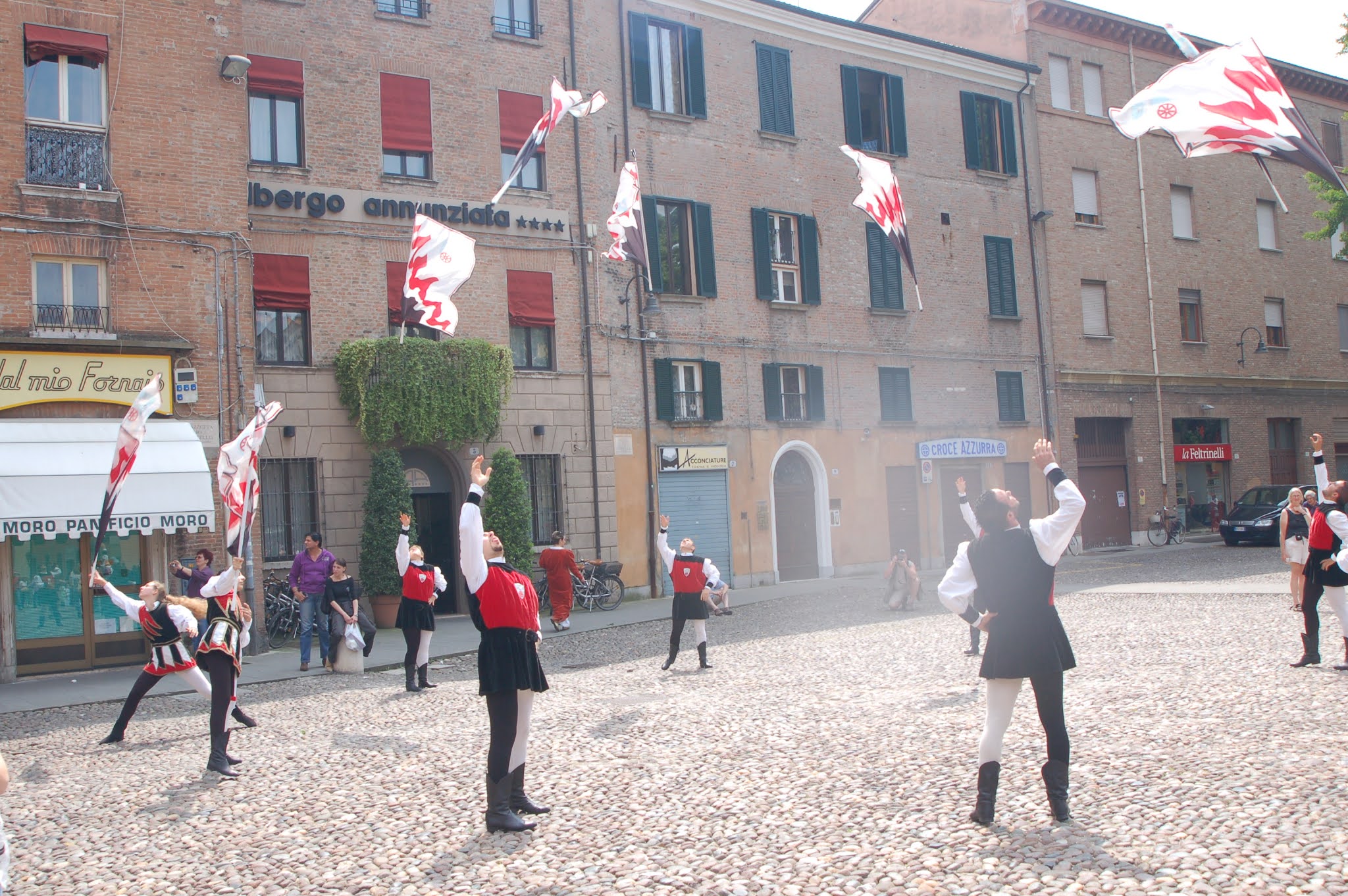
These flag handlers reminded me of the flag acrobats in Italy, though in Italy they throw the flags in the air and catch them (usually) on the way down.
Flag handlers, Ferrara 2010

Music and bands are nearly universal in parades. Here the marching bands were mostly high school bands.

Some of the bands are on floats.
Paddlewheel boat float

Amusing "ambulance"
Float from local Chevy dealership
And this being America, there are many cars.

Patriotic Chargers
One of the more interesting parades in the anthropological literature is a parade that used to be held by the Tang lineage in the New Territories of Hong Kong. The Tangs were the big landowners of the Yuen Long area. They paraded along the boundaries of their territory. Their purpose, from a political point of view, was to show other lineages, and their tenants in outlying villages, how powerful and numerous they were.  I did some brief research in a village that was located next to a small Gun Yam (觀音) temple that belonged to the Tang, a place they would visit annually on their parade. (This is described in a book chapter by James L. Watson entitled "Fighting with operas: processionals, politics, and the spectre of violence in rural Hong Kong.") These parades are a bit like the way dogs mark their territory. And they are also reminiscent of the Unionists' parades celebrating victories over Irish Catholics in Northern Ireland.

Interestingly, the Independence Day Parade in St Louis has a somewhat similar political origin. The current parade began as part of a "Veiled Prophet" parade. The Veiled Prophet Organization was a club for the elite men of St Louis. It was founded in 1878, a year after white and Black workers held a major strike that shook the city. Once the strike was broken, the elite sought to heal the wounds, but on their terms. The Veiled Prophet Organization held a debutante ball and a parade, which essentially expressed who was in charge of the city. People have protested against the Veiled Prophet for years, claiming it was elitist, racist, and sexist (see 1969 article on protests in the St Louis Post Dispatch and a 2014 article in The Atlantic). Just last month, Ellie Kemper (an actress from Missouri) was criticized for having participated in the debutante ball when she was 19 (she was crowned "Queen of Love and Beauty") and she apologized. (Vanity Fair had a good analysis here.) The Veiled Prophet Organization has adapted and changed over the years, and the Veiled Prophet Parade that used to be held at the time of the Ball in October has become a "Fair St Louis" parade over July 4th. 

In general, I find that most people who did not grow up in St Louis are shocked at the Veiled Prophet as a cultural institution, but those who grew up here or have lived here a long time take it as normal, simply part of the culture. There is so much that could be said about the Veiled Prophet. Maybe some other day. Right now I want to focus on the "America's Birthday Parade" and on the custom of parades in general (realizing that by doing so, I'm whitewashing the role of the Veiled Prophet in St Louis).

I had never noticed that people hand out candies to children along the parade route, but I saw this in St Louis and then found a picture of the same practice in my files of Hong Kong's Shau Kei Wan parade for Tam Kung.

Of course, these similarities between religious and secular processions are not mere coincidences, but are evidence for the theory that nationalism is the "civil religion" of the United States. This is the theory that rituals like Thanksgiving Day, 4th of July parades and fireworks, and the singing of the national anthem and reciting of the Pledge of Allegiance are ways Americans create a common understanding of who they are. These secular rituals are necessary because no one religion unifies the country. 

And, furthermore, the similarities also suggest that what we label "religion" is really not a separate domain at all, but is simply one form of symbolic thinking and ritual behavior that all humans engage in. This is a growing argument in the anthropology of religion and in religious studies, which sees the Western definition of religion as culture-bound. Indeed, Chinese did not have a word for "religion" until about 1900, when the neologism zongjiao å®—æ•™ was introduced. Of course, Chinese had all sorts of rituals and ideas (e.g. ancestor worship and the emperor's offerings at the Temple of Heaven) that Westerners called "religious" (actually, they called them "superstitions," but that is another problem), but only in the West, where Papal authority was separate from the "secular" authority of emperors and kings, did a notion of religion develop.

This is a big topic I hope to write about in the future. In the meantime, it helps me understand my local parade as a ritual of integration, and historically as a display of power.

Monday, March 16, 2020

Still no need to panic, but need to be cautious


Re-reading my previous blog post, I feel that my emphasis was wrong. While there are no incorrect facts, the takeaway message now seems wrong. I did not sufficiently emphasize that the peak of infections can easily overwhelm hospitals. Currently, a doctor friend told me St Louis University hospital has only 10 vacant beds out of 65 ICU beds. There are only1888 ICU beds in the entire state of Missouri (population about 6.1 million). The number is low because of cost-cutting, especially since 2008, because having empty beds is “wasteful.” But reducing the number of beds so they are mostly being used reduces our capacity to deal with crises. As a doctor friend put it, “Hospitals in the US are already always running at 110 percent.” The additional serious cases of COVID-19, even if they are only 1 of 100 who get sick, can still easily be too many for the hospital to cope, and doctors will have to decide who gets the ventilator and who dies.

Three articles this past week, a piece in Medium by TomasPueyo, an article on Vox, and an article in the NY Times byNicholas Kristof and Stuart Thompson, make the point that the problem is not treating the disease itself, but is going to be treating the sick at the peak of the epidemic when hospitals are overwhelmed. I highly recommend these articles. The Times article also has a table that shows that the peak of the epidemic is likely to be in July, which means Americans' current “social distancing” is going to have massive economic effects.

It seems everyone I speak to has seen the Tomas Pueyo article, and I see now that it has been viewed 35 million times in 6 days. It gives me hope that ideas can, in fact, sometimes change people's ideas and behavior!

In the US, everything changed this week. Universities started closing on Tuesday, March 10, and the NBA suspended the season the next day. That was when everyone knew it was really serious. I don’t know all the factors that have gone into closing universities, but I’m told a major issue is uncertainty over a university's liability if they stayed open and someone got sick and died. It is easier to close. This is disturbing, because it is not clear what foreign students are supposed to do, and the extra travel this causes is precisely what we don’t want if we’re trying to prevent the spread of disease. I would have thought isolating the campus from outside visitors would have been more effective, in public health terms. But, I’m not aware of all the considerations. And I’m grateful I did not have to make these difficult decisions.

One thing I did not anticipate in my earlier blog was that Americans would take no precautions at all. I did not realize how unscathed the US was from SARS. Many friends who lived through SARS in Asia have commented on how blithely Americans have been taking the epidemic. I have not been panicking, but I have certainly been washing my hands a lot and avoiding crowds. I open doors with my back (to avoid touching the door with my hands), and push elevator buttons with my knuckle--all skills learned during SARS in Hong Kong. But a combination of lack of focus, and the fiasco with the US insisting on developing its own test for the COVID-19 virus and flubbing it, has led to serious problems. As late as yesterday, March 15, we’ve been reading reports in our local paper and on social media (see for example here) of people displaying coronavirus symptoms but not being tested because they do not meet some criterion. They perhaps came from Toronto, but not Italy, so are not eligible for the test. The problem is that from a public health point of view, we need to test everyone with symptoms so we can contact others who might have been infected. And there does not seem to be much contact tracing here in the US.

Taiwan is getting some attention for its success in limiting the epidemic, though it would be getting a lot more attention if it were part of the WHO. An article in the Journal of the American Medical Associationonline notes first, how early authorities moved to test visitors and suspected cases. 

On December 31, 2019, when the World Health Organization was notified of pneumonia of unknown cause in Wuhan, China, Taiwanese officials began to board planes and assess passengers on direct flights from Wuhan for fever and pneumonia symptoms before passengers could deplane. As early as January 5, 2020, notification was expanded to include any individual who had traveled to Wuhan in the past 14 days and had a fever or symptoms of upper respiratory tract infection at the point of entry; suspected cases were screened for 26 viruses including SARS and Middle East respiratory syndrome (MERS). Passengers displaying symptoms of fever and coughing were quarantined at home and assessed whether medical attention at a hospital was necessary.

China only began to take action by classing COVID-19 as a notifiable disease on Jan. 20, and shutting down Wuhan on Jan. 23.

Taiwan’s quick and effective reaction was possible because they have highly centralized immigration records and a National Health Insurance Administration (AKA "universal healthcare"), and were able to link the two databases. Though 850,000 Taiwanese live and work in China, and many came back to Taiwan for the Lunar New Year on Jan. 25, the health authorities could identify who had traveled from China within the previous 14 days and could contact them for testing. Taiwan’s household registration system also allows authorities to locate residents; the US has no such system. In Taiwan, and Hong Kong, they have the data and the will to trace contacts; this does not seem to be the case in the US. In Hong Kong and Taiwan, they also monitor people by tracking their cell phone, something that will probably not be politically possible in the US. But I had assumed tracking contacts of people who come down with COVID-19 would be standard procedure in the US, as it was in Asia for SARS in 2003, and is currently the case in Asia. But as I mentioned, they are not even testing many of the people who show coronavirus-like symptoms, let alone tracing contacts. The first case in Missouri was a student who took the train from Chicago on March 4, and came down with symptoms on March 6th. They did disinfect the entire train.

Many people are expecting the epidemic to end with warmer weather, as happens with the flu season. Unfortunately, the fact that there are coronavirus cases in Singapore, which is on the equator, and that the Spanish Flu actually first emerged in June-July of 1918, make this unlikely. (The seasonality of the flu is actually an interesting scientific puzzle.)

Frozen food section at Trader Joe's 
 The panic in the US really hit on Thursday March 12, when there were runs on supermarkets. The panic buying of toilet paper has been widely reported, and my local supermarket had empty shelves; even paper dinner napkins were all gone. Especially surprising was the fact that all the white vinegar was gone! Back in January 2003, Hong Kong newspapers carried stories that mocked Guangzhou people for clearing stores of vinegar, because “superstitious” people were boiling vinegar to prevent what later was known as SARS. Just two months later, there was also a run on vinegar in Hong Kong, as the illness spread to the region. So it is a bit surprising that I see vinegar also gone from my local supermarket.

Paper products at local supermarket
But there are notable differences in cultural ideas of how to quarantine. In Hong Kong, people were encouraged to keep windows open at home, and go out in country parks to get fresh air. (Many people do not realize that Hong Kong is actually 70% country parks and nature reserves.) In California, starting tomorrow, people are required to stay in their homes. It seems to me that it is very safe to go outside as long as there are no crowds, but that is not the advice we are being given in St Louis. We are expected to stay indoors; in Hong Kong, fresh air was believed to be healthy.

The most notable difference in how COVID10 is dealt with is with masks. In Hong Kong, everyone is expected to wear a mask when outside. In the US and Singapore, one is only to wear a mask if ill. The argument is that a surgical mask does not help much in preventing catching the virus. (Here is a brief and insightful anthropological analysis of the different beliefs surrounding masks.) Of course, most people operate on the “better safe than sorry” principle, so would wear masks if they could. But they have been unavailable in St Louis since late January. And now we learn from the NY Times and Wired that there are people who have been buying up masks and hand sanitizers since January, to sell them on eBay and Amazon at a steep markup. This should be the topic of a future (economic anthropology) blog posting, but for now, I'll just say that it adds to the chaos and distrust.


My 90-year mother-in-law lives near Seattle in a retirement home. When asked how she was doing, with all this worry about coronavirus, she said that she has seen so many things in her life, this does not scare her that much. After all, she lived through the Japanese occupation of Hong Kong during WWII, the Cold War and "Red Scare." Yes, this is serious. But with organization and care, societies can get through this.

Thursday, August 15, 2019

The Benefits of Life in a Smaller City


One of the advantages of living in St Louis is that I can attend events that would be crowded or not accessible to me in larger cities. St Louis is not small; the metropolitan area has 2.8 million residents and ranks 21st in the nation (it fell below 20th for the first time in 2017 because the population is not growing here, while it is growing in the south). So St Louis has more events than I could possible attend. And this week, I discovered a subculture that is interesting as a cosmopolitan competition and network of fans.

Two days ago, I attended the St Louis Rapid & Blitz chess tournament. Chess has its own subculture, about which I knew next to nothing. By coincidence, I had just heard about blitz chess for the first time in a great podcast by Malcolm Gladwell, and when I heard there would be a tournament in St Louis, I thought I would go to check it out. In blitz chess, players each have a total of 5 minutes to make all their moves, so they have to decide quickly. I thought that for a non-chess expert like me, this would be more interesting than watching players ponder their next move, as in regular chess. I went on day 4 of the 5-day competition, the first day of blitz (the previous days had been “rapid”, which allows 15 minutes per side).

Watching the competition live on the 1st floor
It was only $10 to attend, and to my astonishment, there were only about a dozen spectators. There are 10 players in the competition, and they play a game every half hour. The setting is the St Louis Chess Club, which is not a large building, really just a pair of townhouses, connected in the middle. On the 1st or ground floor, they had set up three rows of seats with a TV, showing the television commentary covering the tournament. The competition was on the 2nd floor, to which I was admitted only upon surrendering my phone and watch (I was told it was to prevent noise, though people with SLR cameras were clicking away during matches). Tables are lined up on one side and a belt separates them from the area for spectators. I was 5 meters from the players.  
Spectators very close to the competitors

I decided to watch the Chinese players (since I had no other logic to follow). I noticed that both Yu and Ding were among the first to sit down at their positions for their match. As in sports, the players shake hands (perfunctorily, I may add) when the second player arrives, and again at the end of the match. Players are given a one minute warning, then a voice calls out (with no microphone) that play is to begin. Play goes very quickly for the first 10 or so moves; they obviously have certain opening moves they all know, so it is only later that play slows down. Then at the end, play can be frantic, as each tries to avoid losing by running out of time. In fact, the timer adds 3 seconds to each player’s clock each time they push down on the timer indicating the end of their turn, so if they move quickly (almost impulsively), they should actually never run out of time, but of course that is when mistakes are made.

Grand Master Maurice Ashley offering post-match commentary
My ignorance of chess is great, and I have no idea why these 10 players were invited, and why the American Hikaru Nakamura, last year's winner, was not present, for example. But in addition to the issues of the organization of the tournament and tour, it was impressive, while watching on TV on the 1st floor, to hear the commentators analyze each move. At one point, world #1 Magnus Carlsen made a mistake, failing to see a move that would have led to a victory. The commentators said that those watching at home (I guess some cable companies carry this channel) should gain confidence from seeing that even someone of Magnus' caliber could make such a dumb mistake. 

Screenshot of TV, live during tournament
The technology supporting the tournament was amazing. Each table had cameras focused on the board and players. The timers, I later realized, were connected to the TV feed, so time remaining was displayed on the TV too. The commentators had various computer programs that allowed them to review the players’ moves and to draw arrows to show potential moves. For someone who knows chess well, it must be thrilling. I was just amazed at the rapid discussion of Qe4 and pawn h5, which I understood literally but knew I did not understand the full meaning.

In all of the three games I saw finish, I was not entirely sure what had happened because they ended so suddenly. One player reached out and shook hands with his opponent, but I could not be sure if he had lost or tied. The problem for me was that the players, and all chess experts, know various endings, so they already know how the game is going to end after a certain point. But I have no clue. You can see the last minute and a half of an ending here (or in the box below, and jump to the 1:57:50 point in the video) and if you turn down the sound, you may experience the confusion I felt. With the sound up, you can hear the excitement of the experts.

Screenshot showing mistake in YU Yangyi's name
Despite all the technology and internationalism of players from 8 different countries, it is a bit disappointing to see that in much of the promotional and television material, they confused the surname and given name of the Chinese players. You can see this in the banners on the 2nd floor of the Chess Club (right), and on the screens on TV (see screenshot above). The surnames of the Chinese players are Ding and Yu, not Liren and Yangyi. In fact, it is actually quite easy to identify Chinese surnames, as 99% of surnames are one syllable long. (Some given names are also one syllable, but that is another matter). Plus, his Wiki page notes "This is a Chinese name; the family name is Yu." It is a bit surprising that this was not caught and corrected. And I assume the Chinese were too polite to point out the error.

Commemorating the 10th anniversary of the Hall of Fame
St. Louis has actually become the major center for chess in the United States, and the reason for this, as for many things, is money. Rex Sinquefield [pronounced sink-field] is the donor who funds the World Chess Hall of Fame, the St Louis Chess Club, and the two annual competitions in St Louis on the Grand Chess Tour, which are called the STL Rapid & Blitz and the Sinquefield Cup. The World Chess Hall of Fame last year celebrated its 10th anniversary by holding an exhibition and releasing a publication that looks like a newspaper entitled The Sinquefield Effect.

Rex Sinquefield is an interesting character. While still a student, he became a believer in the “efficient market” theory, which says that it is very difficult if not impossible for investors to do better than the market. He acted on these ideas and made a fortune in Chicago as an early creator and manager of index funds. Index funds do not pick stocks; they invest in stocks to match an index, like the S&P500, which reflects the 500 largest publicly traded companies in the US, or a fund that mimics the Consumer Staples component of the market. Research shows between 64 and even over 70% of mutual funds do not beat their sector’s index (depending on the sector). Since the cost of running an index fund is so low (no research), they always do better than most stock-picking mutual fund.

Sinquefield has said he got bored with his index fund work when he was 61 (and a billionaire), and moved back to his hometown of St Louis in 2005 to make a difference. He is politically very conservative, and gives money to politicians and organizations to try to lower taxes, believing that will help spur economic "growth". He particularly despises St Louis City’s 1% income tax, and even has promoted the total repeal of the state income tax. He has created the “Show Me Institute” (website here, or see pithy Wiki summary here) (Missouri is known as the “Show Me State”) as a think tank to promote his conservative, libertarian, and free market ideology.

Sinquefield was widely believed to be the éminence grise behind a push to combine St Louis City with St Louis County. The county has over 80 different cities and villages and towns, most with their own police and fire department and other services. The duplication of services and inefficiency of the system is obvious to all, but the status quo also protects rich towns from having to contribute to the costs of poverty alleviation, and makes their public schools well-funded, while poorer towns have underfunded and struggling schools. These inequalities are huge, and difficult to tackle, and in fact the proposed merger was not really going to address them directly, but might have started the process. He funded a group, Better Together, that submitted a proposal and held town hall meetings to try to gain support. But as it happened, the St Louis County executive, Steve Stenger, who was to have become the executive/mayor of the combined county-city, was arrested and has now been sentenced to 46 months in prison for corruption, so the push for county-city merger has died, again. The issue seems to come in 10 year intervals.

Prize money and points for STL Rapid & Blitz
Sinquefield has bragged, “If you get involved at the locallevel, you will be amazed at how much influence you can have.” I do not have millions of dollars to influence local politics, but I was able to see a major world chess tournament, and rub shoulders with Grand Masters like Magnus Carlsen, Fabiano Caruana, YU Yangyi and DING Liren (or, should I write, Yangyi Yu and Liren Ding?), in a way that would not be possible in big cities like Hong Kong or New York, where there would be hundreds if not thousands of fans and spectators. The prize money is not like some sports (hm, is chess a sport? That was a topic for week one of my Sports and Culture course) but is not insignificant. St Louis is the capital of chess in the US today.