Tuesday, March 31, 2020

The Science and Culture of (Medical) Masks


There have been reports the CDC is reconsidering its recommendation that people not wear a surgical mask when they go out (see WaPo story here and NY Times story here, for example). As it has become clear that asymptomatic people can transmit the coronavirus, more and more Americans have been wondering whether it would not be a good idea for ordinary people to wear masks all the time.

Scientists have long said that wearing surgical masks to protect against SARS and Covid-19 is not effective. The scientific view is that surgical masks help prevent someone who is infected from spreading the virus, but wearing a mask does not protect against becoming infected. (Here is an adamant position against non-sick people wearing masks, from 29 Feb.)  As this NPR story from 2015 notes, masks are good if you are sick so you don’t spread germs to others, but it is better to just stay home. The CDC, as of today, only recommends wearing a facemask around other people if you are sick, or if you are in the same room as someone with coronavirus who cannot wear the mask (e.g. because of difficulty breathing). 

The Hong Kong health authorities during SARS essentially agreed with this viewpoint, and said that people should wear masks to avoid stigmatizing anyone who had to wear a mask. The thinking was that if only sick people wear masks, then they would be discriminated against; people who should wear one would not do so to avoid being shunned.

Actually, most Hong Kong residents felt that wearing a mask would help at least a little, and even if they had doubts, “it’s better to be on the safe side” and “it can’t hurt.” It has gradually become common sense that wearing a mask protects the wearer. And this approach predominates with the coronavirus; the Hong Kong government encourages people to wear a mask when they go out. This is contrary to the WHO, which only recommends wearing a mask if caring for an infected person.

An opinion piece in the NY Times by the medical anthropologist Christos Lynteris argues that though there is little evidence that wearing a surgical mask is a good prophylactic against the coronavirus, in Asia wearing a mask is a sign of being modern, of taking hygiene seriously, and of concern for others because wearing it prevents the spread of the virus if the wearer is asymptomatic. Chinese first wore masks in 1910, when the Cambridge-educated doctor Wu Liande recommended the use of gauze masks to fight the pneumonic plague. He was right, and his success, in contrast to European doctors at the time who disagreed with him, was a source of pride for Chinese and began the custom of wearing masks against contagion, Lynteris argues.

But it was SARS in 2003 that made mask-wearing ubiquitous in recent times. I was in Hong Kong at the time, and no one went out without a mask. However, it has never been shown that the wearing of masks was significant in winning the battle against SARS.

The PRC government position is that before hospital personnel realized there was a coronavirus outbreak, many hospital workers contracted the disease and dozens died. The government then mobilized 20,000 doctors and nurses from the rest of the country to go to Wuhan to deal with the epidemic, and all used masks, eye shields and gowns, and none of them were infected. George Gao, a leading Chinese researcher, says it is a mistake that people in the West are not wearing masks, because asymptomatic and pre-symptomatic cases can spread the virus.

There are three issues with having everyone wear masks. First, the medical effectiveness of ordinary people using masks and N-95 respirators is not clear. This MedpageToday article from 2009 shows how contradictory the evidence has been, with many tests showing no benefit to wearing a surgical mask to avoid contagion.  A recent Lancet article includes a box that shows most countries agree there is no benefit to the public from wearing masks.

But then you have non-medical commentators, like this AI entrepreneur, who think the argument for wearing masks is clear, and who calls for everyone to wear masks. (It's funny how people successful in one field, especially rich people, show no hesitation about propounding on other areas outside their area of expertise.) The problem with masks is that if they are not worn, removed and disposed of correctly, they are of little use. The “best” masks, the N-95 respirator, makes it very difficult to breath if it is worn properly, with edges sealed. (And one cannot have facial hair and seal the edges.) Some have said (and I know from experience) that even walking is difficult when wearing the N-95, if it is worn properly.

The second issue is the shortage of masks in the US. When Covid-19 struck, the government stockpile of N-95 and surgical masks was way down because of a failure to restock after the 2009 Avian Flu epidemic (blame for this can be spread widely). The CDC and other authorities’ recommendation was that the general public NOT wear masks, and that they leave them for the health professionals who really needed them. There are horrifying reports of many hospitals and nursing homes where staff have to reuse masks. By comparison, during SARS, we were told in Hong Kong that we should replace the mask once it became wet from our breath, roughly every two hours. So one can’t help wonder whether the calls for the public not to wear masks are because of a kind of rationing, giving priority to those who benefit the most, rather than that the masks do not help at all. But of course the argument that they do not help long precedes the coronavirus crisis.

Third, there is the issue of the image of masks. Americans have been giggling about Asians wearing masks for years, and I’ve noticed that in a number of cases of reported anti-Asian incidents, the victim was wearing a mask (on 'maskphobia' see here). A number of Chinese friends have been shocked at Americans’ reluctance to wear masks. This humorous video sums up American’s views on the wearing of masks. 
The lyrics say:
Don’t wear masks
They don’t work
(and plus you look like a jerk)
You might think you’ll help a billion
but you scare the little children!
While in Asia, wearing a mask is seen as pro-social, protecting others from one’s own possible infection, in the US it is a sign of being sick. Americans have a strong antipathy towards medical masks, which is surprising because everyone wore a mask during the 1918 pandemic (see here and here). This crisis may well change American attitudes.

The anthropologist Gideon Lasco has noted
People’s motivation for wearing these masks goes far beyond simple considerations of medical efficacy. Cultural values, perceptions of control, social pressure, civic duty, family concerns, self-expression, beliefs about public institutions, and even politics are all wrapped up in the “symbolic efficacy” of face masks.
Which leads me to wonder if libertarian and other Americans skeptical of the government will not resist and even refuse to wear a mask. The same people who think Covid-19 is "political" will see wearing a mask as some sort of government plot. Already skeptical of science, they will wonder why the establishment has changed its mind on masks.

Interestingly, US hospitals have rules against medical personnel wearing masks that seem to focus primarily on not scaring other patients and avoiding the impression the hospital is germ-filled. Several doctors who insisted on wearing a mask in hospital hallways have been disciplined and fired, though it seems some hospitals have reversed themselves. As this NYTimes article today puts it: 
Amid the confusion, furious and terrified, doctors and nurses say they must trust their own judgment. Administrators counter that doctors and nurses, motivated by fear, are writing their own rules.
As the article notes, some hospitals are insisting that masks are not necessary, and are insisting on all staff sticking to the rules. Other hospitals are allowing, or even recommending, that caregivers wear surgical masks at all times at work.

This article from WebMD yesterday (30 March) says that wearing even a homemade mask might help, but hand washing and keeping distance from others are more important. Many reading that article will think, “Better safe than sorry,” and decide to wear a mask.

Since we will not eliminate the virus but can only try to control it, i.e. prevent its rapid spread, I can’t help but wonder, after the “stay at home” rules end on April 30, will the mask will become required when in public? We face many months of continuing, albeit hopefully low level infection, until a vaccine is developed or sufficient immunity in the population allows the epidemic to burn out. Already an article from 20 March in The Lancet argues for widespread use of masks, calling it a “rational recommendation”:
“As evidence suggests COVID-19 could be transmitted before symptom onset, community transmission might be reduced if everyone, including people who have been infected but are asymptomatic and contagious, wear face masks.”
Interestingly, of the six co-authors, two are based in Hong Kong (the rest in the UK) and five have Chinese names (the one Anglo name is based in Hong Kong). One wonders how much Asian attitudes towards masks influenced their recommendation. Conversely, one wonders what cultural attitudes make Western medical researchers resistant to the generalized wearing of masks. This really shows how cultural attitudes can influence scientists' judgement.

It seems we are close to a tipping point where everyone in the US will be allowed, or even encouraged, to wear a mask. But it will be hard to know if it is medically advantageous and appropriate, or is being done primarily to make people feel protected and more in control. But first the country needs a supply of masks.

Saturday, March 28, 2020

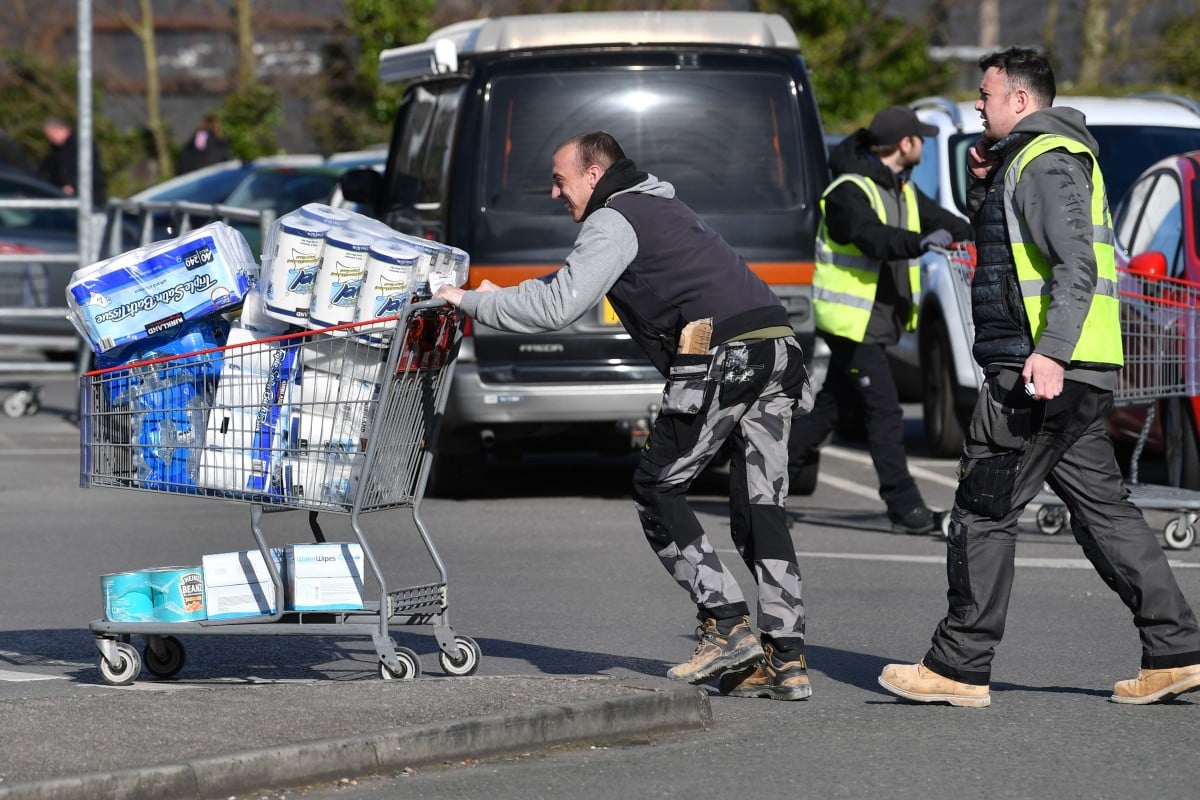
Covid-19: toilet paper and containment


Two Covid-19 issues have been weighing on my mind: toilet paper hoarding, and virus containment.

Many have been asking why people around the world have been hoarding toilet paper. A friend of mine captured the irrationality of people hoarding toilet paper by saying “It’s because they’re scared shitless!” 

There is a long history of toilet paper shortages during crises; the US had a run on toilet paper in 1973, in part created by a joke told by late night TV host Johnny Carson, but coinciding with shortages of many other consumer items, including gasoline (petrol).

I’m especially intrigued by this run on toilet paper because it seems to have started in Hong Kong, and spread to much of the rest of the world. Hong Kong even had a widely reported case of a toilet paper robbery. There seems to be something cross-cultural about the phenomenon.

Few of the articles on this phenomenon really offer a good explanation (see SCMP Agence France-Presse article). CNN.com offered a list of explanations on March 9th that included:
  1. Reason 1: People resort to extremes when they hear conflicting messages
  2. Reason 2: Some are reacting to the lack of a clear direction from officials [Hmm, this sounds like Reason 1]
  3. Reason 3: Panic buying begets panic buying [This is true; now that there is a shortage, I have no choice but to try to buy toilet paper. This is the “game theory” explanation. But it does not explain why the panic buying started in the first place.]
  4. Reason 4: It's natural to want to overprepare. [Really? Why focus on toilet paper and not tuna or beans?]
  5. Reason 5: It allows some to feel a sense of control [Control what?! An uncontrolled bowel?!]

So the psychologists say that by preparing when they feel helpless, even just by purchasing toilet paper, people get a sense of control. But none of these reasons explain why “toilet paper” and not, say breakfast cereal. After all, diarrhea is not one of the symptoms of the coronavirus.

This is actually a classic cultural, and thus anthropological, question: why do people value one thing over another. Economists can tell you where supply meets demand, but they assume demand exists. Anthropologists want to know what creates demand for a particular thing, i.e. why it has value.

Here is a better explanation. Niki Edwards, School of Public Health and Social Work, Queensland University of Technology:

Toilet paper symbolises control. We use it to “tidy up” and “clean up”. It deals with a bodily function that is somewhat taboo.

When people hear about the coronavirus, they are afraid of losing control. And toilet paper feels like a way to maintain control over hygiene and cleanliness.

So, to really get at the root of the phenomenon, we need to look at the symbolism of toilet paper. The “control” some people talk about is not controlling the disease, but the control of bodily functions that we usually rather not think about. People think of toilet paper as essential for “hygiene.” People are also told to wash their hands after they go to the bathroom. Thus, toilet paper is associated with hygiene and hand washing.

Indeed, a lot of the “hygiene” people follow to protect themselves against infection is not really effective. During SARS, there were many reports of people cleaning all the door knobs inside the house, even though they were in isolation at home. With no outsiders coming in, it is hardly necessary to wipe door knobs. The same is happening now in the US. I've heard of people washing their hands compulsively even though they are in isolation. And in one business I know of, though there are less than 10 managers left working in a large office, they have cleaning staff come through the office numerous times a day to wipe down and disinfect surfaces. I think the managers would be safer if the cleaning staff did not come, but the idea that surfaces should be “disinfected” and “cleaned” is very powerful.
  
Containment vs Mitigation

When Americans look at what China did to control the Covid-19 virus, they tend to attribute it to China’s authoritarianism. It is true that there are aspects of China’s response which were possible only because of the authoritarian state—including the denial of the problem for 3 weeks, when doctors knew the virus was serious and spreading (though we still, even today, March 28, have officials in the US downplaying the seriousness of the epidemic). But most of China’s response is not due to the authoritarian nature of the state, but to state capacity. China was able to trace contacts and impose quarantines because it had the health care personnel to do it. Proof that it is not due to authoritarianism is the fact that Korea and Taiwan were also able to react as quickly, but are very robust democracies. In Korea and Taiwan, people who came down with Covid-19 had their contacts traced and notified, and some were put in isolation to prevent them from further spreading the virus. This has helped contain the virus in China, Korea and Taiwan. (For an article on Korea, see here; on Taiwan, see here.) 

The US did not do that. Authorities delayed responding. Already in mid-February, experts were saying that the opportunity to contain the virus in the US was close to finished. (See for example Tom Bollyky of the Council on Foreign Relations, “Expert: It’s close to the point where governments decide thecoronavirus outbreak is a mitigation vs. containment situation”)

In one case, in Westport, CT, on March 5, 50 people at a party were exposed to the virus and dozens subsequently came down sick.   “Even in a well-connected, affluent town like Westport, contact tracing quickly overwhelmed health officials. ... One of the party guests later acknowledged attending an event with 420 other people, he said. The officials gave up.” This is because they lack the capacity, and perhaps the will. The parts of Asia that went through SARS were more aware that contact tracing was important. 

Contrast this with what was done in China. First, everyone who traveled to other parts of China from Wuhan was forced by local authorities to quarantine. Note that this sounds oppressive and authoritarian, but they were able to do something similar in Taiwan and Korea. Then, they closed off neighborhoods with infections, forced visitors to go through 14 days of quarantine before going to work, and placed restrictions on restaurants (but they did stay open, in contrast to ours which are all closed). I highly recommend this 12 minute video (in window below) by a Japanese businessman based in Nanjing, which was not heavily affected by Covid-19, but you can see the efforts the city went through to contain the epidemic. 


Containment may also be difficult because Americans are more mobile (though I don't know if this is true); this video by Tectonix GEO shows how the cell phones of spring break partiers (known as Covidiots) on a beach in Fort Lauderdale spread to the rest of the country in the following weeks. This video shows how people from the New York metropolitan area spread over the entire US in the two days after Gov. Cuomo announced #stayhome rules. But millions of people left Wuhan for the Chinese New Year before January 25th, and yet China’s local authorities were able to prevent them from transmitting the virus locally by requiring visitors to isolate at home. Taiwan was also able to contact tens of thousands of residents who arrived from China to contain the spread of the epidemic. But the US does not have neighborhood associations and health authorities like Asian countries have.

It is not because China is authoritarian that containment was possible; it was because they had state capacity. The same is true for Taiwan and Korea. In part, the experience of SARS in Asia meant that states there prepared better. But the US is also underprepared because Americans, and especially libertarians and Republicans, distrust state power. Trump dismantled the pandemic response team in 2018 that had been created by the Obama administration. 

A weak state is not a bug; it is a feature of America. The Trump administration has been cutting budgets of all government departments, including the CDC. The “small government” ethos is strong in America. It is linked to ideas of freedom and liberty. You can see this skepticism of the government and of public health officials, that grows from a fear of state power, in websites like this of the libertarian magazine Reason.

No one knows what will happen with this pandemic; as thisblog post says, every model and prediction we read “is just a guess but with statistics.” (But he’s not simply dismissive; he adds, “All models are wrong. Some models are useful.”). And it is useful to go back to the Feb. 13 NY Times article interviewing Donald G. McNeil Jr., their health and science reporter who has covered epidemics since 2002, to realize how little was known as late as mid February. There are still important questions about the mortality rate, like why the rate is so much lower in Germany than Italy.   

But the chance for the US to contain the virus has passed. China, Korea, Taiwan, Hong Kong and Singapore have largely succeeded but are still fighting to contain the epidemic. In the US, because of a lack of testing and the debacle over tests, and because we don’t know how reliable the tests are anyway, we have no idea what percentage of the population has been infected. But now the US has passed China and has the most confirmed cases in the world. Rah rah patriots can cheer, “We’re number one!”

As long as people worry that going out will expose them to coronavirus infection, the economy will not rebound, even if authorities do relax restrictions. President Trump and a number of business leaders want people to get back to work, but the epidemic has to recede before people will go to the theatre, to the mall, and to restaurants, not to mention travel internationally and take a cruise. The chance to contain the epidemic has passed. Mitigation will be long and messy, and it is hard to know how and when it will end.

Monday, March 16, 2020

Still no need to panic, but need to be cautious


Re-reading my previous blog post, I feel that my emphasis was wrong. While there are no incorrect facts, the takeaway message now seems wrong. I did not sufficiently emphasize that the peak of infections can easily overwhelm hospitals. Currently, a doctor friend told me St Louis University hospital has only 10 vacant beds out of 65 ICU beds. There are only1888 ICU beds in the entire state of Missouri (population about 6.1 million). The number is low because of cost-cutting, especially since 2008, because having empty beds is “wasteful.” But reducing the number of beds so they are mostly being used reduces our capacity to deal with crises. As a doctor friend put it, “Hospitals in the US are already always running at 110 percent.” The additional serious cases of COVID-19, even if they are only 1 of 100 who get sick, can still easily be too many for the hospital to cope, and doctors will have to decide who gets the ventilator and who dies.

Three articles this past week, a piece in Medium by TomasPueyo, an article on Vox, and an article in the NY Times byNicholas Kristof and Stuart Thompson, make the point that the problem is not treating the disease itself, but is going to be treating the sick at the peak of the epidemic when hospitals are overwhelmed. I highly recommend these articles. The Times article also has a table that shows that the peak of the epidemic is likely to be in July, which means Americans' current “social distancing” is going to have massive economic effects.

It seems everyone I speak to has seen the Tomas Pueyo article, and I see now that it has been viewed 35 million times in 6 days. It gives me hope that ideas can, in fact, sometimes change people's ideas and behavior!

In the US, everything changed this week. Universities started closing on Tuesday, March 10, and the NBA suspended the season the next day. That was when everyone knew it was really serious. I don’t know all the factors that have gone into closing universities, but I’m told a major issue is uncertainty over a university's liability if they stayed open and someone got sick and died. It is easier to close. This is disturbing, because it is not clear what foreign students are supposed to do, and the extra travel this causes is precisely what we don’t want if we’re trying to prevent the spread of disease. I would have thought isolating the campus from outside visitors would have been more effective, in public health terms. But, I’m not aware of all the considerations. And I’m grateful I did not have to make these difficult decisions.

One thing I did not anticipate in my earlier blog was that Americans would take no precautions at all. I did not realize how unscathed the US was from SARS. Many friends who lived through SARS in Asia have commented on how blithely Americans have been taking the epidemic. I have not been panicking, but I have certainly been washing my hands a lot and avoiding crowds. I open doors with my back (to avoid touching the door with my hands), and push elevator buttons with my knuckle--all skills learned during SARS in Hong Kong. But a combination of lack of focus, and the fiasco with the US insisting on developing its own test for the COVID-19 virus and flubbing it, has led to serious problems. As late as yesterday, March 15, we’ve been reading reports in our local paper and on social media (see for example here) of people displaying coronavirus symptoms but not being tested because they do not meet some criterion. They perhaps came from Toronto, but not Italy, so are not eligible for the test. The problem is that from a public health point of view, we need to test everyone with symptoms so we can contact others who might have been infected. And there does not seem to be much contact tracing here in the US.

Taiwan is getting some attention for its success in limiting the epidemic, though it would be getting a lot more attention if it were part of the WHO. An article in the Journal of the American Medical Associationonline notes first, how early authorities moved to test visitors and suspected cases. 

On December 31, 2019, when the World Health Organization was notified of pneumonia of unknown cause in Wuhan, China, Taiwanese officials began to board planes and assess passengers on direct flights from Wuhan for fever and pneumonia symptoms before passengers could deplane. As early as January 5, 2020, notification was expanded to include any individual who had traveled to Wuhan in the past 14 days and had a fever or symptoms of upper respiratory tract infection at the point of entry; suspected cases were screened for 26 viruses including SARS and Middle East respiratory syndrome (MERS). Passengers displaying symptoms of fever and coughing were quarantined at home and assessed whether medical attention at a hospital was necessary.

China only began to take action by classing COVID-19 as a notifiable disease on Jan. 20, and shutting down Wuhan on Jan. 23.

Taiwan’s quick and effective reaction was possible because they have highly centralized immigration records and a National Health Insurance Administration (AKA "universal healthcare"), and were able to link the two databases. Though 850,000 Taiwanese live and work in China, and many came back to Taiwan for the Lunar New Year on Jan. 25, the health authorities could identify who had traveled from China within the previous 14 days and could contact them for testing. Taiwan’s household registration system also allows authorities to locate residents; the US has no such system. In Taiwan, and Hong Kong, they have the data and the will to trace contacts; this does not seem to be the case in the US. In Hong Kong and Taiwan, they also monitor people by tracking their cell phone, something that will probably not be politically possible in the US. But I had assumed tracking contacts of people who come down with COVID-19 would be standard procedure in the US, as it was in Asia for SARS in 2003, and is currently the case in Asia. But as I mentioned, they are not even testing many of the people who show coronavirus-like symptoms, let alone tracing contacts. The first case in Missouri was a student who took the train from Chicago on March 4, and came down with symptoms on March 6th. They did disinfect the entire train.

Many people are expecting the epidemic to end with warmer weather, as happens with the flu season. Unfortunately, the fact that there are coronavirus cases in Singapore, which is on the equator, and that the Spanish Flu actually first emerged in June-July of 1918, make this unlikely. (The seasonality of the flu is actually an interesting scientific puzzle.)

Frozen food section at Trader Joe's 
 The panic in the US really hit on Thursday March 12, when there were runs on supermarkets. The panic buying of toilet paper has been widely reported, and my local supermarket had empty shelves; even paper dinner napkins were all gone. Especially surprising was the fact that all the white vinegar was gone! Back in January 2003, Hong Kong newspapers carried stories that mocked Guangzhou people for clearing stores of vinegar, because “superstitious” people were boiling vinegar to prevent what later was known as SARS. Just two months later, there was also a run on vinegar in Hong Kong, as the illness spread to the region. So it is a bit surprising that I see vinegar also gone from my local supermarket.

Paper products at local supermarket
But there are notable differences in cultural ideas of how to quarantine. In Hong Kong, people were encouraged to keep windows open at home, and go out in country parks to get fresh air. (Many people do not realize that Hong Kong is actually 70% country parks and nature reserves.) In California, starting tomorrow, people are required to stay in their homes. It seems to me that it is very safe to go outside as long as there are no crowds, but that is not the advice we are being given in St Louis. We are expected to stay indoors; in Hong Kong, fresh air was believed to be healthy.

The most notable difference in how COVID10 is dealt with is with masks. In Hong Kong, everyone is expected to wear a mask when outside. In the US and Singapore, one is only to wear a mask if ill. The argument is that a surgical mask does not help much in preventing catching the virus. (Here is a brief and insightful anthropological analysis of the different beliefs surrounding masks.) Of course, most people operate on the “better safe than sorry” principle, so would wear masks if they could. But they have been unavailable in St Louis since late January. And now we learn from the NY Times and Wired that there are people who have been buying up masks and hand sanitizers since January, to sell them on eBay and Amazon at a steep markup. This should be the topic of a future (economic anthropology) blog posting, but for now, I'll just say that it adds to the chaos and distrust.


My 90-year mother-in-law lives near Seattle in a retirement home. When asked how she was doing, with all this worry about coronavirus, she said that she has seen so many things in her life, this does not scare her that much. After all, she lived through the Japanese occupation of Hong Kong during WWII, the Cold War and "Red Scare." Yes, this is serious. But with organization and care, societies can get through this.

Sunday, February 02, 2020

The Coronavirus Panic


I have been interested in “risk” for my research on pesticides, and as part of my work on magic and the supernatural. I therefore look at the world response to the new coronavirus that emerged in Wuhan with a slightly different perspective. While I understand the fear of a novel illness (having lived through SARS in Hong Kong), I also see that a lot of the fear is unnecessary and irrational, if understandable.

Every year, influenza kills thousands of people in the US and around the world, and people accept that as somehow normal. Pneumonia is the 2nd leading cause of death in HK (8032 people in 2017, causing 17.5% of deaths). And the death-rate from pneumonia shoots up for people over 74. In the US, 55,672 people died of influenza and pneumonia in 2017. The press regularly mentions large numbers of infected and dead (14,300 and 305 as I write) which seem like large numbers, but in comparison to the overall population of China is small. For the US, the NY Times reports
For perspective: The flu kills roughly 35,000 Americans every year. This season, it has already sickened an estimated 15 million Americans and killed 8,200, according to C.D.C. estimates.
  • Influenza kills more Americans every year than any other virus, Dr. Peter Hotez, a professor at Baylor College of Medicine, told Liz Sabo at Kaiser Health News. But the flu is rarely paid such attention, and fewer than half of adults get a vaccine.
  • “When we think about the relative danger of this new coronavirus and influenza, there’s just no comparison,” Dr. William Schaffner, a professor at Vanderbilt University Medical Center, told Ms. Sabo. “Coronavirus will be a blip on the horizon in comparison.”
As Elizabeth Rosenthal (a physician and NY Times journalistwho lived in Beijing through SARS) says, “Remember, by all indications SARS, which killed about 10 percent of those infected, was a deadlier virus than the new coronavirus circulating now. So keep things in perspective.” As you can see from the table below, influenza regularly kills between 0.2 and 0.4% of patients who see a doctor for the flu, and 7-13% of those who are hospitalized for the flu. It is estimated that 10% of those affected by the Spanish flu of 1918 died. The main reason for the fear today is that the coronavirus is new, so we don’t know everything about it. But much about it is already quite clear: the mortality rate appears to be at most 2-4%, and it spreads through heavy water droplets (i.e. sneezing and direct contact). This is not Ebola.


The media tend to emphasize the risk because fear attracts viewers. Readers are much more likely to forward and make viral an article that warns about the virus and emphasizes the danger. The NY Times had a photo essayentitled “China’s Battle with a Deadly Corona Virus” and “The Test a Deadly Coronavirus Outbreak Poses to China’s Leadership” but it was already clear on Jan. 21 that this virus is not as deadly as SARS or Ebola. And though we don’t know some things about the new coronavirus, we do know a lot, and it is misleading to call it “mysterious” (as Fox News did here)

Lest I be considered distant and unaffected by the virus, let me add that my wife has a colleague in China whose father-in-law is among the dead, so I fully understand how serious and tragic influenza can be. But we need to take reasonable precautions and not panic. Often, panic causes more problems than the problem that sparked the fear. The point is, as Ian Johnsonputs it, “This outbreak is serious but not catastrophic.” (His essay on the government's Aksionismus or "actionism" is excellent, like most of his writing.)

There has been a run on masks, but as Rosenthal notes, masks are not that effective. They help in crowded places, but they have to be replaced frequently, because if they work and get viruses on them, they are contaminated. It is basic hygiene, like washing your hands frequently, and staying home if sick, that helps prevent the spread of viruses. There are many draconian measures undertaken in China that are pointless (like shutting gates to apartment complexes at night). Lest Americans think they are more “rational,” I hasten to point out that our local drug stores have sold out of masks. We tried to buy some for a friend who wanted to send them to Hong Kong, but even in St Louis, there has already been a run on masks!

Many of the bans being put in place are informed as much by xenophobia as by public health concerns. Particularly worrying are bans on all Chinese (like in Singapore), as if being Chinese was a marker of likely being ill. Stories that focus on Chinese eating wild animals have gone viral (pun unintended) but have nothing to do with the cause or spread of the disease (see the weird case of “bat soup”here). Jason Oliver Chang, Associate Professor of History and Asian American Studies at the University of Connecticut, has created a Googledoc with resources to teach about “Yellow Peril” to try to counteract these racist and xenophobic narratives that unfortunately fit into Trumpian anti-foreign sentiments.

It is natural to be cautious and afraid. I remember from the SARS outbreak in Hong Kong, and Emily Feng of NPR in Beijing said the same thing last week, you can know the chance of getting sick is small and not worry about yourself, but you worry more about transmitting it to others. You think, “What if I’m the person that spreads the disease to my workplace?”

Those of us who lived through SARS in Asia changed our habits, as Rosenthal notes. In addition to washing our hands more often, we push elevator buttons with our knuckles and not our fingertip, and we stay home if we are sick. I’m struck that many people with a cold or flu symptoms in the US do not quarantine themselves, but continue going to work and social events. And how many people who are worried about the coronavirus did not get their flu vaccine this year?

It is not that we don’t have to be vigilant. In fact, Laurie Garrett (Pulitzer-prize winning author of books on epidemics and public health) notes that the US is totally unprepared for an epidemic because: “In 2018, the Trump administration fired the government’s entire pandemic response chain of command, including the White House management infrastructure. In numerous phone calls and emails with key agencies across the U.S. government, the only consistent response I encountered was distressed confusion.” Not that is alarming.

Another thing is also clear: governments are under tremendous pressure to "do something" even if it is not necessary; no one wants to be blamed for not doing enough. And the weird thing is, if public health efforts succeed and there is no pandemic, or the virus burns out naturally before becoming a pandemic, both health and political officials will be accused of overreacting! It is not easy to make the calls right now. But we individually can at least avoid panicking.

PS: Here is a good NPR Morning Edition story from Monday Feb. 3rd that argues there is no need to panic. 

Monday, December 16, 2019

Observations on the Hong Kong Protests in Early December

I was in Hong Kong for ten days at the end of November and early December, and though I had been following the protests fairly closely from afar, there were several things that struck me once I was there. I arrived the morning after the election, and since I had no idea how the election would turn out (Would a “silent majority” turn out to support the government? Had protester violence alienated the public?), I quickly checked the results on my phone as the airplane taxied to the exit. I was surprised to see how strongly the pro-democracy candidates had won. It was an unprecedented repudiation of the pro-establishment parties and the government, and of Beijing. There could be no doubt that the protesters represented the anger and frustration of a large segment of the public.

Kowloon Tong MTR
I should mention that many in the US seemed worried for me, but this was ridiculous. The protests are usually announced in advance, and are very localized. Most people go on living their life. Images on TV focus on the "action" but that occurs in small pockets, and it is fairly easy to avoid the protests. There can be traffic jams caused by protests, and the MTR did close early for a while. But Hong Kong's protests are not a civil war. I was not worried for my safety in going on this visit. I just hoped the wedding I was planning to attend would not have to be canceled because of protests. But everything went well. There was in fact a lull in the protests following the election. The odd thing, actually, was the lack of response from the government or Beijing.

There are many reasons for the high level of anger and frustration in Hong Kong, and it is wrong to try to identify the single or primary cause. Thus, the government’s strategy (pushed by Beijing) of focusing on economic and livelihood issues is not likely to resolve the protests. There can be no doubt that the high cost of housing, rising inequality, and limited prospects for many young people are contributing factors, but they are not the “material base” on which all other elements rest, to use Marxist theory. There are identity issues, and ideas of justice, that are harder to address. And we have to be frank that a layer of anti-Mainlander bigotry also adds emotional power for some of the protesters.

Graffiti, Hong Kong Island
Another explanation that Beijing has for the protests, aside from economic issues, is “foreign interference.” The assumption that foreign “black hands” are behind the protests might seem plausible from afar, and the CIA has certainly promoted and organized protests and coups in the past (Iran 1953Guatemala 1954, Bay of Pigs 1961, etc.). But it surely is an exaggeration of American power to think the CIA can mobilize the thousands of protesters who have repeatedly come out on the streets to protest. It is, of course, also an insult to them, assuming they are being manipulated. But this belief in “black hands” is probably not insincere; communists believe in organizing protests, and it is hard for them to believe that people would spontaneously and of their own individual will come out to protest. Pro-Beijing protests on campuses overseas, and the flag-waving crowds greeting Chinese leaders at various venues in China and overseas, are all organized by the party, so it is only natural, in their minds, that protesters against the Party must also be organized but some secretive forces.

Instead, what I heard from many people I spoke to was how ordinary people felt compelled to donate supplies (masks, umbrellas, clothes, etc) to support the protesters. People leave change and single-trip MTR cards on subway vending machines to help protesters leave without leaving a trace on their Octopus cards that would record their travel. People with cars have driven protesters away from police action. I suppose it would be naïve to think foreign agencies are not supporting the protests, but that is hardly an explanation for what is going on.

Graffiti against police violence
The degree to which ordinary members of the public are involved is striking. Several friends commented with awe and surprise that on the Monday when a general transportation strike occurred (Nov. 11), and buses were stuck for hours on Nathan Road, passengers who got out to walk were not angry, but said things like “Yes, this is inconvenient for me, but I understand why the protesters need to do this.” This was surprising because during the Umbrella Movement in 2014, much of the public complained about the inconvenience caused by the protests.

A sociologist in Hong Kong who studies protest movements made two interesting observations. He noted that the protests may seem to have erupted suddenly from nowhere, but there are protesters who have over a decade of experience in battling the police. From battles over Queen’s Pier, the Kwu Tong redevelopment  and the high speed train station, protesters and police have years of experience in fighting with each other (my retired police office friends refer to them as “professional protesters”). Indeed, at the outbreak of the Umbrella Movement, the very first day when tear gas was first used (to the shock of Hong Kong society not used to such methods), we saw protesters with defensive equipment from masks to plastic wrap arrive prepared for battle. So these tensions have been simmering for years. Each side has learned from the other, and escalated in their tactics, but their attacks also have a ritualized quality.

The sociologist’s other observation was that the protesters have deliberately and successfully provoked a violent police response. In fact, the protesters and police engage in verbal sparring and name-calling during protests. It seems the protesters calculated that the public would support the protesters if they saw the police using violence against them. Though this has indeed occurred, it is hard to know how deliberate this was. Another argument claims that the police withdrew and allowed the protesters to enter and vandalize the Legislative Council chamber, believing that this would turn the public against the protesters. Indeed, many are puzzled as to why the police retreated and allowed the protesters to enter the chamber. In any case, if it was deliberate, it did not work, but only further polarized society, with pro-establishment people horrified by the anarchy and defacing of national symbols, and protesters emphasizing the symbolic nature of the damage (e.g. that the protesters did not touch the library and that they left money for the drinks they took).

V for Vendetta sign in Mong Kok 
Another surprising aspect of the protest is how deep the frustration of the protesters is. Many are willing to tear down all of Hong Kong if their demands are not met. One of the slogans spray-painted on walls and on the streets says “If we burn, you burn with us” (a famous line from The Hunger Games). The common Cantonese expression is 攬炒 lam chau (or in Jyutping romanization, laam5 caau2See article on the term here. Lam literally means to grasp or to pull something into one’s arms; chau means to stir fry, and by extension to speculate (e.g. in stocks), as well as to fire (sack) someone. But here the expression means to go down together, taken from a poker strategy. This nihilistic attitude of course alarms many people. The circle with a letter V on it, from “V for Vendetta,” is a common graffiti around Hong Kong, expressing the anarchistic idea that a chaotic interim period is necessary before a functioning society can emerge.

Protesters use many leftist quotes from Mao and from the communist party, but also anti-globalization ideas from the far right. The Hong Kong protesters mimic a segment of Trump supporters in the US, but the idea many protesters have that they have to “blow it all up” is similar to the “drain the swamp” and anti-establishment ideas of many Trump supporters. Thus, while it may seem odd that pro-democracy protesters in Hong Kong have Pepe the Frog dolls and masks (see "Know-your-Meme" that does not see the meaning here and NY Times article here), these protesters identify with the anti-establishment ethos that the Alt-Right has created for the frog (much to the dismay of the frog’s creator; see a Reply All podcast and transcript here). The protesters do not see Pepe as a symbol of hate, but they correctly identify it as a symbol of protest, and some of the anti-Mainlander bigotry (as noted in the excellent This American Life episode) also fits with the Alt-Right's use of Pepe as a symbol of hate. So, many pro-establishment people are probably right when they say that Americans and Europeans would not be so sympathetic to the protesters if they were protesting like this in their countries.

On the other hand, a European friend in Hong Kong said that only now, with the protests, does Hong Kong feel like home. Before, with everyone worrying about making money and about brand-name clothes, she felt alienated from Hong Kong society, but now that people are political in a way that she understands and recognizes from her youth back home, she feels much more of a connection and bond with Hong Kong. She cares much more about the society now that she knows others care about society’s future too.

But most people are more negative. One friend has begun the process of emigrating to Malaysia (which for a Chinese person seems, at least superficially, to be like "out of the frying pan into the fire"). Several other recently retired friends who are strongly anti-protester are now planning on moving to England, though they had planned to remain in Hong Kong. They say they do not recognize their city any more.

CUHK graffiti: "would rather be dead than not free"
It is not clear how things will end. The protesters are unorganized by design, to prevent the government from arresting the leadership like they did vindictively several years after Umbrella Movement had ended. It is hard to imagine Beijing yielding on direct elections of the Chief Executive. Indeed, all pro-Beijing figures keep talking about how Hong Kong people need to be educated to be more patriotic, which, of course, is precisely the attitude that mobilizes people to go out on the street in the first place. Even the protesters’ demand of an independent commission to investigate police violence seems impossible, because the government is simply hiding behind the police. If the government were to announce an independent commission, the police would feel they were being thrown under the bus and would refuse to prop up the government. It seems clear that it is not in the interest of Beijing to send in the PLA. It is also not clear what the PLA could do to quell the protests that the police has not tried, short of shooting hundreds of people, which would have huge international repercussions. It is said that some protesters are hoping to provoke just such a response by Beijing to put more pressure on the authorities. Most people see this as a mad fantasy.

It seems the government intends to simply wait out the protesters, hoping they will tire. In the meantime, the reputation of the police, until recently touted as “Asia’s finest,” is in tatters. Stories of summary arrests and beatings by police, even of innocent bystanders, are common. And a surprising number of people believe that the police has killed protesters at the Prince Edward MTR station and disposed of the bodies. Rumors about the toxic chemicals in the tear gas and blue dye shot from the water cannon are rife. There is no trust in the government. The government claims to have foiled two recent bomb plots. Such an escalation would be tragic, and probably self-defeating. But it is hard to predict anything about these protests, given how unpredictable they have been thus far.

Tuesday, October 15, 2019

Are Paved Roads "Unnecessary Government Spending"? What is Government in a Democracy?

Yesterday we went out into the countryside to visit a friend who lives on a farm. It was a beautiful sunny day, and the leaves are just starting to turn colors. On the drive back home, we saw a Jeep Wrangler (a large 4 by 4) with a spare wheel cover like on the right. It says, "PAVED ROADS: Another Fine Example of Unnecessary Government Spending."

This struck me as peculiarly American. Of course, I understand that this is partly in jest; the website where this spare wheel cover is sold sells other humorous tire covers (see below) and notes that with this cover you can "and enjoy the stares when the guys behind you read it." (I'm actually not sure how you're supposed to see the faces of people behind you without crashing into the people in front of you, but that's another issue.)

The website where this is sold is called Extreme Terrain Off-Road Outfitters, and they have a smaller sticker for $5, about which they say: "Does your rig rarely see the road? Happier on the trail? Government annoy you? (You're not alone!) Get a few grins with this decal."  So they think it is funny. But at the same time, it is not. It is serious political propaganda.

The notion that the government is an oppressor is not new in the US, and it goes back to the 1776 Revolution, as exemplified by the famous Gadsden Flag with the coiled snake and the words "Don't Tread On Me" and the anti-tax Whiskey Rebellion of 1794. Anthropologists also view states as fundamentally oppressive and exploitative institutions. Most people view the rise of states as the beginning of "civilization," but in fact, they are just created when a minority (a priesthood, an oligopoly, a nobility, elites, etc.) take control, organize armies and food deliveries, and maintain their superior power, usually through some sort of force (think military, or police, or praetorian guard). Since the first state, leaders have controlled the state to their own advantage. They may claim they need to do so to organize production or for defense, but the fact is the leaders of states have benefited at the expense of the majority of people (the peons).

But it seems a bit Luddite to believe that we can live, in our current world, "independently," "free" of any government constraint. That Jeep Wrangler was, after all, driving on I-64, a 6-lane interstate paid for by the federal and state governments. We would not be able to travel 30 miles to have lunch with friends if we did not have paved roads--which are paid for by the government!

The genius of American politics in the past was the combination of a belief in small government, to avoid bureaucracy and high taxes, along with the belief that science and technical progress supported by the government could solve human and social problems. From the battles between the two approaches, or rather, compromises between the two, progress could be made. But in the past few decades, a Libertarian ethos has arisen that holds that all government programs are evil: they waste money, undermine people's freedom, and don't work to boot. The fact is, this is sometimes true, but not always. The trick is to know when to use government programs, and when they do not work. The assumption that all government programs are bad is an ideological position promoted by a few super-wealthy Americans like the Kochs and Mercers, and it has grown in influence over recent decades.

Now the US electorate is again debating healthcare: progressive Democrats are proposing "Medicare for All." How this will be funded is not clear, and this is making many centrist voters nervous, especially those who have good health insurance and who worry that it will be taken away and that they will be forced to go into a bureaucratic government-funded health system. And yet, it is incredible that there are still millions of Americans who have no health insurance.

Two days ago, I went to a "Gala" (a fundraiser) for a local charity called "Gateway to Hope." They support low-income women who have cancer by helping them maintain their insurance payments, or helping them pay their mortgage and food bills, so they can concentrate on their treatment. Fact: 36% of women with breast cancer cannot work. If they lose their job, they can lose their insurance! It is shocking that people who get cancer risk losing their job and their house, or that they have to scrimp on food while they are trying to recover from chemotherapy. So it is shocking that such a charity is actually necessary, in one of the richest countries in the world. Why does this charity have to solicit from private donors? Everyone should be contributing, through their taxes, to spread the burden evenly. One would think that everyone would receive this kind of support as a matter of course, but that is not the case.

Hong Kong has also long been governed by the principle of limited government, but Hong Kong has a good public health care system that is very inexpensive to the patient. It is true that there are long waits for some specialties (especially for psychiatric care--suicidal patients have to wait many months to see a psychiatrist), but patients with money can pay out of pocket or buy insurance to get private treatment. Emergency treatment is available to all; the registration fee is HK$100 (US$13). Hong Kong also has many NGOs providing social services, but their funding does not totally come from private sources; many receive all or nearly all their funds from the government. The government audits them and makes sure the money is well spent, but the services are provided in a less bureaucratic form by NGOs. Even many private schools in Hong Kong get significant portions of their funds from the government.

I find that when people in Taiwan, China and even Hong Kong find that there is something wrong in society, they expect the government to step in and address the problem. That is not true for many Americans; Reagan famously said that the nine most terrifying words are "I'm from the government and I'm here to help." The odd thing is that in a democracy, "the government" should be "we, the people." It is a sign of how much more democratization we need in America that people still see the government as an oppressor, even though they supposedly elect it every election.

So a wheel cover claiming that public roads are a waste of taxpayers' money is not funny. I wish it was, that we could agree that it was absurd. But as long as extreme individualist libertarians proclaim their notions of very limited government, it is not a joke but an example of an anti-social and selfish ideology.

Thursday, August 15, 2019

The Benefits of Life in a Smaller City


One of the advantages of living in St Louis is that I can attend events that would be crowded or not accessible to me in larger cities. St Louis is not small; the metropolitan area has 2.8 million residents and ranks 21st in the nation (it fell below 20th for the first time in 2017 because the population is not growing here, while it is growing in the south). So St Louis has more events than I could possible attend. And this week, I discovered a subculture that is interesting as a cosmopolitan competition and network of fans.

Two days ago, I attended the St Louis Rapid & Blitz chess tournament. Chess has its own subculture, about which I knew next to nothing. By coincidence, I had just heard about blitz chess for the first time in a great podcast by Malcolm Gladwell, and when I heard there would be a tournament in St Louis, I thought I would go to check it out. In blitz chess, players each have a total of 5 minutes to make all their moves, so they have to decide quickly. I thought that for a non-chess expert like me, this would be more interesting than watching players ponder their next move, as in regular chess. I went on day 4 of the 5-day competition, the first day of blitz (the previous days had been “rapid”, which allows 15 minutes per side).

Watching the competition live on the 1st floor
It was only $10 to attend, and to my astonishment, there were only about a dozen spectators. There are 10 players in the competition, and they play a game every half hour. The setting is the St Louis Chess Club, which is not a large building, really just a pair of townhouses, connected in the middle. On the 1st or ground floor, they had set up three rows of seats with a TV, showing the television commentary covering the tournament. The competition was on the 2nd floor, to which I was admitted only upon surrendering my phone and watch (I was told it was to prevent noise, though people with SLR cameras were clicking away during matches). Tables are lined up on one side and a belt separates them from the area for spectators. I was 5 meters from the players.  
Spectators very close to the competitors

I decided to watch the Chinese players (since I had no other logic to follow). I noticed that both Yu and Ding were among the first to sit down at their positions for their match. As in sports, the players shake hands (perfunctorily, I may add) when the second player arrives, and again at the end of the match. Players are given a one minute warning, then a voice calls out (with no microphone) that play is to begin. Play goes very quickly for the first 10 or so moves; they obviously have certain opening moves they all know, so it is only later that play slows down. Then at the end, play can be frantic, as each tries to avoid losing by running out of time. In fact, the timer adds 3 seconds to each player’s clock each time they push down on the timer indicating the end of their turn, so if they move quickly (almost impulsively), they should actually never run out of time, but of course that is when mistakes are made.

Grand Master Maurice Ashley offering post-match commentary
My ignorance of chess is great, and I have no idea why these 10 players were invited, and why the American Hikaru Nakamura, last year's winner, was not present, for example. But in addition to the issues of the organization of the tournament and tour, it was impressive, while watching on TV on the 1st floor, to hear the commentators analyze each move. At one point, world #1 Magnus Carlsen made a mistake, failing to see a move that would have led to a victory. The commentators said that those watching at home (I guess some cable companies carry this channel) should gain confidence from seeing that even someone of Magnus' caliber could make such a dumb mistake. 

Screenshot of TV, live during tournament
The technology supporting the tournament was amazing. Each table had cameras focused on the board and players. The timers, I later realized, were connected to the TV feed, so time remaining was displayed on the TV too. The commentators had various computer programs that allowed them to review the players’ moves and to draw arrows to show potential moves. For someone who knows chess well, it must be thrilling. I was just amazed at the rapid discussion of Qe4 and pawn h5, which I understood literally but knew I did not understand the full meaning.

In all of the three games I saw finish, I was not entirely sure what had happened because they ended so suddenly. One player reached out and shook hands with his opponent, but I could not be sure if he had lost or tied. The problem for me was that the players, and all chess experts, know various endings, so they already know how the game is going to end after a certain point. But I have no clue. You can see the last minute and a half of an ending here (or in the box below, and jump to the 1:57:50 point in the video) and if you turn down the sound, you may experience the confusion I felt. With the sound up, you can hear the excitement of the experts.

Screenshot showing mistake in YU Yangyi's name
Despite all the technology and internationalism of players from 8 different countries, it is a bit disappointing to see that in much of the promotional and television material, they confused the surname and given name of the Chinese players. You can see this in the banners on the 2nd floor of the Chess Club (right), and on the screens on TV (see screenshot above). The surnames of the Chinese players are Ding and Yu, not Liren and Yangyi. In fact, it is actually quite easy to identify Chinese surnames, as 99% of surnames are one syllable long. (Some given names are also one syllable, but that is another matter). Plus, his Wiki page notes "This is a Chinese name; the family name is Yu." It is a bit surprising that this was not caught and corrected. And I assume the Chinese were too polite to point out the error.

Commemorating the 10th anniversary of the Hall of Fame
St. Louis has actually become the major center for chess in the United States, and the reason for this, as for many things, is money. Rex Sinquefield [pronounced sink-field] is the donor who funds the World Chess Hall of Fame, the St Louis Chess Club, and the two annual competitions in St Louis on the Grand Chess Tour, which are called the STL Rapid & Blitz and the Sinquefield Cup. The World Chess Hall of Fame last year celebrated its 10th anniversary by holding an exhibition and releasing a publication that looks like a newspaper entitled The Sinquefield Effect.

Rex Sinquefield is an interesting character. While still a student, he became a believer in the “efficient market” theory, which says that it is very difficult if not impossible for investors to do better than the market. He acted on these ideas and made a fortune in Chicago as an early creator and manager of index funds. Index funds do not pick stocks; they invest in stocks to match an index, like the S&P500, which reflects the 500 largest publicly traded companies in the US, or a fund that mimics the Consumer Staples component of the market. Research shows between 64 and even over 70% of mutual funds do not beat their sector’s index (depending on the sector). Since the cost of running an index fund is so low (no research), they always do better than most stock-picking mutual fund.

Sinquefield has said he got bored with his index fund work when he was 61 (and a billionaire), and moved back to his hometown of St Louis in 2005 to make a difference. He is politically very conservative, and gives money to politicians and organizations to try to lower taxes, believing that will help spur economic "growth". He particularly despises St Louis City’s 1% income tax, and even has promoted the total repeal of the state income tax. He has created the “Show Me Institute” (website here, or see pithy Wiki summary here) (Missouri is known as the “Show Me State”) as a think tank to promote his conservative, libertarian, and free market ideology.

Sinquefield was widely believed to be the éminence grise behind a push to combine St Louis City with St Louis County. The county has over 80 different cities and villages and towns, most with their own police and fire department and other services. The duplication of services and inefficiency of the system is obvious to all, but the status quo also protects rich towns from having to contribute to the costs of poverty alleviation, and makes their public schools well-funded, while poorer towns have underfunded and struggling schools. These inequalities are huge, and difficult to tackle, and in fact the proposed merger was not really going to address them directly, but might have started the process. He funded a group, Better Together, that submitted a proposal and held town hall meetings to try to gain support. But as it happened, the St Louis County executive, Steve Stenger, who was to have become the executive/mayor of the combined county-city, was arrested and has now been sentenced to 46 months in prison for corruption, so the push for county-city merger has died, again. The issue seems to come in 10 year intervals.

Prize money and points for STL Rapid & Blitz
Sinquefield has bragged, “If you get involved at the locallevel, you will be amazed at how much influence you can have.” I do not have millions of dollars to influence local politics, but I was able to see a major world chess tournament, and rub shoulders with Grand Masters like Magnus Carlsen, Fabiano Caruana, YU Yangyi and DING Liren (or, should I write, Yangyi Yu and Liren Ding?), in a way that would not be possible in big cities like Hong Kong or New York, where there would be hundreds if not thousands of fans and spectators. The prize money is not like some sports (hm, is chess a sport? That was a topic for week one of my Sports and Culture course) but is not insignificant. St Louis is the capital of chess in the US today.