Monday, August 22, 2022

On Migrants and Immigration

I often wonder what later generations will “see” as obviously irrational, immoral, or unjust practices in our culture, and ask themselves how we could have accepted these, the way we look back at enslavers today. Some are obvious: even before I die, expect my grandchildren to ask me why we were so careless in burning carbon, what with all the airplanes, heating and air conditioning, and big cars. Some people argue that future generations will look in horror at our carnivorous practices; I’m skeptical, though I assume we’ll eat a lot less meat, especially beef.

So I was fascinated to hear Mohsin Hamid on the Ezra KleinShow podcast say that he thought we today are as barbaric today for preventing migration ("enforcing the limits of geography on people’s lives") as slaveholders were for enforcing birth hierarchies 150 years ago. He points out that humans, like all animals, migrate. In fact, the enforcement of borders is actually fairly new.

[N]one of us are, in a sense, indigenous to where we live.… [W]herever we are, in a sense, we are migrants. And up until quite recently, this idea of the nation-state with such impermeable borders and passports and this entire mechanism didn’t exist. Of course, there were tribes that wouldn’t let members of other tribes live among them. There were wars, there were all kinds of things. But the human record is of movement, incredible amounts of movement.

Europeans migrated to the New World with almost no restrictions until the early 20th century. The Qing dynasty tried to prevent Chinese from moving to Taiwan and the Philippines in the 17th century, but pretty much failed. But today, Hamid notes, we have governments attempting to use industrial technology to stop any movement. He continues:

And I think that, while I fully understand and can empathize with the idea that, well, if we let everybody come, it will change everything and we can’t do that, I can understand that. And there needs to be some navigation of how do we manage this tussle of what those who wish to move and those who do not wish others to move to where they are, how do we manage the balance between those two things.

But what I think is very stark is that it cannot be that the moral right is simply to say that people mustn’t move, they are criminal if they move, they should be criminalized if they move, because in a world where there will be, I think, enormous flows of people, due to climate change and environmental disruption, but also wars and other things, if we say to people that they just can’t move, we’re, in a sense, handing out death sentences to millions and millions of our fellow human beings. If you can’t leave a country where there’s a war underway and where people of your particular group are being killed, or if you can’t leave a country where there is enormous starvation and crops have failed, we are basically deciding that these people now need to die.

And for me, that decision should be revealed in its correct moral complexion, which is to say it isn’t the person who wishes to move who is the criminal here. If somebody is drowning and we can help them and we don’t, it’s not the person who drowns that is the criminal here. 

The same day that I heard this podcast interview, I also heard news from an IPSOS poll that Americans are very misinformed about immigration. 

Over half of American adults believe it is either completely or somewhat true that the U.S. is experiencing an invasion at the southern border, according to a new NPR/Ipsos poll. Moreover, half believe there is at least some truth to the view that migrants bringing fentanyl and other illegal drugs over the southern border are responsible for the increases of overdoses in the U.S.

The idea of an “invasion” is hyperbole at best, and the migrants are not bringing drugs, but trying to save themselves. Though half of all respondents believe migrants are smuggling drugs, Republicans who watch Fox are most likely to believe this (89%), compared to 64% of Republicans get their news elsewhere.

The survey also shows that support for giving citizenship to Dreamers (people brought to the US by their parents as children) has fallen from 65% in January 2018 to 51% today. And “Fewer Americans today (56%) believe that immigrants are an important part of our American identity than in January 2018 (75%).” This represents a significant rightward tilt in the country. 

I’ll admit I’m biased; I am the child of immigrants. My father’s family migrated to the US in 1920. My mother survived Allied bombing near Argenta, in Emilia-Romagna, and relied on distant relatives and strangers to survive. Her beloved great aunt, virtually her only relative on her father’s side, was killed in a bomb shelter in Ferrara. She always said that in wars, everyone suffers. My parents taught me that refugees needed help and that we should help them. They lived those values by sponsoring a family of Vietnamese refugees in 1979. 

In another coincidence, this week I also heard Malcolm Gladwell’s last podcast of the 7th season, “I Was A Stranger and You Welcomed Me,” which tells the story of how his parents and their friends sponsored three Vietnamese refugees in 1979 (I highly recommend listening to this podcast; excellent, as usual). He makes the point that many people contributed to the effort, and there was little or no organization; many of the people Gladwell assembles for his interview were not aware of who did what or how things got done. It was all a series of small acts of kindness. No bravery was necessary; like the “Good Samaritan” of the Bible, who does not fight off hoodums or sneak the injured man past a military checkpoint, but just tends his wounds and pays an innkeeper to restore him to strength, a number of people donated money and time to help refugees start a new life in Canada.

The group in Canada was in part motivated by their Christian faith, and the podcast has them reciting these verses from Matthew 25:

For I was hungry and you gave me food. I was thirsty and you gave me something to drink. I was a stranger and you welcomed me. I was naked and you gave me clothing. I was sick and you took care of me. I was in prison and you visited me.

I have to wonder at these people who consider themselves Christians, or even "Christian Nationalists," and yet spread misinformation about migrants at the border, and are able to turn their backs on their suffering. And I worry that the poll shows this country is turning Rightward, becoming more intolerant and fearful. What will our grandchildren say?

Sunday, August 14, 2022

Observations on Working as an Election Judge on the Aug. 2nd Primary

The people who serve as election judges work part time, only on election days. Most are retired; a few are elderly, some are stay-at-home moms. I worked with a woman, who I’ll call Pam, who has lived over 50 years in the neighborhood, and knew many of the people who came to vote. She herself was a Republican, but many who came to vote requested the Democratic ballto. They would say they wanted to go to Pam, so would wait until her position was open. Neighbors, fellow church members, and even her daughter came to vote at her station. Later, while fellow election judges were teasing her about knowing so many voters, she mentioned she also knew the man who had just come in. Pam said to him, “Your wife came earlier.” Him: “Yes, I heard.” I later figured out he was her son-in-law! My colleague was the nicest, kindest person, and wore a perpetual smile. I’m sure she made a good impression on most voters.

Earlier, while we waited for polls to open, I spoke with another judge I had met working the local election last April. He told me that he once worked in polling a place where everyone was very nasty. He said if the manager saw a voter lingering “too long” at a check-in station, he would yell, “What’s going on there!” That is ridiculous because it is not uncommon for there to be an issue with the voter’s ID or registration. He said another station was staffed by two older and very short ladies who were not visible to voters in line, because they were so short and hidden behind the poll-pad and printers. They would yell, “NEXT!” and get angry that voters did not step forward, but he said people could not even tell where the voice was coming from. He says he told the Election Board that he would not serve if he had to go back there. That is how he’s ended up at my location.

We ourselves had one new election judge who was described by a voter as “alarmingly perky.” She said “HELLO!” and “WELCOME!” to everyone who entered as if they were long-lost friends, and was always laughing and smiling. She was very pro-active and helpful, but sometimes intervened where she was not needed and thus complicated matters (like causing a queue for us to print out ballots, which can cause problems if we’re not careful to give the right ballot to the right voter, because every voter’s ballot can be different, since the county allows voters to vote at any polling place in the county.) But Miss Perky was very organized and pro-active, and got us packed and ready to go home just 30 minutes after polls closed, by starting the tear-down process early and assigning everyone tasks (though technically that was not really her job). It takes informal leaders to make individualistic Americans work as a team.

Early in the morning, while I was managing the scanner (standing aside so I could not see the ballot, but giving voters instructions on how to scan their ballot: “Insert it in any direction, except sideways!”), a woman stood in front of the scanner and called out, “How do I know that this machine is not going to change my vote? Is it connected to the Internet?” I explained that it was not connected, that we had to take a USB drive out and bring it to election headquarters at the end of voting, and that the original ballots would be available for checking. She continued on, saying that she knew that votes had been changed by machines in other states, though not in Missouri. The Republican judge working with me looked at me with her eyes open wide in shock, and also added a few reassuring words to the voter, but after the voter left, she commented, “Oh my goodness, some people….” She did not have to finish the sentence.

I was surprised by the number of people who complained that we did not offer computer voting (that is, voting on a touch screen). Sometimes, if I was not busy, I explained that this system was more secure, because each voter marked the paper ballot which remained as a record, and a machine scanned and counted the ballots, whereas the other system was viewed as less secure because you voted on a machine which created a paper record that you could not see. About five voters complained that we were going backwards, that this was not modern, and at least two of them were registering for Republican ballots, which surprised me since I would have thought Republicans would be in favor of more ballot security. The most vociferous complainer was a man with a police shield hanging on a chain around his neck, and a gun (looked like a Glock, but I don’t really know guns) in his holster on his right side. He was not in uniform; in fact, he was wearing an irreverent T-shirt that read “Breaking News: I Don’t Care” which I found a bit disconcerting on a police officer with a gun. Guns are not allowed in the polling area, but my Democratic manager claimed officers wearing a badge were allowed to carry a gun at all times and everywhere. He said that in any case, he does not argue with police. I told him I was not arguing with the police, but that was why I raised it with him.

Very few people tried to vote with anything but a driver’s license. I saw one woman vote with a Wisconsin driver’s license; I don’t really understand why that is legal, since to get a Wisconsin license, you need to be a Wisconsin resident, but to vote in Missouri you need to be a resident of Missouri. That issue is above my pay grade. Nobody tried to vote with a bank or utility statement, which is still allowed. I saw two people vote with a paper “Board of Elections ID” which did not have a photo on it; we had to tell them that in the November election, they would not be allowed to use that as a form of ID. Both of them knew that already, suggesting they were choosing not to use their driver’s licenses, for whatever reason. The state legislature has made voting “safer” according to Republicans, or “more difficult” according to Democrats, by requiring a photo ID.

One woman very apologetically said she was going to cause us trouble, and pulled out a “safe voter” ID. She said she did not know how it would work since this was the first time she tried to vote with it. This is for voters who need to hide their residence from stalkers or estranged partners. I had actually just learned how to handle this type of voter by reviewing the training video the day before, and it was no problem. The video said that there were less than 100 such IDs in St Louis County, but that it was good to know about it just in case. That turned out to be true. I was glad to be able to tell—and show—this voter that it was not a problem.

One of the more disappointing cases was of an elegant African-American woman, perhaps 25-30 years of age, first said she wanted a Democratic ballot, which we printed for her. Most minorities picked the Democratic ballot (except the Vietnamese, who all chose Republican), so thus far, she fit a stereotype. But then before she had even left our desk, said, “Wait, I want to vote for Vicky, because she is the only candidate I know, but I don’t know what party she is in.” She also did not know Vicky’s full name. We established that she meant a senate candidate, and so it must have been Vicky Hartzler. So we spoiled the Democratic ballot, and printed a Republican ballot for her. She brought to mind the criticisms of people like Walter Lippman that most people are not smart enough to know how to vote. I wonder what made her want to vote for “Vicky,” and how well informed she was of Vicky’s extremely conservative views, given that she did not even know what party she belonged to. Ignorant voters like this make decisions based on media images rather than policies, and can tip election results in our closely balanced and very polarized electorate.

Voters are also not allowed to wear clothes or hats that promote a candidate or party. At one point, while we were putting up a sign on our door and could see outside, we saw a man approaching with a t-shirt that said “Trump Lost” in large bold letters. We had a quick discussion and decided that since Trump was not on the ballot, that shirt was not a form of prohibited electioneering.

Voters have to sign on an electronic screen with a soft tip on a pen, and use the other end of the pen—a black ball-point—to mark the ballot. Nearly everyone finds this confusing. They use the wrong end to try to sign, and then they can’t figure out that you need to twist the pen to get the ball-point to come out. And nearly everyone feels foolish for being confused. It is a classic example of something that is easy once you know it, but can fluster you the first time. Fortunately, all of us judges were patient with the voters; I suppose we’ve also been there, done that. Nearly everyone leaves the process embarrassed.

The county results for both parties mirrored results across the state. No major surprises. The beer heiress Trudy Busch Valentine won the Democratic nomination for senator, despite not debating her main opponent or taking any press interviews. St Louis Public Radio made the Democratic primary look like a three-way race between Valentine, Kunce and Toder, but Spencer Toder did not raise much money and ended up getting less than 5% of the vote. It is clear that the Democratic Party establishment mostly was alarmed by Lucas Kunce’s populism and thus got behind Valentine, even though many commentators noted that only someone like Kunce has a chance in Missouri. Now, no one thinks the Missouri senate seat is in play.

In the Republican Senate primary, the establishment also worried that Eric Greitens (who is always described as “the disgraced governor”) would win the primary but be unable to win what should be a safe Republican seat. A PAC was formed to attack him, and polling showed that within one week of the PAC starting to show TV ads highlighting his ex-wife’s claims of physical and mental abuse, his numbers tanked. Eric Schmitt, who filed aquixotic suit against China for causing COVID (in case you were wondering, it did not work), and sued school districts who tried require students to wear masks, was able to get a plurality of votes in a crowded field. People who knew him 10 years ago say he is a good man, but to win the Republican nomination he has had to veer far to the right, as can be seen from his victory statement, where he still harps on fighting socialism and "Critical Race Theory." One of the more dispiriting criticisms against him is that he tried to create a logistics hub at the St Louis airport for trade with China--that is being portrayed as somehow being pro-China and disloyal. 

Screenshot from KMOV news broadcast
The only odd result on the Republican side was the loss by veteran politician Shamed Dogan in the race for the nomination for St Louis County Executive. He was defeated 44%-56% by a candidate who did not raise any money or campaign, and who even Republican officials say they don’t know and have never met. This news report expresses the surprise and mystery over her victory, and notes that her blog indicates she believes there are microchips in vaccines, and believes QAnon and global conspiracy theories. The obvious reason for the surprise result is race: Dogan is Black, and Pinner is White. Amazingly, KMOV and other news reports fail to note this—maybe they don’t have to; everyone already knows.

The best news from Missouri is that there are efforts to change the primary system from a party primary to non-partisan primary, as has been introduced in California and Washington state. That would make it less necessary for candidates in each party to appeal to their vocal and most committed fringe. In heavily Democratic areas like St Louis, the primary effectively decides the winner. A non-partisan primary would take the two most popular candidates of any party, and have them run against each other in the general election. It would make both the primaries and the general elections more interesting, more fair, and more representative of public opinion. In Election Judge training, they told us not to ask voters which ballot they want, but to turn the poll pad around so they can see the choice of parties, and they mark the poll pad with the stylus. They recommended doing this because many people don't like to have to announce what party they belong to. That suggests that a non-partisan primary would be popular with the public. 

Wednesday, July 27, 2022

The July 26 Floods in STL

Many friends have reached out to check that we are OK, given the news coverage of the flooding in St Louis, so I thought I’d write a bit about our experience. (BTW, it is a sign of America's influence [hegemony?] that people from all over the world know about flooding in my city, but floods have to be very serious before we in the US hear about it.) (You can see some pictures from weather.com here  from the National Weather Service here.)

First of all, I slept through the entire storm, which started late at night. So either I sleep very soundly, or, more likely, the storm was not very noisy. But I did wake up to find an emergency notice on my phone (which had not rung because it was in “Do Not Disturb” mode) saying to stay home because of flooding on many roads. My wife spent the day working from home.

Early in the morning, my wife had gone to the basement to exercise, only to find water pouring from a small hole in the wall. 


Our basement is not finished and has drains in the ground, so the water drained out or collected in shallow puddles that we were able to clear out. At first, I wanted to use a mop, but we don’t have one. Then we realized we have a “wet/dry vac” (AKA “shop-vac”, which is a brand name--that company announced it was closing down in 2021, but then was bought by a Chinese company), which is like a vacuum cleaner that can pick up water. This is a pretty standard American home appliance that I don’t think is very common in Asia. Worked great.

Our house is not in a flood-prone area, but when there is this much water in the ground, some water can seep into the basement. While we were in the basement, I also heard our sump pump go off for the first time ever; glad to know it actually works. (Sump pumps are water pumps placed in the lowest place in a corner of the basement to pump out into the back yard any extra water that collects from below). It only stayed on for a few seconds. Since the previous owner’s sump pump had been broken when we bought the house, and she had not noticed it, I was not sure we even needed one, but I guess we do.

From www.weather.gov/lsx/July262022Flooding


Previous floods that I know of have occurred because of rising rivers, with the rain and melting snows coming from much further north. In this case, we were victims of a very strange weather pattern. You can read more about it at the government weather website here, but basically, the rain was trapped between weather patterns to the north and south of us, so the rain, instead of passing through as a vertical band from west to east as usual, became what they call a “train” (as in railroad train), with constant rain for over 6 hours. That is why we were dumped with 6 to 12 inches of rain in about 15 hours. You can see the moving radar map at theweather.gov website. 


As always, it is the poorer neighborhoods that suffered most. They tend to be in lower areas. And in our town, there is a river, River Des Peres, that has been channeled and actually goes underground through Forest Park. Except that with so much rain in such a short time, it could not drain fast enough. It ended up filling the train track of the MetroLink, our subway system.


In another neighborhood nearby, the water reached up to a stop sign! The weather service said that we had the equivalent of all of July and August's rainfall in just one day, and of course we broke all records for precipitation. It may not be due to climate change, but it is not normal. So yes, we are fine. But maybe the earth is not.

Sunday, July 24, 2022

Athletes Are not Heroes


One of the impressive aspects of the St Louis Cardinals baseball organization is their farm system, meaning the organization they have in place to select, train and prepare their young players for the Major Leagues. As a result, the Cardinals are never a bad team; they are not like the Marlins or Cubs, who have sold all their good players once they win a championship. Being consistently above average maintains fan interest in the team: St Louis has been second or third in attendance in the National League in most years, which is pretty good for a small-town market.

 The Cardinals’ two stars, however, are actually on the team as the result of trades. First baseman Paul Goldschmidt was traded from the Arizona Diamondback in 2019, and 3rd baseman Nolan Arenado came from the Denver Rockies in 2021. They were both named to the All-Star game last week, and are having phenomenal seasons. Goldschmidt is batting .333, and Arenado .299. Both are outstanding defensive players, with Arenado making unbelievable off-balance throws all the way to first base.

Equally important to me, both are humble and team players. When Goldschmidt had streaks of 25 games with a hit and 46 games on base, he repeatedly told journalists that he did not care about these personal accolades and that all that mattered was that the team won the game. Both seem to be team players.

So it is with great sadness and disappointment that I read today (also here) that both Goldschmidt and Arenado will not be traveling with the team to play against Toronto because they have not been vaccinated. Canada requires all people who enter the country to show proof of vaccination. They will forfeit their pay over those two games, but given their importance in producing runs for the team (a desperate need for the team), they will sorely be missed.

But what disappoints me is not that the Cardinals will more likely lose the games, but what it says about the players. The Cardinals did not give an explanation for Goldschmidt’s vaccine refusal, but apparently he’s an evangelical Christian, so perhaps he’s influenced by that community’s vaccine skepticism (though Tommy Edman is also an evangelical, and is vaccinated). In Arenado’s case, the team president, John Mozoliak said Arenado “was hoping to begin a family with his wife and for him it was a personal decision, and we honor that.”  Of course, there is no evidence that getting vaccinated against Covid has any effect on fertility or a baby.

I believe in being civil and polite, so try to respect other people’s opinions. But I always struggle with how to react to opinions that are illogical and/or unscientific. I do realize that today’s scientific consensus may turn out to be wrong, so we cannot be doctrinaire about science. But how are we supposed to react to people who thumb their noses at not only at science, but also at the rest of society, because by not being vaccinated, they undermine “herd immunity.” They are making their bodies available for the Covid virus to spread and mutate (hence Canada’s immigration rules). At what point do we start condemning people for their irrational and anti-social beliefs?

They will both be penalized financially. “Arenado will forfeit $384,615 of his $35 million annual salary for the two missed games, while Goldschmidt will lose $285,714 of a contract that pays him $26 million in2022.”  I respect people who stick to their beliefs despite financial costs. But in this case, given that there is no evidence to support their skepticism (but plenty of political misinformation and pseudoscience), how do we balance respect for other people’s beliefs with an insistence that the truth matters, and that social responsibility is important?

My respect for the two of them has plummeted. This is a reminder of why athletes are poor role models: they are lauded for performance in a sport, and that has little or no bearing on other aspects of life. They may be famous, but they are not heroes. They may even be knuckleheads.

Tuesday, April 19, 2022

An Individualistic (and Ridiculous) Ruling on Masks

 When I lived in Austria, my Hausfrau (landlady) would hear stories about America in the news and say, "Nur in Amerika ist es möglich!" (Only in America is this possible!) I remember she once used this expression when telling me that a local Austrian band that was touring the US was stiffed by their American promoter and had no money to come back home.

I could not help but think of this expression when I read yesterday that a federal judge in Florida overturned the CDC’s mask mandate. There are three aspects of this story that make it unbelievable, and culturally significant.

1) The political. What kind of crazy country is this that a 35 year old judge, one appointed by then President Trump after he had lost the election, can declare that the nation's top health officials do not have the authority to require people to wear masks? Judge Mizelle had been rated not qualified (for lack of experience) by the American Bar Association, but she was rapidly confirmed by the Senate along party lines anyway. Our public health measures are decided by her? Republicans and the group that brought the lawsuit (Health Freedom Defense Fund) complain about unelected officials making rules (“Unelected officials cannot do whatever they like to our personal freedoms just because they claim good motives and a desirable goal”), but the judge was also not elected, and was named to the bench in a most unseemly manner, too.

2) Mask science: Opponents of mask mandates often say that wearing a mask should be voluntary. This misunderstands the science of masks, which shows that they primarily work to prevent sick people from spreading the virus, more than protecting the wearer from others who are sick (though it helps in that too). Here is the CDC’s current view:

Masks are primarily intended to reduce the emission of virus-laden droplets by the wearer (“source control”), which is especially relevant for asymptomatic or presymptomatic infected wearers who feel well and may be unaware of their infectiousness to others (estimated to account for more than 50% of SARS-CoV-2 transmissions). 

Of course, masks alone are not the perfect protection, but they do work by reducing transmission.

3) Individualism. I have always bristled when Asians comment that Americans are individualistic, because Americans are also joiners and are not selfish, as is often implied. But in this case, I have to agree that it is American individualism that is distorting Americans’ understandings of masks. It has long been noted that the Sony Walkman was developed in Japan so listeners would not disturb others, while Americans bought the Walkman to socially distance (if you walk around with headphones on, no one will disturb you). The judge’s ruling that the Public Health Service Act of 1944 covers only “sanitation” and not “hygienic steps” like masks a) treats masks as an undue burden, and b) seems to prevent any public health measure. She's quoted in the NY Times as ruling:

“If Congress intended this definition, the power bestowed on the C.D.C. would be breathtaking,” she wrote. “And it certainly would not be limited to modest measures of ‘sanitation’ like masks.”

If the government’s broader interpretation of the agency’s powers were accurate, she added, the C.D.C. could require businesses to install air filtration systems, mandate that people take vaccines, or even require “coughing into elbows and daily multivitamins.” 

Of course, health authorities have required vaccines for decades. There is an individualistic, indeed, selfish, streak in her logic that is truly amazing to me.

It is shocking, and very disturbing to me, to see Americans unable to understand that wearing a mask is not primarily to protect yourself, but to protect others. This type of individualism is a dysfunctional, anti-social perspective, that when combined with a lack of scientific understanding of mask use, and a hyperpartisan political environment in which unqualified judges are named and then can make major decisions, bodes ill for the US. Nur in Amerika ist es möglich!

Tuesday, March 08, 2022

A Data Point in the History of Email

I have been trying to cull files and get rid of "stuff," and came across a folder labeled "Letters" that began after my arrival in Hong Kong in August 1992, and interestingly ended with a copy of a fax I sent in October 1994. As I looked through this odd time-capsule-like folder, I realized that the reason the folder ended was that by 1995, almost all correspondence had switched to email. The few letters I received after that would have been filed under the specific topic; I no longer used airmail for regular correspondence, so the file folder went dormant. This file provides a date on when that shift occurred, a shift I was hardly aware was happening.

When I first started my administrative/post-doc job at the East Asian Institute of Columbia University in August 1989, I read about this new form of communication, electronic mail, and suggested to my boss that we should get it for our research project. Email turned out to be very helpful for planning a trip to Taiwan that December to study an election, because we could communicate very quickly with our colleagues in Taiwan on the itinerary and arrangements.

When I contacted the Information Technology people at Columbia that August to set up our email account, email was brand new. They told me that we had to put money into a non-refundable account in advance to cover the costs of email. I asked them how much it would cost per message, or per byte, and they said they did not know, so we initially put only $100 in the email account, and we thought we'd see about topping it up later, depending on how much it cost. Keep in mind that email in those days was not user-friendly; we had to learn all sorts of UNIX commands, and it only worked by logging into the mainframe computer from my office. But it was fast; because of the time-zone differences with Taiwan, we would get a reply overnight. 

We were never approached by the Information Technology Dept. to top up our account. At the end of the year, I checked our budget to see how much we had spent: only $0.79. (Unfortunately, the Information Technology Dept. kept the remaining $99.21). For the next year, Columbia decided it was costing more to collect the money than it was worth, so email was free.

That was 1990. In my Letters folder, I found a September 1993 letter from the Assistant Director of the East Asian Institute at the time. She thanks me for mailing her some receipts from Hong Kong, then adds:

I have resisted e-mail so far. I know that people love it, and it's convenient and cheap, but, but, but, people already have so many ways to get me. As it stands, there is phone mail, and regular mail, and people coming through the door at all hours of night and day, and messages, and, and, and. But I feel myself breaking down, because [the director], too, has been pestering me about getting it. His latest not very subtle message was that he would teach me how to use it.

Till then, snails will be my model. 

Thanks for writing. 

There are only a few more letters (from other people) in my folder. And then, the world shifted to email, and the folder stopped growing. It is interesting that four years after I was among the first at Columbia to use email, she was still under the impression that this was a new and optional technology. And by about a year later, everyone was on email. The change was gradual and it is hard to remember when it happened. This file shows the timing of that change, at least for my academic circle.


Wednesday, February 09, 2022

Connection & Separation

People like to believe the idea that we are all connected by “six degrees of separation.” This is the idea that between me and any other person in the world, there are only five persons, each of whom know each other and have a personal connection, i.e. six links. The research to support that notion is pretty weak; Stanley Milgram’s famous research that popularized the notion actually had at most 30 percent of seeds actually reach the target person; some psychologists even consider “six degrees of separation” an academic urban myth (see Psychology Today article here). 

What strikes me about this concept, however, is the separation, not the links. Some people enjoy “connecting,” meeting new people. To me, however, meeting people I will never see again is sad, almost depressing. Maybe I’m an introvert, or maybe it is because my family moved every two or three years until I went to high school, so I lost friends and contacts after every move. I value permanent connections and friendships, not brief encounters. Of course, this is a stupid approach, because you can’t have long friendships if you do not start with the encounters. Plus, nothing in life is permanent; we just have to go with the flow.

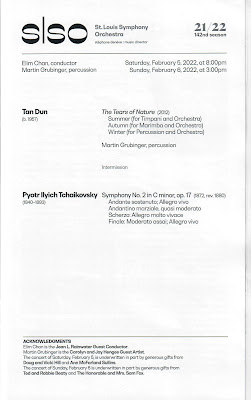
This was brought home to me this weekend when we went to a St Louis Symphony concert celebrating the Lunar New Year. Though we are being very cautious about going out and even about meeting people because my 91-year old mother-in-law is staying with us, we decided that since everyone in the symphony hall would be vaccinated (and mostly older), and everyone would have masks on the entire time, it was relatively safe. We were especially eager to go because the guest conductor was going to be Elim Chan (陳以琳), who in December of 2014, at age 28 and while still a doctoral student at the University of Michigan, won the Donatella Flick LSO Conducting Competition, the first female conductor to win the competition in its history (and one of only 5 females among 225 entrants in this overwhelmingly male occupation) (see NYTimes article here). We had read about her while living in Hong Kong, because she was Hong Kong born and raised, (see SCMP article here [paywall, after intro], for example). So we thought it would be fun to go see her conduct in St. Louis.

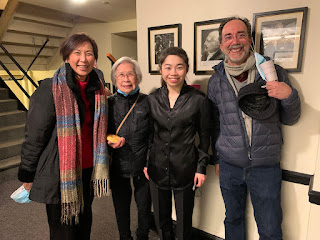
Elim Chan’s visit was held in partnership with the St Louis Asian American Chamber of Commerce, and through friends we were invited to meet Elim Chan backstage after the concert. Due to a bit of miscommunication, the person who was to take us backstage did not meet us at our seats after the show, as we expected, and we ended up waiting in the hall while the ushers cleaned up, searching for lost glasses and gloves. All this time we could actually see Elim on stage, deep in discussion with a musician. 

I was ready to abandon the whole thing. To me, what was the point of meeting her briefly, since we will never see her again (or if we do at a concert in, say New York, we certainly will not be able to meet her backstage). My mother-in-law, on the other hand, suggested we just call out to her to get her attention; I’m not sure whether my wife or I were the more mortified.

Finally a kind usher went and found our contact person, who very apologetically came and took us backstage, where we met and chatted with the conductor for five or ten minutes. She was charming and gracious, and said she was happy to be able to speak Cantonese with my mother-in-law.

And it turns out we have some connections. Elim Chan did her final two years of high school at Li Po Chun, which is a branch of the famous United World College located in Ma On Shan, very near the Chinese University of Hong Kong. Our daughter has a good friend, Bettina, who was one year behind Elim at Li Po Chun, and Elim knew Bettina. Bettina’s father was a colleague of mine at CUHK, and we knew him and his wife socially as well.

My mother-in-law asked Elim Chan if she knew Tsung Yeh, currently the director of the Singapore Chinese Orchestra. She said she of course knew about him, and that he was up there, indicating with her hands that she considered him to be in an exalted position. My mother-in-law noted that she was good friends with Tsung and his wife, because he had been conductor of the South Bend Symphony for 28 years before his retirement in 2016. South Bend is her home town. In fact, I also met the conductor many times, and enjoyed a long conversation with him in the O’Hare United Airlines lounge in the early 2000s, where he taught me many interesting things about conducting and we speculated on why his baton, which could really be a lethal weapon, was never confiscated or examined by TSA. He also had consulted with my parents, who were teachers of Italian, on the finer points of Italian pronunciation, so he knew my parents well.

We took pictures before we left; only then did we lower our masks briefly for the photo. And I was glad we had stayed and was really charmed by Elim’s graciousness. She may have had more interesting people to talk to than us, but she did not express that. A few of the departing musicians stopped by and complemented her on how efficient she had been, because it turns out that due to the heavy snowfall on Wednesday and Thursday, they were not able to hold rehearsals on those days as planned.

As we left and walked to our car, I reflected on this brief encounter. Though I very much enjoyed meeting her, I’m sad we’ll probably never meet again. And I thought about Tan Dun. The first piece performed by the symphony was composed by Tan Dun. I actually met him shortly after he arrived in New York. I remember that he was very friendly, and that he was surprised and amused that I spoke Chinese. He lived in an apartment across the street from me, on 113th street, in an apartment that was an “anthropology apartment.” I don’t know how or why, but that apartment had had a series of anthropology grad students living in the apartment over the years; the apartment even had a bow and arrow hanging on the wall, and as I remember it, no one seemed to know who they had belonged to. Ashraf Ghani, later the president of Afghanistan, had lived in that apartment four years earlier, I believe—at least, I met him there, when Ghani was finishing his notoriously lengthy dissertation.

So as pleasant as meeting Elim Chan was, there is also a sadness in it for me. It highlights the impermanence of relationships in the everyday flow of life. Not only is the notion of “six degrees of separation” a myth, but most of the “connections” we make are fleeting and fade away. Such is life.